
Logo

American Heart Association

  16
  0


Final ID: MP1833

4D Cardiac Optogenetics Enable Complex Arrhythmia Modelling and Precise Interventional Simulation

Abstract Body (Do not enter title and authors here): Background:
Cardiac arrhythmias are a major cause of morbidity and mortality. Yet, current in vitro arrhythmia models neither permit reproducible creation of complex arrhythmia substrates, nor allow reversible perturbations of the system, which are crucial for deciphering arrhythmia mechanisms and identifying the sites that are critical for their perpetuation. A high-resolution, fully reversible platform permitting targeted electrical silencing is therefore urgently needed to model arrhythmia substrates and accelerate therapeutic discovery.
Hypothesis:
The PAC-K construct, a light-gated hyperpolarizing potassium channel, can be applied to in vitro cardiac models to (i) generate temporary arrhythmogenic substrates, (ii) reproducibly induce and terminate complex arrhythmias, and (iii) evaluate the effects of different ablation-like interventions within those substrates.
Methods:
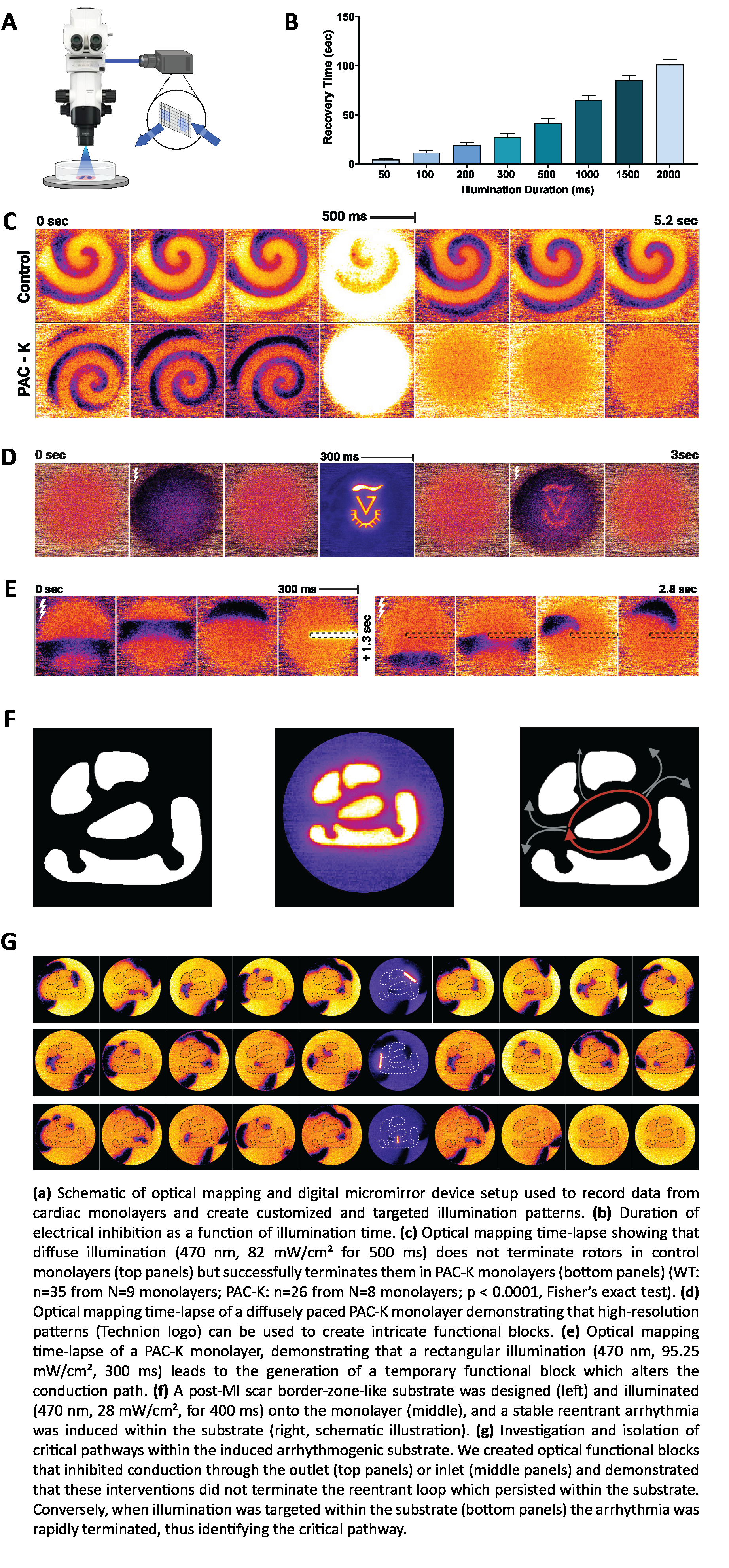
We developed a four-dimensional (3D space + time) optogenetic platform combining a stable hiPSC PAC-K line and an optical mapping setup. A digital micromirror device was used for targeted illumination, and duration of inhibition was controlled by modulating the light dose.
Results:
Using this platform, we induced arrhythmias in hiPSC-derived cardiac monolayers with targeted illumination. These arrhythmias were successfully terminated (100% success, n=26, p<0.0001) using diffuse 470 nm light (82 mW/cm2, 500 ms). Next, we demonstrated the ability to generate high-resolution conduction blocks using patterned illumination. This enabled the creation of clinically relevant arrhythmogenic substrates by applying illumination patterns mimicking the post-infarct border zone. We then induced arrhythmias within these substrates and applied targeted light pulses to functionally ablate different conduction pathways. This allowed us to investigate which arrhythmias are most likely to develop in each substrate and isolate the critical pathways necessary for their perpetuation.
Conclusion:
This study introduces a 4D optogenetic platform for precise, reversible, and high-throughput arrhythmia modeling and interventional simulation. By dynamically controlling spatial and temporal electrophysiology, this system advances arrhythmia research by providing a powerful tool for studying arrhythmogenesis and testing anti-arrhythmic strategies. The ability to induce intricate and reversible conduction blocks, which behave like pathological and ablative scars, offers exciting research and translational opportunities.
  • Wexler, Yehuda  ( Technion Institute of Science , Efrat , Israel )
  • Grinstein, Harel  ( Technion Institute of Science , Efrat , Israel )
  • Landesberg, Michal  ( Technion Institute of Science , Efrat , Israel )
  • Glatstein, Shany  ( Technion Institute of Science , Efrat , Israel )
  • Huber, Irit  ( Technion Institute of Science , Efrat , Israel )
  • Arbel, Gil  ( Technion Institute of Science , Efrat , Israel )
  • Gepstein, Lior  ( RAMBAM HEALTH CARE CAMPUS, TECHNION , Haifa , Israel )
  • Author Disclosures:
    Yehuda Wexler: DO NOT have relevant financial relationships | Harel Grinstein: No Answer | Michal Landesberg: No Answer | Shany Glatstein: DO NOT have relevant financial relationships | Irit Huber: DO NOT have relevant financial relationships | Gil Arbel: No Answer | Lior Gepstein: No Answer
Meeting Info:

Scientific Sessions 2025

2025

New Orleans, Louisiana

Session Info:

Mechanistic Advances in Heart Disease: Targeting Remodeling, Aging, and Inflammation

Sunday, 11/09/2025 , 09:15AM - 10:25AM

Moderated Digital Poster Session

More abstracts on this topic:

A Large Animal Model of Persistent Atrial Fibrillation

Mostafizi Pouria, Goldman Steven, Moukabary Talal, Lefkowitz Eli, Ref Jacob, Daugherty Sherry, Grijalva Adrian, Cook Kyle Eric, Chinyere Ike, Lancaster Jordan, Koevary Jen

High-Resolution Optical Mapping of hiPSC Cardiac Grafts in Swine Reveals Reentry and Automaticity as Potential Arrhythmia Mechanisms at the Host-Graft Interface

Guragain Bijay, Zhang Hanyu, Wei Yuhua, Ye Lei, Walcott Gregory, Rogers Jack, Zhang Jianyi

You have to be authorized to contact abstract author. Please, Login
Not Available