The RXFP1 Agonist ML290 Protects Against Doxorubicin-induced Cardiomyocyte Injury in vitro
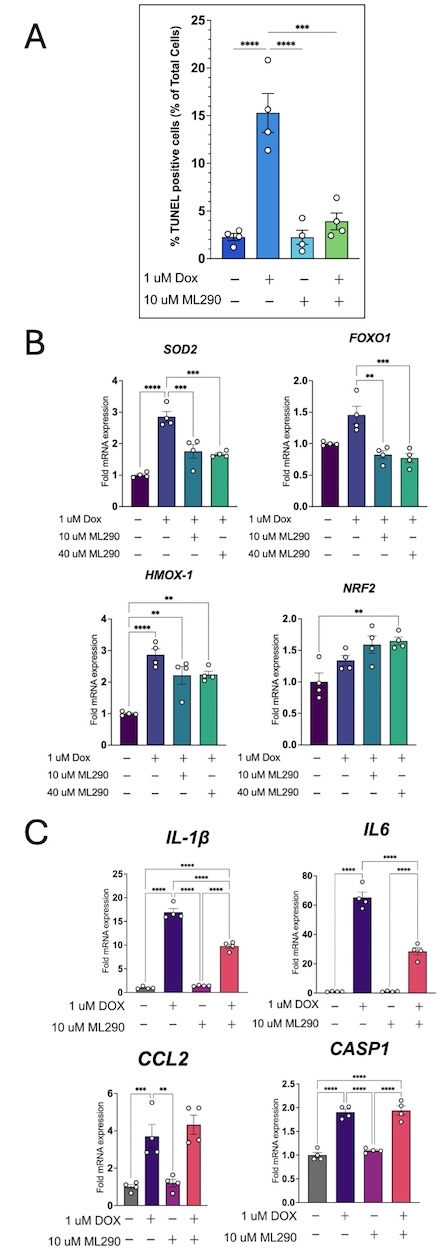
Abstract Body: Introduction: Doxorubicin (DOX) is a widely used chemotherapeutic associated with dose-dependent related cardiotoxicity, termed DRC. DOX damages cardiomyocytes by driving oxidative stress that initiates inflammatory signaling. The relaxin family peptide receptor 1 (RXFP1) was first identified for its role in the cardiac remodeling characteristic of pregnancy. Relaxin-2 (RLX) is the cognate hormone for RXFP1, and when infused into murine models of ischemic heart failure attenuates cardiac dysfunction. Current heart failure therapies have not proven effective in treating DRC. However, synthetic, long-acting RXFP1 agonists may represent a novel therapeutic modality given their antifibrotic, antioxidant, and anti-inflammatory effects. Hypothesis: The synthetic RXFP1 agonist ML290 mitigates DOX-induced cardiomyocyte injury. Goal: To investigate the cardioprotective potential of ML290 in an in vitro model of DRC. Methods: AC16 cardiomyocytes were treated with 1µM DOX ± 10µM or 40µM ML290 for 24 hours and assessed for oxidative stress (CellROX Red), DNA damage (TUNEL staining), and gene expression (RT-qPCR, n=4). Expression was analyzed via the ddCt (2(-DDCt)) method and normalized to B2M. Statistical significance was determined by one-way ANOVA with Tukey’s test. Error bars represent the mean ± SEM. P values denoted as **p<0.01, ***p<0.001, ****p<0.0001. Results: TUNEL positivity, a marker of DNA damage, was higher in DOX-treated cells but reduced by ML290 (Fig. A). DOX also increased ROS, which was attenuated by ML290 (not shown). This was reflected by the expression of oxidative stress genes SOD2, FOXO1, and HMOX-1 (Fig. B). DOX upregulated pro-inflammatory genes CCL2, IL-1β, IL-6, and CASP1; IL-6 and IL-1β were attenuated by ML290 (Fig. C). Conclusion: These findings suggest ML290 protects cardiomyocytes from DOX-induced oxidative stress, DNA damage, and inflammation, highlighting RXFP1 as a potential therapeutic target for DRC.
Martin, James
(
Virginia Commonwealth University
, Richmond , Virginia , United States )
Mauro, Adolfo
(
Virginia Commonwealth University
, Richmond , Virginia , United States )
Mezzaroma, Eleonora
(
Virginia Commonwealth University
, Richmond , Virginia , United States )
Salloum, Fadi
(
Virginia Commonwealth University
, Richmond , Virginia , United States )
Author Disclosures:
James Martin:DO NOT have relevant financial relationships
| Adolfo Mauro:DO NOT have relevant financial relationships
| Eleonora Mezzaroma:DO NOT have relevant financial relationships
| Fadi Salloum:DO have relevant financial relationships
;
Advisor:NovoMedix:Active (exists now)
; Consultant:Medera:Past (completed)
; Research Funding (PI or named investigator):Novartis:Past (completed)