
Logo

American Heart Association

  58
  0


Final ID: Wed046

Hydrogen Sulfide Donor, SG1002 attenuates the development of aging-associated cardiac dysfunction.

Abstract Body: Background: Aging promotes cardiac remodeling, dysfunction, fibrosis, and a chronic systemic inflammatory response. Increased NLRP3 inflammasome activity is associated with cardiovascular diseases and aging. Hydrogen sulfide (H2S) has been shown to inhibit NLRP3 inflammasome formation and activation in the heart post-myocardial infarction and in primary cardiomyocytes subjected to simulated ischemia-reoxygenation.
Hypothesis: H2S supplementation mitigates the development of age-associated cardiomyopathy, myocardial fibrosis and inflammasome activation.
Methods: Left ventricular (LV) systolic and diastolic function (isovolumetric relaxation time; IRT) were measured by echocardiography at 3 (young), 12 (middle-aged), and 24 (old) months in C57BL/6J mice. Two groups of mice were fed with a standard diet (SD) or SD enriched with SG1002 (H2S donor, 40 mg/kg/day) starting at 12 months of age, for an additional 12 months. Interstitial fibrosis was detected with picrosirius red staining. Cardiac inflammasome activity was measured by immunofluorescence as aggregation of the inflammasome scaffolding protein, apoptosis speck-like protein (ASC), and with a cell-based interleukin-1 (IL-1) activity reporter assay to measure plasma IL-1 activity.
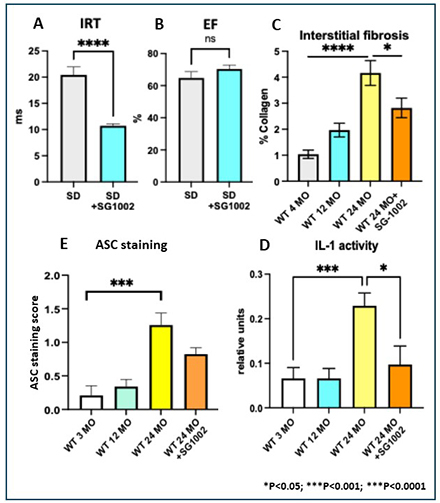
Results: Aging is associated with LV diastolic dysfunction, fibrosis and NLRP3 inflammasome activation. Treatment with SG-1002 prevented the development of diastolic dysfunction (Fig. A) at 24 months without affecting systolic function (Fig. B). SG-1002 treatment attenuated the increase in interstitial fibrosis observed at 24 months (Fig. C) and blunted the age-dependent increase in inflammasome with a reduction in ASC staining (Fig. D) and plasma IL-1 levels (Fig. E).
Conclusions: H2S donor initiated in middle-aged mice preserves diastolic function in aging mice and reduces age-dependent increase in interstitial fibrosis and inflammasome activation, slowing down the cardiovascular aging process.
  • Mauro, Adolfo  ( Virginia Commonwealth University , Richmond , Virginia , United States )
  • Mezzaroma, Eleonora  ( Virginia Commonwealth University , Richmond , Virginia , United States )
  • Toldo, Stefano  ( University of Virginia , Charlottesville , Virginia , United States )
  • Salloum, Fadi  ( VIRGINIA COMMONWEALTH UNIV , Richmond , Virginia , United States )
  • Author Disclosures:
    Adolfo Mauro: DO NOT have relevant financial relationships | Eleonora Mezzaroma: No Answer | Stefano Toldo: No Answer | Fadi Salloum: DO have relevant financial relationships ; Advisor:NovoMedix:Active (exists now) ; Consultant:Medera:Past (completed) ; Research Funding (PI or named investigator):Novartis:Past (completed)
Meeting Info:

Basic Cardiovascular Sciences 2025

2025

Baltimore, Maryland

Session Info:

Poster Session and Reception 1

Wednesday, 07/23/2025 , 04:30PM - 07:00PM

Poster Session and Reception

More abstracts from these authors:
The RXFP1 Agonist ML290 Protects Against Doxorubicin-induced Cardiomyocyte Injury in vitro

Martin James, Mauro Adolfo, Mezzaroma Eleonora, Salloum Fadi

Measuring Fibrosis Progression in Duchenne Cardiomyopathy Using Cardiac Magnetic Resonance in mice

Hawkins India, Mitchell Josh, Mauro Adolfo, Carter Nigeste, Corwin Frank, Salloum Fadi, Raucci Frank

You have to be authorized to contact abstract author. Please, Login
Not Available