Trends in Out-of-Pocket Spending for Drugs Under Medicare Part D in Coronary Artery Disease and the Impact of the Inflation Reduction Act
Abstract Body (Do not enter title and authors here): Introduction: Coronary artery disease (CAD) is common among Medicare beneficiaries, often requiring chronic use of both low-cost generics (e.g., statins, nitrates) and high-cost branded agents (e.g., PCSK9 and P2Y12 inhibitors). In 2025, the Inflation Reduction Act (IRA) introduced a $2,000 annual out-of-pocket (OOP) cap for Medicare Part D, aiming to improve affordability. However, the cap’s impact may differ substantially depending on the baseline cost of the prescribed regimen.
Methodology: Medicare Part D Formulary and Pricing Files (2020–2025) were used to evaluate Annual OOP costs (Median [interquartile range]) for five predefined cardiovascular (CV) medication combinations. C1 included ticagrelor, isosorbide mononitrate, and atorvastatin; C2 is C1 + ezetimibe; C3 is C2 +bempedoic acid; C4 is C2 + evolocumab; and C5 is C3 + icosapent ethyl and ranolazine. Median annual OOP costs were compared pre- and post-IRA using interrupted time series regression (R version 4.5.0), with 2025 as the intervention point.
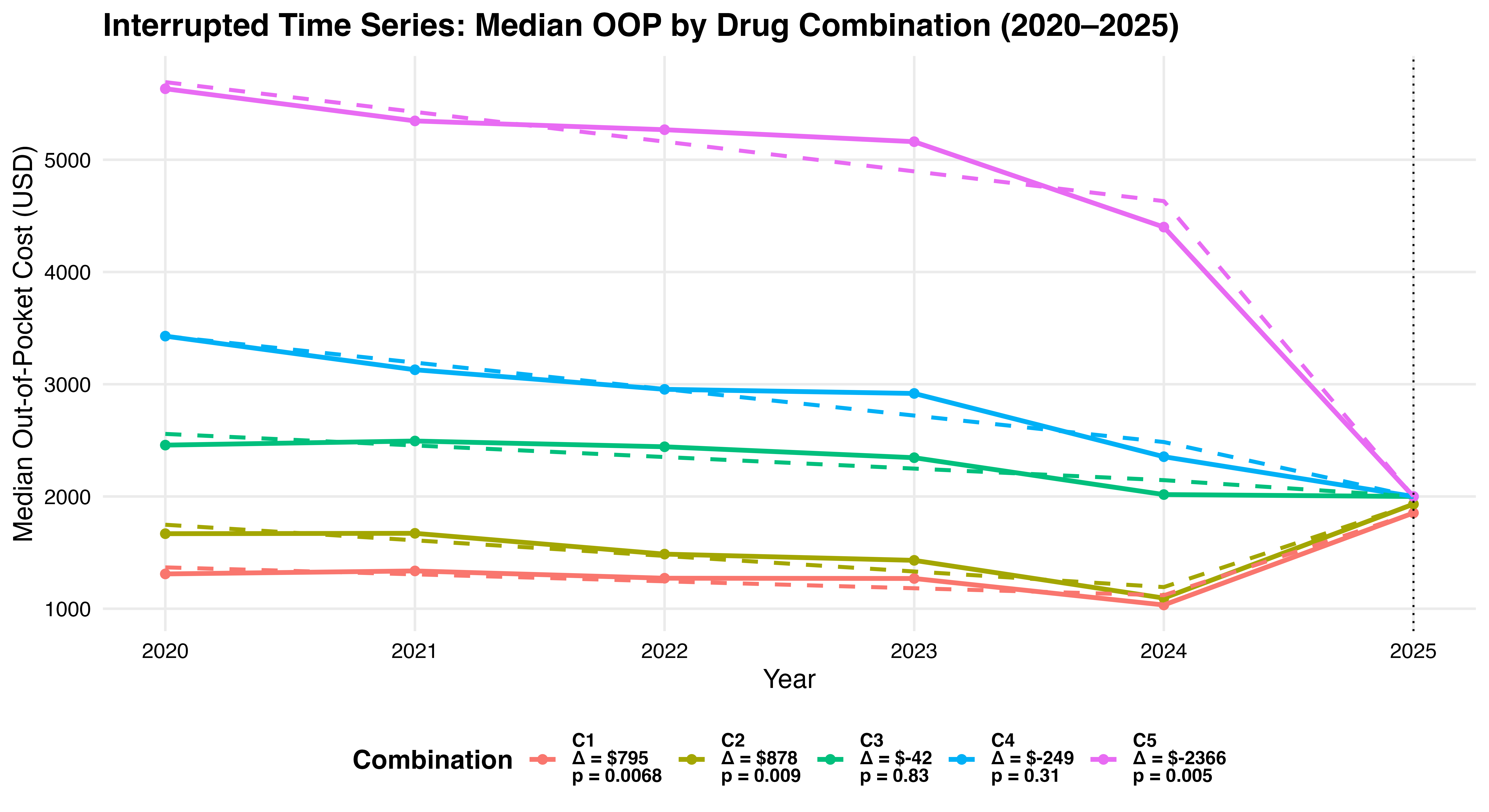
Results: From 2020–2024, modest cost reductions were observed ( C5: $5,632 to $4,400). After the IRA cap in 2025, costs approached or reached $2,000 for all regimens. However, C1 and C2, previously low-cost, paradoxically saw significant OOP increases (C1: +$795, p = 0.0068; C2: +$878, p = 0.009), while C5 experienced a significant reduction (–$2,366, p = 0.005). C3 and C4 showed minimal or nonsignificant changes. ITS regression confirmed significant level shifts in 2025 for C1, C2, and C5 (Figure 1).
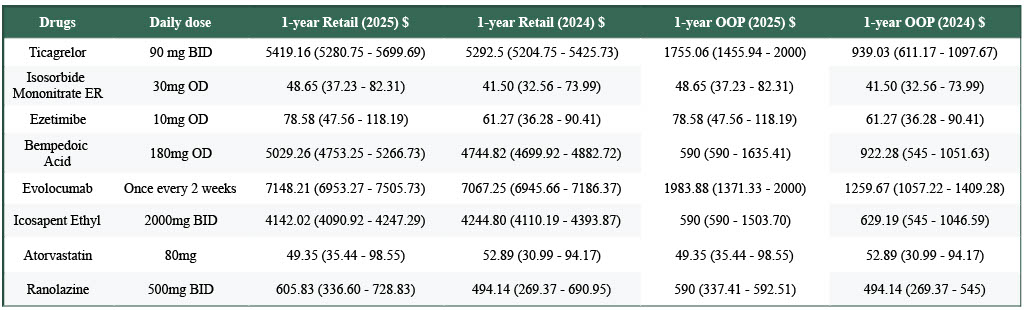
Discussion: The 2025 Medicare Part D redesign successfully reduced OOP costs for high-cost CV regimens but unexpectedly raised costs for patients on lower-cost combinations (Table 1). This paradox stems from structural changes: the elimination of the coverage gap, removal of manufacturer discount credits toward OOP thresholds, and introduction of flat 25% coinsurance until the cap is reached. Patients on moderately priced therapies, who previously benefited from phased cost protections, may now face higher spending despite unchanged total drug prices. These findings highlight unintended consequences of a one-size-fits-all benefit model. Future reforms may need to adopt tiered cost-sharing, restore manufacturer contribution crediting, or exclude essential therapies from coinsurance. Policymakers should monitor whether these shifts affect medication adherence or clinical outcomes, particularly among chronically ill patients using mid-tier therapies.
Venkataramana Raju, Arvind Kumar
(
Saint Vincent Hospital
, Worcester , Massachusetts , United States )
Pathiyil, Mythili Menon
(
Saint Vincent Hospital
, Worcester , Massachusetts , United States )
Bansal, Kannu
(
Saint Vincent Hospital
, Worcester , Massachusetts , United States )
Gajjar, Aryan
(
UCLA
, Folsom , United States Minor Outlying Islands )
Dani, Sourbha
(
LAHEY HOSPITAL MEDICAL CENTER
, Burlington , Massachusetts , United States )
Author Disclosures:
Arvind kumar Venkataramana Raju:DO NOT have relevant financial relationships
| Mythili Menon Pathiyil:No Answer
| Kannu Bansal:DO NOT have relevant financial relationships
| Aryan Gajjar:DO NOT have relevant financial relationships
| Sourbha Dani:DO NOT have relevant financial relationships