Cardiovascular Disease Mortality in American Women: National Decline Masked by Rising Burden in Younger Age Groups (1999–2020)
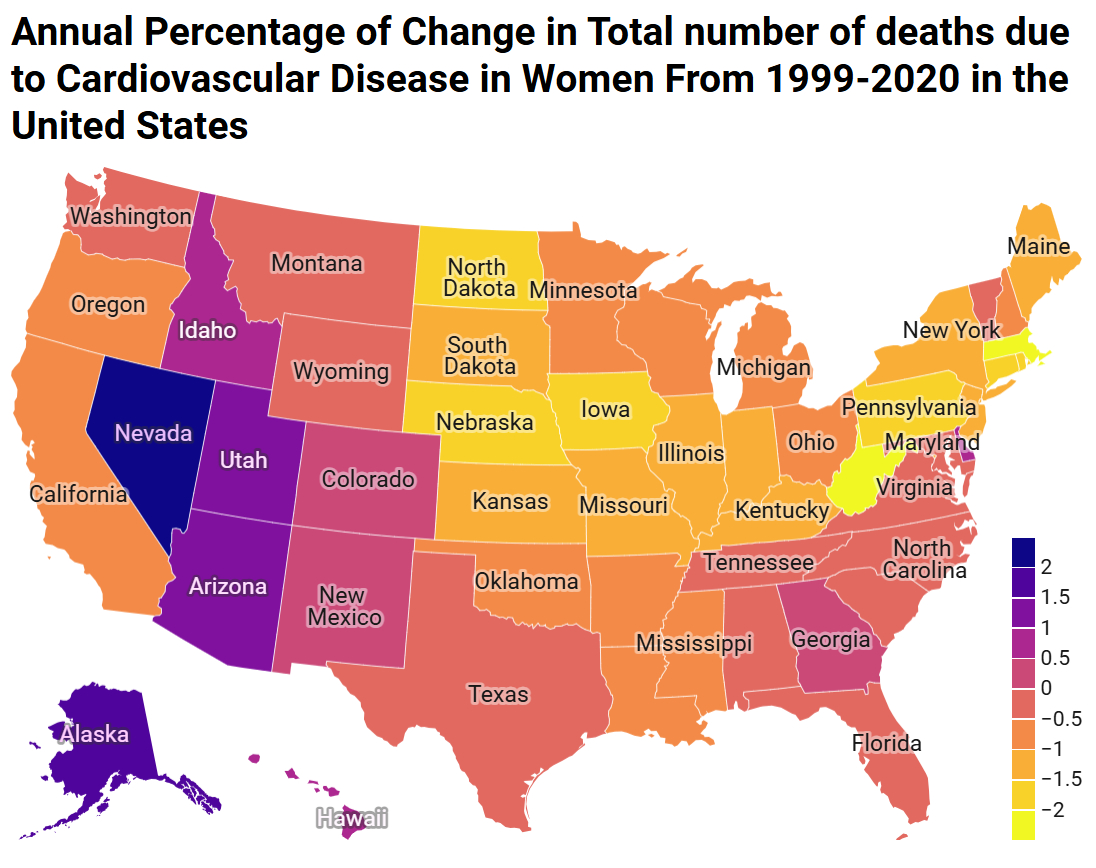
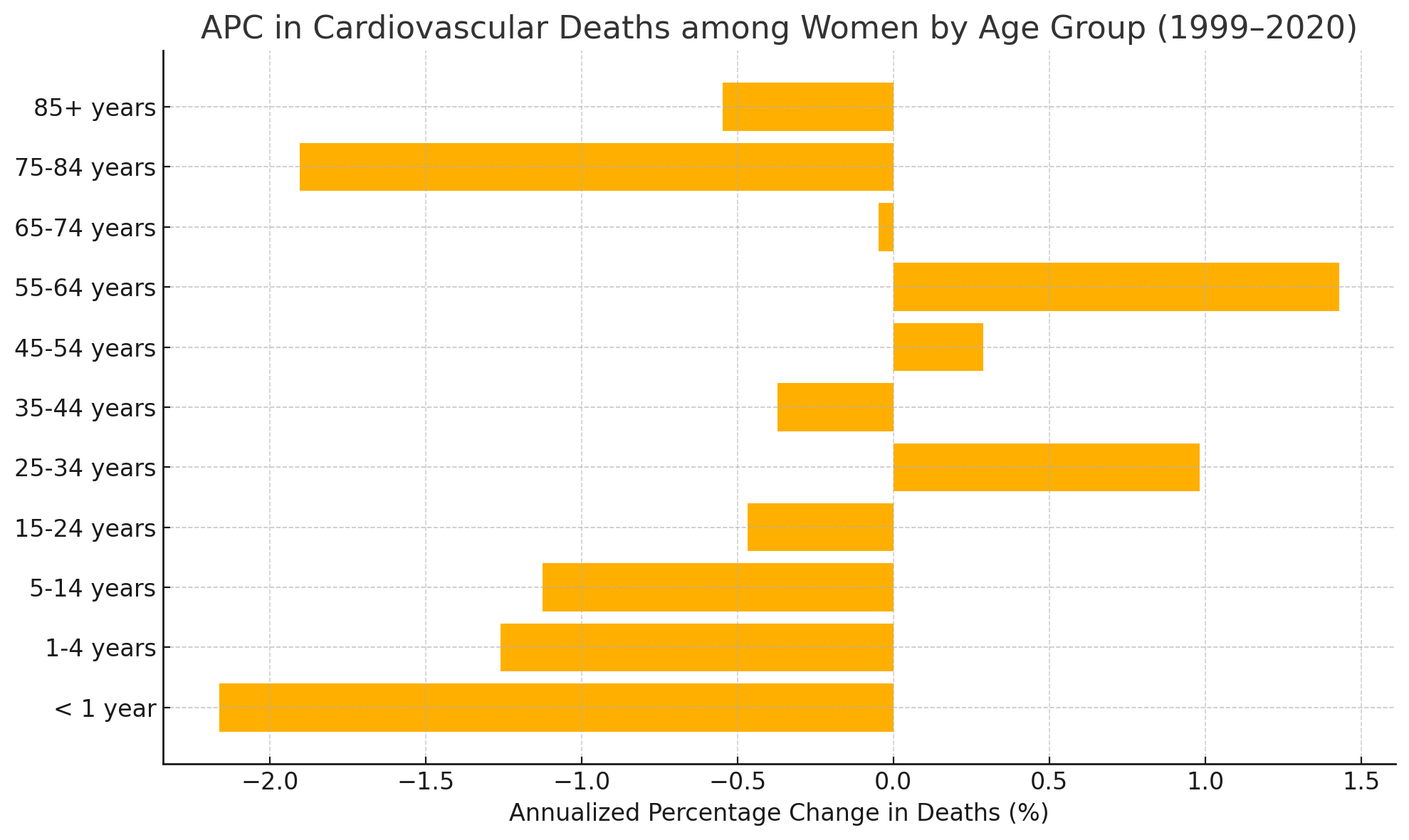
Abstract Body (Do not enter title and authors here): Background: Cardiovascular disease (CVD) remains the leading cause of death among women in the United States. Understanding temporal and demographic trends in mortality is essential to inform targeted public health strategies and equitable interventions. Methods: We analyzed female mortality due to cardiovascular disease in the U.S. from 1999 to 2020 using national death certificate data. Age-adjusted mortality rates (AAMRs) were calculated per 100,000 population. Annualized Percentage Change (APC) in AAMRs and absolute deaths was assessed using log-linear regression models. Analyses were stratified by census region, state, urbanization level, age group, race, and Hispanic origin. Results: Between 1999 and 2020, total cardiovascular deaths among U.S. women declined from 510,798 to 441,532, with an APC of -0.69%. The AAMR decreased markedly from 297.9 to 183.1 per 100,000, reflecting an APC of -2.29%. Regionally, the greatest declines were seen in the West (-2.53%), followed by the Northeast (-2.49%), South (-2.21%), and Midwest (-2.07%). At the state level, the sharpest reductions were observed in California (-2.85%), Alaska (-2.29%), and Arizona (-2.04%). Urban-rural disparities were evident: Large Central Metro areas experienced the steepest decline (-2.49%), followed by Large Fringe Metro (-2.44%), Medium Metro (-2.22%), Micropolitan (-1.93%), and NonCore rural areas (-1.81%). Age-stratified analysis showed the greatest mortality reduction in the 1–4 years group (-1.26%), whereas rising trends were noted among women aged 25–34 (+0.98%) and 45–54 years (+0.29%). Racial disparities were observed, with the largest AAMR decline in American Indian or Alaska Native women (-2.89%), followed by Asian or Pacific Islander (-2.44%), White (-2.29%), and Black or African American women (-2.10%). By Hispanic origin, Hispanic or Latino women showed a greater decline (228.8 to 139.0; APC: -2.35%) compared to Non-Hispanic women (300.3 to 187.9; APC: -2.21%). Conclusion: Cardiovascular mortality in U.S. women has declined substantially over the past two decades, with notable geographic, racial, ethnic, age, and urbanization-based disparities. The growing burden in younger women and persistent racial differences warrant tailored prevention strategies to sustain and equitably advance cardiovascular health gains.
Sethi, Angad Singh
(
Government Medical College & Hospital, Chandigarh
, Chandigarh , India )
Patel, Tirth
(
G.M.E.R.S. Medical College
, Ahmedabad , India )
Patel, Vishva
(
GMERS Medical college and Civil Hospital, Sola, Ahmedabad - 380060
, Ahmedabad , GUJARAT , India )
Parikh, Jainil
(
GMERS Medical colleg,Gotri,Vadodara
, Ahmedabad , India )
Gopi, Gokul
(
Ascension Sacred Hearts Hospital, Pensacola, Florida
, Pensacola , Florida , United States )
Kotnani, Sandeep
(
Rutgers Monmouth Medical Center
, Monmouth , New Jersey , United States )
Amin, Vishrant
(
JFK University Medical Center
, Milltown , New Jersey , United States )
Desai, Hardik
(
Independent Clinical and Public Health Researcher
, Ahmedabad , GUJARAT , India )
Sharma, Kamal
(
Gujarat University
, Ahmedabad , India )
Author Disclosures:
Angad Singh Sethi:DO NOT have relevant financial relationships
| Tirth Patel:DO NOT have relevant financial relationships
| Vishva Patel:DO NOT have relevant financial relationships
| Jainil Parikh:DO NOT have relevant financial relationships
| Gokul Gopi:DO NOT have relevant financial relationships
| sandeep kotnani:DO NOT have relevant financial relationships
| VISHRANT AMIN:DO NOT have relevant financial relationships
| HARDIK DESAI:No Answer
| kamal sharma:No Answer