
Logo

American Heart Association

  15
  0


Final ID: Su4022

Genomic Insights into Incretin-Based Therapeutics for Peripheral Arterial Disease

Abstract Body (Do not enter title and authors here): Background: Peripheral arterial disease (PAD) is a major cause of morbidity and mortality, particularly in type 2 diabetes mellitus (T2DM). Current treatments for diabetic PAD patients have limited efficacy, necessitating novel therapeutic approaches. The GIPR and GLP1R pathways have emerged as potential targets. This study leverages genetic data from the Million Veteran Program (MVP) to investigate the roles of GIP, GIPR, and GLP1R in PAD pathogenesis.

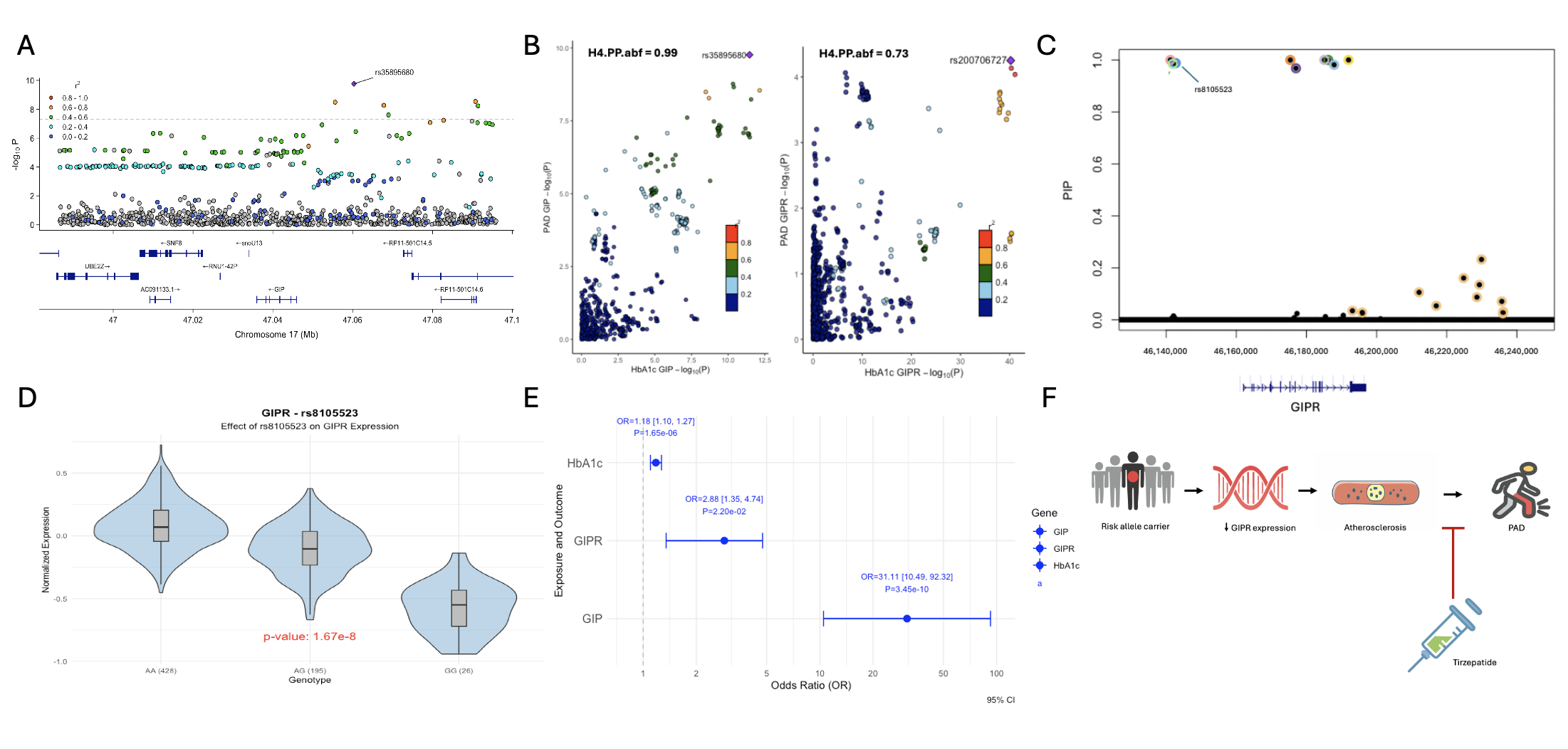
Methods: We analyzed 51,330 European ancestry PAD cases and 256,807 controls. Locus zoom plots assessed genetic associations at GIP, GIPR, and GLP1R loci. Fine mapping (SuSiE) identified credible SNPs at GIP/GIPR, and Mendelian randomization (MR) evaluated causal effects of glycemic traits (HbA1c, T2DM) on PAD. Colocalization analysis assessed shared genetic signals.

Results: GIP was significantly associated with PAD (rs35895680, P = 1e-10), with fine mapping identifying it as the most likely causal SNP (PIP = 0.993). While GIPR was not genome-wide significant, fine mapping identified an eQTL variant (rs8105523) linked to decreased GIPR expression. Colocalization confirmed shared genetic signals between PAD and HbA1c (PP = 0.99). MR analysis linked decreased GIPR expression with increased PAD risk for HbA1c (OR = 2.88, P = 0.020) and T2DM (OR = 1.95, P = 0.040).

Conclusion: These findings highlight the therapeutic potential of dual GLP1R/GIPR agonists like Tirzepatide in PAD, supporting further clinical trials to validate incretin-based therapies in diabetic PAD patients.
  • Sorondo, Sabina  ( Stanford University , Redwood City , California , United States )
  • Cabot, John  ( Stanford , Palo Alto , California , United States )
  • Tsao, Philip  ( Stanford University-VAPAHCS , Los Altos , California , United States )
  • Klarin, Derek  ( Stanford University , Mountain View , California , United States )
  • Leeper, Nicholas  ( Stanford University , Redwood City , California , United States )
  • Adkar, Shaunak  ( Stanford University , Redwood City , California , United States )
  • Author Disclosures:
    Sabina Sorondo: DO NOT have relevant financial relationships | John Cabot: No Answer | Philip Tsao: DO NOT have relevant financial relationships | Derek Klarin: DO have relevant financial relationships ; Employee:Bitterroot Bio:Active (exists now) | Nicholas Leeper: No Answer | Shaunak Adkar: No Answer
Meeting Info:

Scientific Sessions 2025

2025

New Orleans, Louisiana

Session Info:

New Genomic and Precision Medicine Treatment Strategies for Amyloidosis and Cardiometabolic Disease

Sunday, 11/09/2025 , 11:30AM - 12:30PM

Abstract Poster Board Session

More abstracts on this topic:
Advanced Age Increases Susceptibility to Ischemic Myopathy after Murine Hindlimb Ischemia

Kulkarni Deepali, Massie Pierce, Justus Matthew, Mazloumibakhshayesh Milad, Coffman Brittany, Pace Carolyn, Clark Ross

A mechanism whereby SGLT2 inhibitor dapagliflozin reverses cardiac diastolic dysfunction in a model of HFpEF

Liu Man, Liu Hong, Kang Gyeoung-jin, Kim Eunji, Neumann Mitchell, Johnson Madeline, Murikinati Ruthvika, Dudley Samuel

More abstracts from these authors:
Genome wide association study of lower extremity aneurysms reveals shared genetic architecture with abdominal aortic aneurysms

Cabot John, Sorondo Sabina, Adkar Shaunak, Klarin Derek, Levin Michael, Tsao Philip, Damrauer Scott

Genetic Evidence for Glucose-dependent Insulinotropic Polypeptide as a Therapeutic Target for Peripheral Artery Disease

Sorondo Sabina, Cabot John, Klarin Derek, Leeper Nicholas, Adkar Shaunak

You have to be authorized to contact abstract author. Please, Login
Not Available