CRISPR-Corrected iPSC Models of Pediatric LMNA Cardiomyopathy: A Meta-Analysis of Preclinical Translational Outcomes
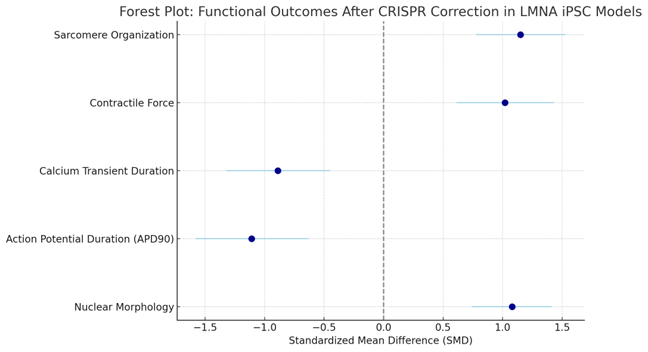
Abstract Body (Do not enter title and authors here): Background: Changes in the LMNA gene are a primary cause of childhood dilated cardiomyopathy (DCM), which may lead to arrhythmias, heart failure at a young age, and the need for a heart transplant. Cardiomyocytes produced from induced pluripotent stem cells (iPSCs) have emerged as key tools for researching LMNA-related DCM and evaluating the therapeutic potential of CRISPR-based gene correction. However, there has not been a systematic approach to determining how much CRISPR correction alters disease features in preclinical iPSC models. Objective: To perform a systematic review and meta-analysis of preclinical data on how CRISPR-corrected iPSC-derived cardiomyocytes may save the functional recovery of LMNA cardiomyopathy phenotypes. Methods: A comprehensive search of the literature was conducted in PubMed, Embase, Web of Science, and bioRxiv until May 2025. Eligible studies employed CRISPR-Cas9 or base editing to repair harmful LMNA mutations in patient-derived iPSCs in vitro or in animal models. They also had to report on cardiac function, such as contractility, calcium management, electrophysiology, and nuclear morphology. We utilized a random-effects model to calculate the pooled standardized mean differences (SMD). We employed SYRCLE for animal studies and CAMARADES for in vitro experiments to detect bias. Results: Nine studies with 27 different LMNA mutations and 154 iPSC lines met the inclusion criteria. Compared to uncorrected LMNA-mutant controls, CRISPR-corrected iPSC-derived cardiomyocytes displayed considerably better sarcomere organization (SMD = 1.15, 95% CI: 0.78-1.53), greater contractile force (SMD = 1.02, 95% CI: 0.61-1.43), and normal calcium transient duration (SMD = -0.89, 95% CI: -1.32 to -0.45). The action potential duration (APD90) was significantly reduced (SMD = -1.11, 95% CI: -1.58 to -0.63), suggesting a partial restoration of electrophysiological function. All investigations demonstrated a morphological reversal of nuclear blebbing and nuclear circularity. The study showed significant heterogeneity (I square = 49%) and little publication bias. Conclusion: CRISPR-mediated gene repair in iPSC models of juvenile LMNA cardiomyopathy successfully restores morphological, functional, and electrophysiological defects associated with the condition. These findings point to the translational potential of genome editing as a future therapy option for laminopathies.
Kumar, Harendra
(
Dow University of Health Sciences
, Karachi , Pakistan )
Kumari, Sonia
(
Peoples University of Medical and Health Sciences
, Nawabshah , Pakistan )
Tiwari, Angad
(
MAHARANI LAXMI BAI MEDICAL COLLEGE
, Jhansi , India )
Sharma, Ashish
(
University of Connecticut School of Medicine
, Hartford , Connecticut , United States )
Author Disclosures:
Harendra Kumar:DO NOT have relevant financial relationships
| Sonia Kumari:No Answer
| Angad Tiwari:DO NOT have relevant financial relationships
| Ashish Sharma:DO NOT have relevant financial relationships