GLP-1 Receptor Agonists Use in Pregnant Women Reduce Adverse Maternal and Fetal Outcomes: A Meta-Analysis
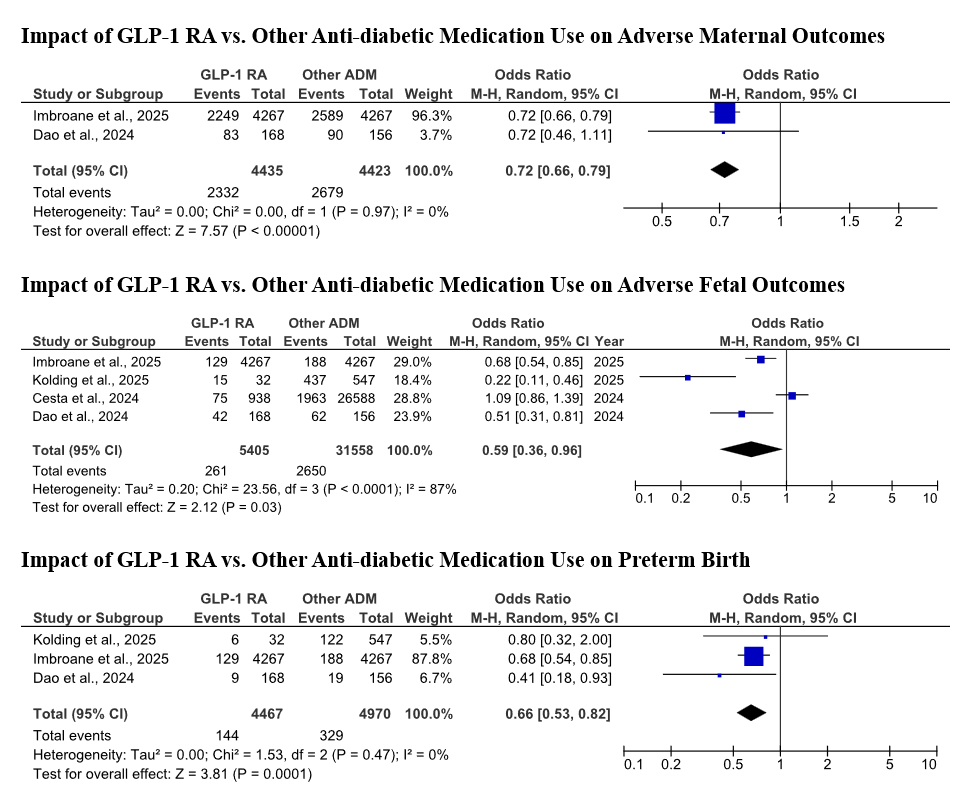
Abstract Body (Do not enter title and authors here): Introduction Glucagon-like peptide-1 receptor agonists (GLP-1 RAs) have recently gained prominence as both anti-diabetic medications and treatments for obesity in pregnancy. Nevertheless, the safety profile concerning maternal and fetal outcomes remains inadequately investigated. This meta-analysis examines the safety of GLP-1 RA utilization in pregnant women, providing valuable insights into maternal and fetal outcomes. Methods Per PRISMA guidelines, a comprehensive literature search was performed in PubMed, Google Scholar, and Embase, along with snowballing to identify relevant studies reporting adverse maternal or fetal outcomes in pregnant women who used GLP-1 RA or other anti-diabetic medications either preconceptionally or periconceptionally. Maternal outcomes included hypertensive disorders of pregnancy, gestational diabetes, cesarean delivery, and pregnancy loss. Fetal outcomes included preterm birth, major congenital anomalies, and abnormal birth weight. Binary random-effects models were utilized to estimate pooled odds ratios (OR) and 95% confidence intervals (CI). A p-value <0.05 was considered statistically significant. Results Four studies with 36,963 pregnancies were analyzed. GLP-1 RA was significantly associated with reduced adverse maternal outcomes (OR: 0.72, 95% CI: 0.66-0.79, p < 0.00001) and preterm birth (OR: 0.66, 95% CI: 0.53 - 0.82, p = 0.0001). However, no increased risk of major congenital anomalies was found compared to other medications (OR: 1.08, 95% CI: 0.86-1.37, p = 0.51) or insulin (OR: 1.00, 95% CI: 0.77-1.28, p = 0.98) (Fig 1). Although there was a noticeable trend toward reduced adverse fetal outcomes, the heterogeneity was significant. This variability is likely due to differences in baseline risk, timing of exposure, and how outcomes were defined in the various studies. Conclusion GLP-1 RA use during pregnancy is associated with improved maternal outcomes and reduced preterm birth, without increased risk of congenital anomalies. Considering the cardiometabolic interplay between pregnancy complications and future cardiovascular disease, these findings support the necessity for future prospective cardio-obstetric studies aimed at assessing the long-term cardiovascular risks for both mothers and their offspring following GLP-1 RA exposure.
Kodali, Lakshmi Sai Meghana
(
University of Michigan-Flint
, Flint , Michigan , United States )
Sharma, Garima
(
Inova Fairfax Medical Campus
, Falls Church , Virginia , United States )
Spitz, Jared
(
Inova Schar Heart and Vascular
, Fairfax , Virginia , United States )
Metlock, Faith
(
Johns Hopkins University
, North Bethesda , Maryland , United States )
Author Disclosures:
Lakshmi Sai Meghana Kodali:DO NOT have relevant financial relationships
| Garima Sharma:DO NOT have relevant financial relationships
| Jared Spitz:DO NOT have relevant financial relationships
| Faith Metlock:DO NOT have relevant financial relationships