Joint Associations of Social and Psychological Health Risk and Life’s Essential 8 among Women of Reproductive Age
Abstract Body (Do not enter title and authors here): Background: Cardiovascular risk factors are increasing among women of reproductive age, yet limited evidence exists on how co-occurring social and psychological burdens influence cardiovascular health (CVH). Understanding these joint effects is critical for guiding early prevention strategies that improve both maternal and long-term CVH.
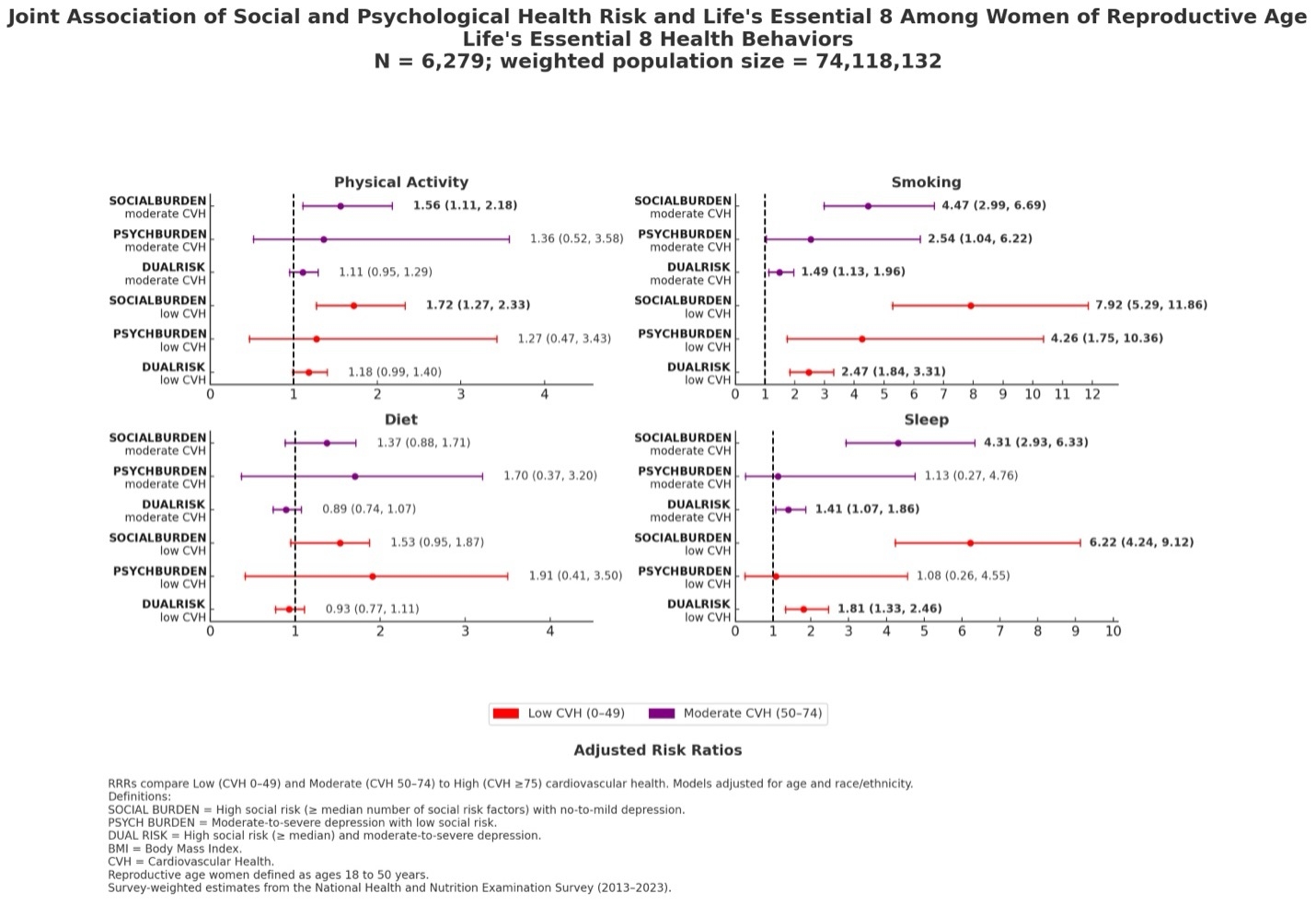
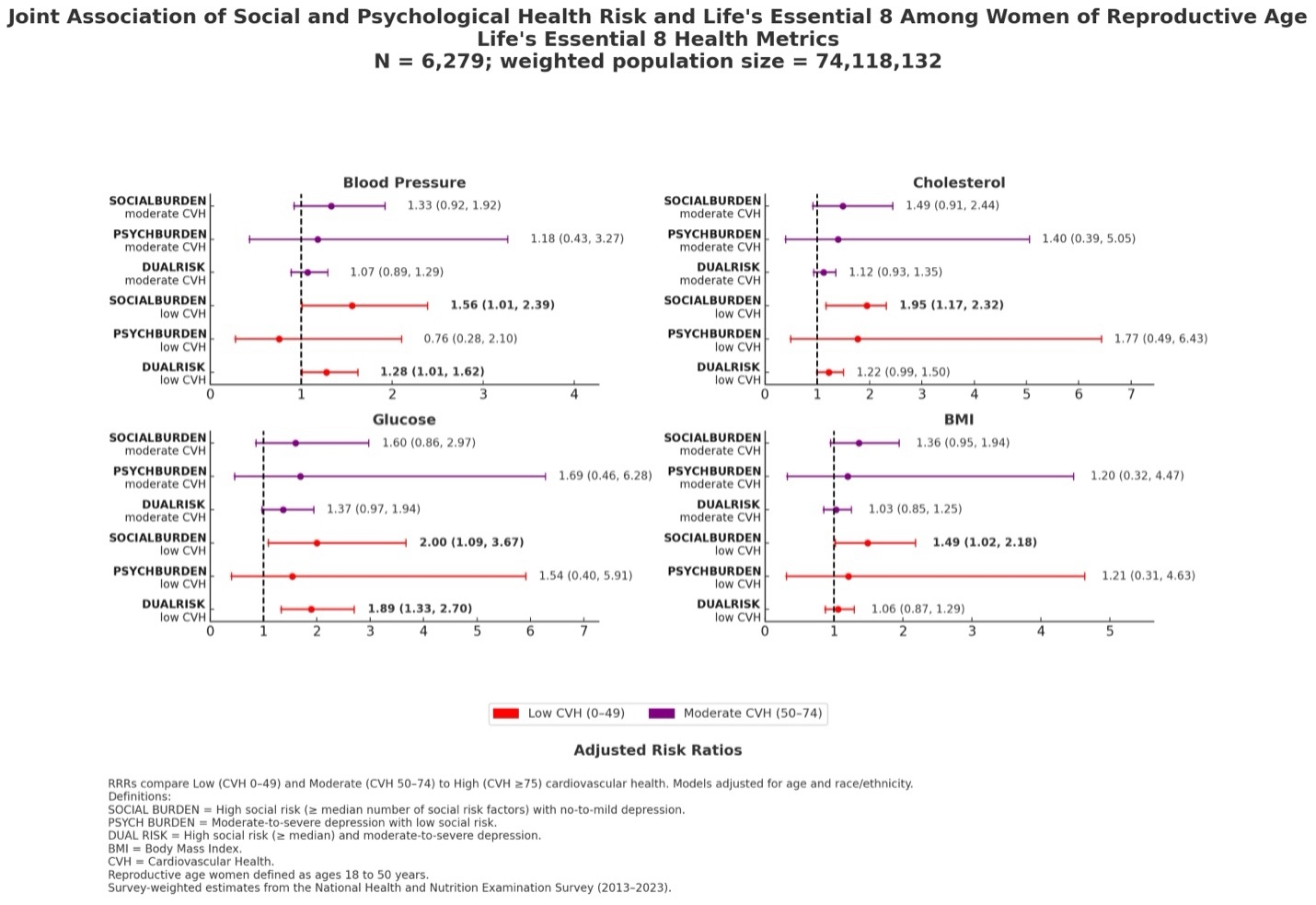
Methods: We conducted a cross-sectional analysis using 2013–2023 National Health and Nutrition Examination Survey data among women aged 18–49. Social burden was calculated as a cumulative score (range 0–5) based on poverty status, education, marital status, insurance, and employment, with high burden defined as scores ≥ the sample median. Psychological burden was assessed using the PHQ-9; scores ≥15 indicated moderate-to-severe depression. Women were categorized into four groups: (1) dual burden (high social and psychological burden), (2) psychological burden only, (3) social burden only, and (4) no burden. Multinomial logistic regression models adjusted for age, race/ethnicity, and Life’s Essential 8 (LE8) metrics, estimated associations between burden group and low (CVH score 0–49) and moderate (50–74) CVH compared to high CVH (≥75) scores. CVH was evaluated using LE8 metrics: diet, physical activity, smoking, sleep, BMI, blood pressure, glucose, cholesterol, and the overall LE8 score.
Results: Among 6,279 women (weighted population ~74 million, mean age 35.0 ± 8.7 years), 25.5% had no burden, 67.9% had social burden only, 0.6% had psychological burden only, and 6.0% had dual burden. Dual burden was significantly associated with low CVH across several domains: smoking (aRRR=2.47; 95% CI: 1.84–3.31), sleep (1.81; 1.33–2.46), glucose (1.89; 1.33–2.70), and blood pressure (1.28; 1.01–1.62). High social burden alone was consistently associated with low CVH, including smoking (7.92; 5.29–11.86), sleep (6.22; 4.24–9.12), physical activity (1.72; 1.27–2.33), glucose (2.00; 1.09–3.67), cholesterol (1.95; 1.17–2.32), BMI (1.49; 1.02–2.18), and blood pressure (1.56; 1.01–2.39). Psychological burden alone was only significantly associated with smoking (4.26; 1.75–10.36).
Conclusion: Women of reproductive age with co-occurring social and psychological burden face heightened risk for suboptimal cardiovascular health, especially in modifiable behaviors. These findings underscore the need for targeted screening and prevention during the reproductive years to reduce both maternal morbidity and long-term cardiovascular disease risk.
Metlock, Faith
(
Johns Hopkins University
, North Bethesda , Maryland , United States )
Ateh Stanislas, Ketum
(
Johns Hopkins University
, Baltimore , Maryland , United States )
Hinneh, Thomas
(
Johns Hopkins University
, Baltimore , Maryland , United States )
Kwapong, Yaa
(
Johns Hopkins School of Medicine
, Baltimore , Maryland , United States )
Nriagu, Bede
(
New York Medical College
, New York , New York , United States )
Meghana Kodali, Lakshmi
(
Inova Schar Heart and Vascular
, Fairfax , Virginia , United States )
Spitz, Jared
(
Inova Schar Heart and Vascular
, Fairfax , Virginia , United States )
Commodore-mensah, Yvonne
(
JOHNS HOPKINS SCHOOL OF NURSIN
, Baltimore , Maryland , United States )
Sharma, Garima
(
Inova Fairfax Medical Campus
, Falls Church , Virginia , United States )
Author Disclosures:
Faith Metlock:DO NOT have relevant financial relationships
| Ketum Ateh Stanislas:DO NOT have relevant financial relationships
| Thomas Hinneh:DO NOT have relevant financial relationships
| Yaa Kwapong:DO NOT have relevant financial relationships
| Bede Nriagu:DO NOT have relevant financial relationships
| Lakshmi Meghana Kodali:No Answer
| Jared Spitz:DO NOT have relevant financial relationships
| Yvonne Commodore-Mensah:DO NOT have relevant financial relationships
| Garima Sharma:DO NOT have relevant financial relationships