
Logo

American Heart Association

  17
  0


Final ID: MP1461

Intersecting Maternity and Cardiology Care Deserts: Assessing the Impact on Maternal Hypertensive Outcomes in the U.S.

Abstract Body (Do not enter title and authors here): Background
Hypertensive disorders of pregnancy (HDP) are a major contributor to maternal mortality in the U.S. While the role of maternity care deserts regions lacking adequate obstetric services is increasingly recognized, the impact of overlapping gaps in both obstetric and cardiology access remains underexplored. As cardiovascular complications account for a growing proportion of maternal deaths, dual-system access may represent a critical equity issue.
Aims
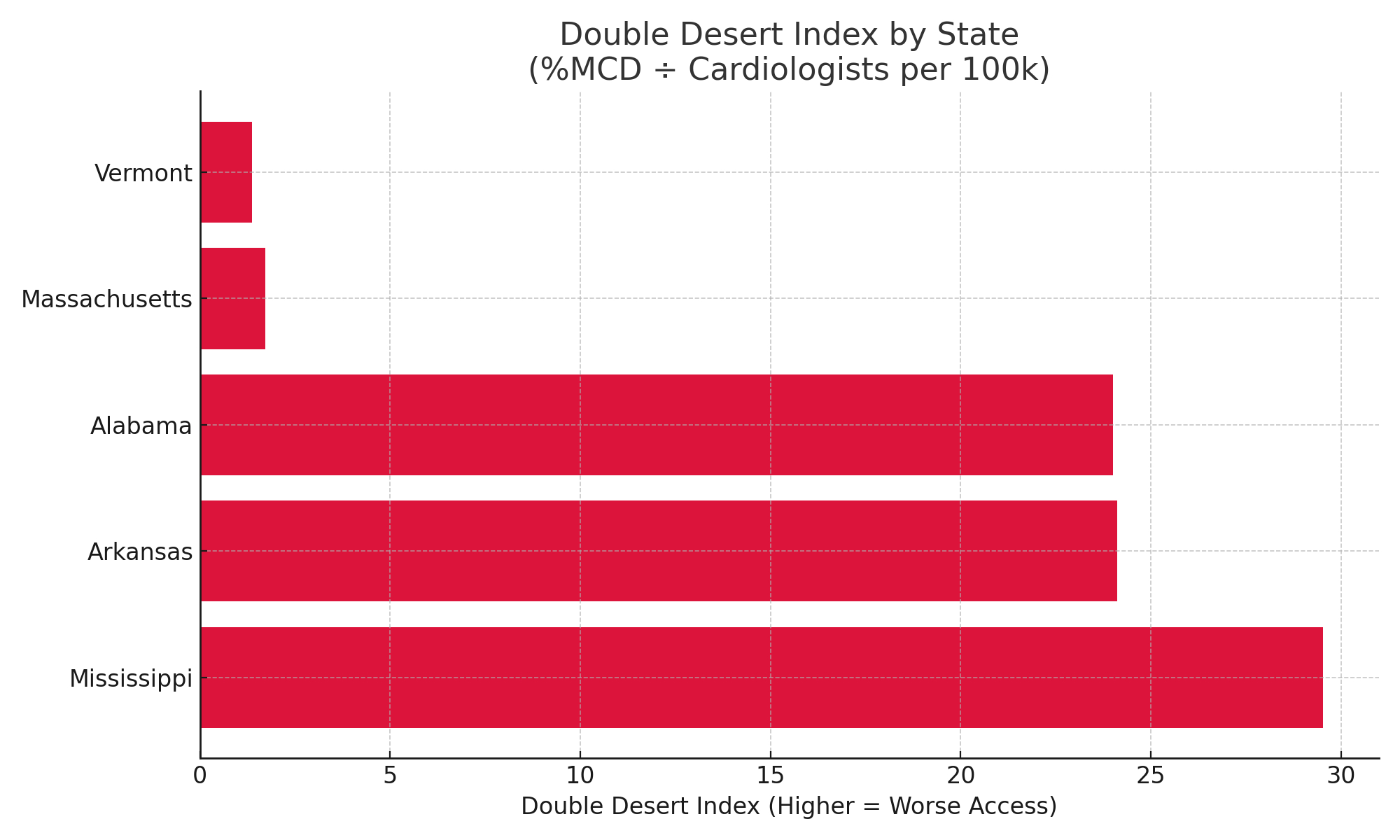
To evaluate the impact of maternity and cardiology care access on maternal hypertensive outcomes; identify “double desert” states with dual deficits; assess their association with MMR, incidence, and DALYs; and propose a “Double Desert Index” to guide policy and interventions.
Hypothesis
We hypothesized that U.S. states with both high maternity care desert burden and low cardiologist density would demonstrate significantly worse maternal hypertensive outcomes, including higher mortality and DALYs, than states with adequate dual access.
Methods
We extracted 2021 state-level data on maternal mortality ratio (MMR), HDP incidence, and disability-adjusted life years (DALYs) from the Global Burden of Disease database. These were merged with 2024 March of Dimes estimates on the percentage of counties per state classified as maternity care deserts (%MCD). Cardiologist density (per 100,000 population) was sourced from AAMC 2021 reports. States were categorized as: (1) single deserts (high %MCD or low cardiologist density), (2) double deserts (high on both), and (3) low-burden (adequate access). Correlation analyses were conducted.
Results
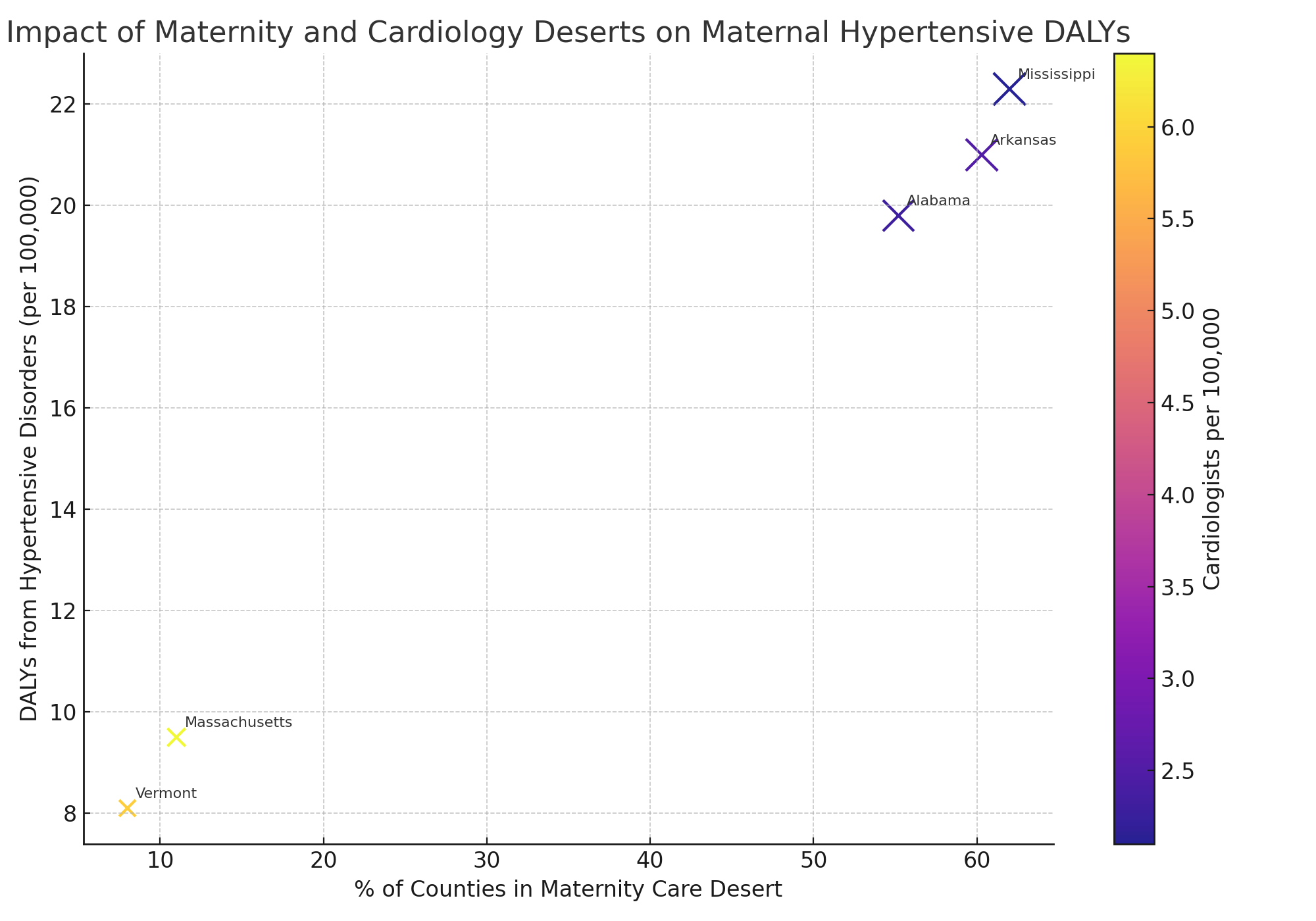
Double desert states (e.g., Mississippi, Arkansas, Alabama) exhibited the highest MMRs (≥3.5 per 100,000 live births) and DALYs (>19.0 per 100,000) compared to low-burden states like Massachusetts and Vermont. A positive correlation was observed between %MCD and DALYs (r = 0.65), and an inverse correlation between cardiologist density and MMR (r = –0.58). Double desert states showed up to 1.7× higher maternal mortality than the national median.
Conclusions
Intersecting gaps in maternity and cardiology access substantially increase maternal hypertensive burden in the U.S. We propose a federally recognized “Double Desert Index” to identify and monitor dual-access deficit regions. This metric could guide equitable health resource distribution, cardio-obstetric service expansion, and maternal cardiovascular risk reduction nationwide.
  • Sahu, Sweta  ( J.J.M. Medical College , Davangere , India )
  • Dixit, Aishwar  ( B.R.D Medical College , Uttar Pradesh , India )
  • Marlecha, Pranay  ( Kempegowda Institute , Bangalore , India )
  • Author Disclosures:
    Sweta Sahu: DO NOT have relevant financial relationships | Aishwar Dixit: DO NOT have relevant financial relationships | Pranay Marlecha: DO NOT have relevant financial relationships
Meeting Info:

Scientific Sessions 2025

2025

New Orleans, Louisiana

Session Info:

Cardiovascular Health at the Crossroads of Sex, Race, and Risk

Sunday, 11/09/2025 , 09:15AM - 10:30AM

Moderated Digital Poster Session

More abstracts on this topic:
3CPR Best Abstract Award: The pathogenic role of ADAMTS13 deficiency in Chronic Thromboembolic Pulmonary Hypertension

Wu Zhijian, Zheng X. Long, Zheng Liang

An Innovative, Non-invasive, Credit-Card Sized Device for Ambulatory 12 Lead ECG Recording: First-In-Human Experience Compared to Standard 12 Lead ECG

Deering Thomas, Vukajlovic Dejan, Babic Milos, Djurdjevic Branko, Atanasoski Vladimir, Miletic Marjan, Mittal Suneet, Sanders Prashanthan

You have to be authorized to contact abstract author. Please, Login
Not Available