
Ethnicity-Based Response in Systolic Blood Pressure Response in Post-Renal Denervation patients: A Meta-Analysis
Abstract Body (Do not enter title and authors here): Introduction/Background Renal denervation (RDN) is an upcoming interventional procedure for resistant hypertension. However, most major RDN trials have disproportionality in enrolled participants, with limited representation of Black, Asian, or Hispanic populations. Whether RDN efficacy varies across ethnic groups, or if underrepresentation hinders generalizability, remains a critical question in cardiovascular research.
Research Questions/Hypothesis We evaluated the level of racial and ethnic representation in RDN trials and explored differences in systolic blood pressure (SBP) reduction across ethnic subgroups. We hypothesized that both disparities in enrollment and potential outcome differences would be evident.
Methods/Approach A meta-review was conducted of six studies with available ethnic subgroup data: SYMPLICITY HTN-3, REQUIRE Trial, SPYRAL HTN-OFF MED, RADIANCE-HTN TRIO, SYMPLICITY Global Registry (Asian cohort), and a Chinese RDN registry study. We extracted SBP outcomes by ethnicity (Black, Asian, White) when reported, and recorded sample sizes and responder trends. Due to heterogeneity and limited quantitative subgroup data, a pooled mean difference was not calculated. Instead, descriptive synthesis and cross-study comparisons were performed.
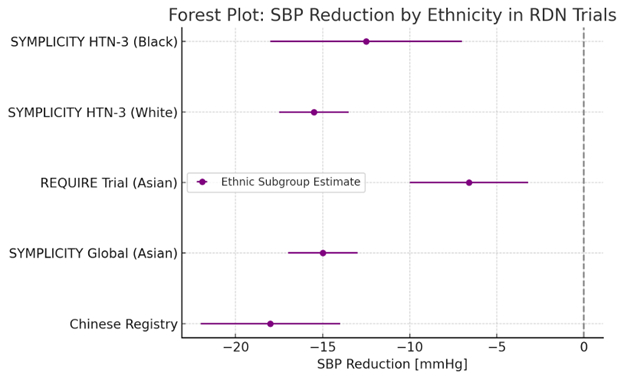
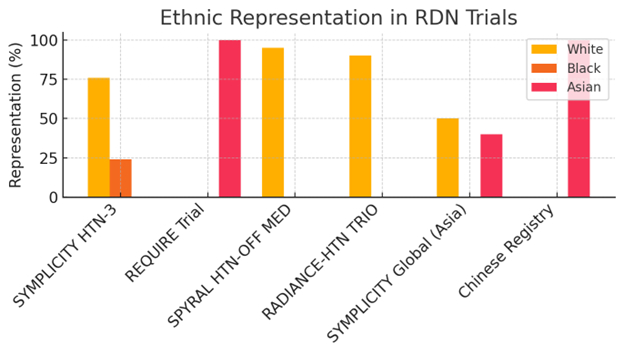
Results/Data Ethnic subgroup reporting was limited across RDN trials. SYMPLICITY HTN-3 included 24% Black patients with SBP reduction of –12.5 mmHg vs –15.5 mmHg in White patients; no significant interaction reported. REQUIRE (100% Asian) showed modest SBP drop of –6.6 mmHg with no superiority over sham. The SYMPLICITY Global Registry (>800 Asians) showed consistent SBP reductions of about 15 mmHg. The Chinese Registry reported SBP reductions (–10 to –20 mmHg) without a comparator. SPYRAL HTN-OFF MED and RADIANCE-HTN TRIO lacked ethnicity-stratified data and enrolled mostly White/European cohorts. Minority representation and subgroup analyses were limited, restricting comparative conclusions.
Conclusion(s) This review highlights a critical gap in both representation and reporting of ethnic subgroup outcomes in RDN trials. Available data suggest that RDN is effective in Asian and Black patients, but sample sizes and statistical rigor remain insufficient to confirm differential efficacy. Greater inclusion and mandatory ethnicity-stratified analyses in future trials are essential to ensure equitable, evidence-based use of RDN across diverse populations.
Marlecha, Pranay
( Kempegowda Institute Of Medical Sciences
, Bangalore
, India
)
Sahu, Sweta
( J.J.M. Medical College
, Davangere
, India
)
Nanjundappa, Aravinda
( Cleveland Clinic
, Cleveland
, Ohio
, United States
)
Author Disclosures:
Pranay Marlecha:DO NOT have relevant financial relationships
| Sweta Sahu:DO NOT have relevant financial relationships
| aravinda Nanjundappa:No Answer