Comparative Outcomes of GLP-1 Agonists vs SGLT2 Inhibitors in Patients with Type 2 Diabetes and Heart Failure: A Propensity-Matched Multicenter Retrospective Analysis
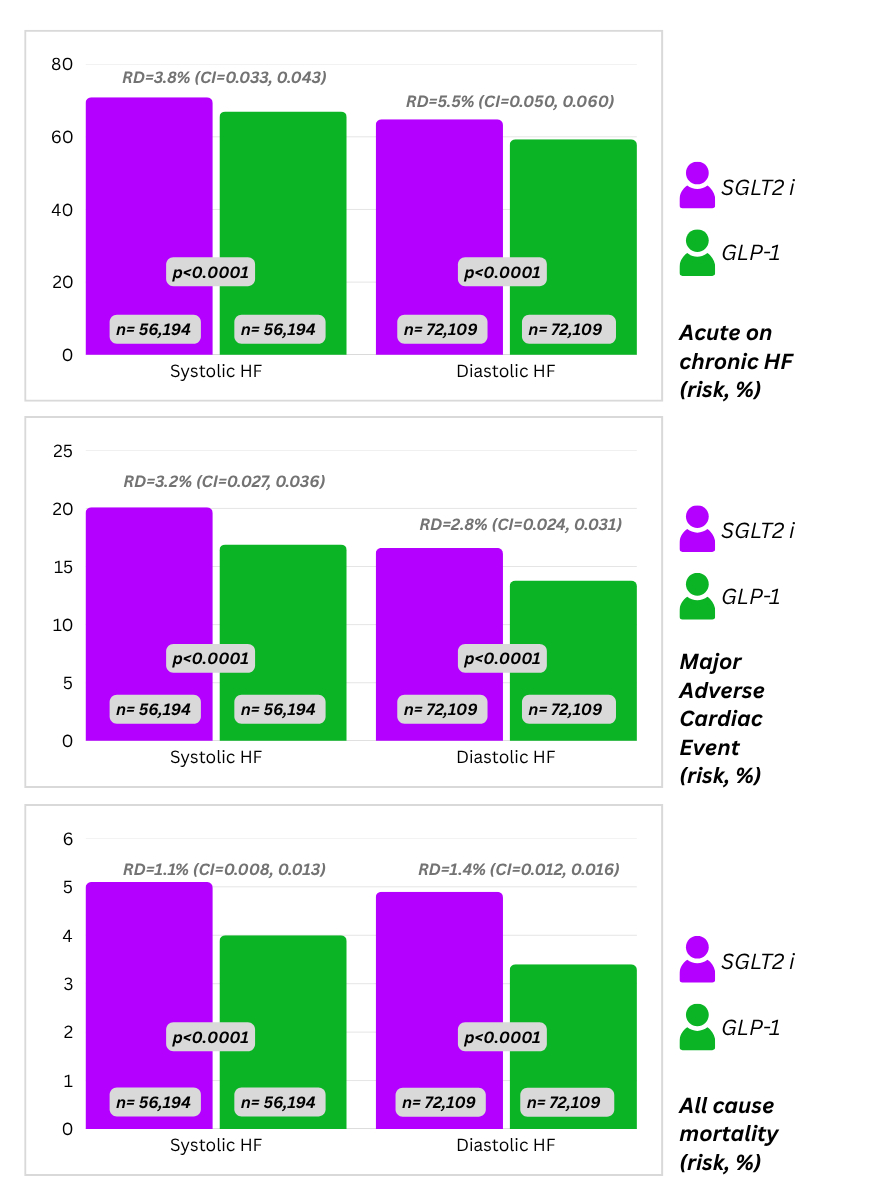
Abstract Body (Do not enter title and authors here): Introduction: Although both SGLT2 inhibitors and GLP-1 agonists have shown cardiovascular benefits in patients with type 2 diabetes mellitus (T2DM), their comparative effectiveness in heart failure, particularly when stratified by systolic and diastolic subtypes, remains uncertain. This study aims to provide real-world data to aid clinical decision making in this challenging clinical context. Methods: We retrospectively analyzed data from the TriNetX global federated health research network. Included were patients >18 years with T2DM and heart failure who initiated either SGLT2 inhibitors or GLP-1 agonists. Cohorts were stratified by systolic and diastolic heart failure. Outcomes were assessed from 1 month to 1 year post-initiation. Propensity matching was done for age, gender, obesity, cardiovascular medications, HbA1c, and pro-BNP levels. Major adverse cardiac event (MACE) was defined as a composite of cardiac mortality, non-fatal cerebrovascular events, and non-fatal myocardial infarction. The renal composite was defined as: end stage renal disease requiring dialysis OR GFR <65 mL/min/1.73 m2 OR creatinine >1.2 mg/dL. Risk difference (RD) with 95% CI was calculated using a two-proportion Z-test. Results: Systolic heart failure: 56,194 patients analyzed post-matching. GLP-1 users had lower rates of acute on chronic heart failure (RD=3.8%, CI=0.033–0.043, p<0.0001), MACE (RD=3.2%, CI=0.027–0.036, p<0.0001), and all-cause mortality (RD=1.1%, CI=0.008–0.013, p<0.0001). SGLT2 inhibitors were superior for renal outcomes (RD=1.0%, CI=0.016–0.004, p<0.0001). More GLP-1 users achieved HbA1c <6.5% (RD=2.6%, CI=0.031–0.022, p<0.0001). Diastolic Heart Failure:72,109 patients analyzed. GLP-1 users again showed better outcomes: acute on chronic heart failure (RD=5.5%, CI=0.050–0.060, p<0.0001), MACE (RD=2.8%, CI=0.024–0.031, p<0.0001), and all-cause mortality (RD=1.4%, CI=0.012–0.016, p<0.0001). SGLT2 inhibitors had better renal outcomes (RD=1.0%, CI=0.015–0.005, p<0.0001), while GLP-1 users more frequently achieved HbA1c <6.5% (RD=4.5%, CI=0.049–0.041, p<0.0001). Conclusions: GLP-1 agonists demonstrate superior cardiovascular protection and lower all-cause mortality compared to SGLT2 inhibitors in patients with T2DM and heart failure, across both systolic and diastolic subtypes. In contrast, SGLT2 inhibitors show greater benefit in preserving renal function regardless of heart failure phenotype. Additionally, GLP-1 agonists were associated with improved glycemic control.
Qureshi, Ali Akram
(
King Edward Medical University
, Lahore , Pakistan )
Bin Kashif, Talha
(
King Edward Medical University
, Lahore , Pakistan )
Munir, Luqman
(
King Edward Medical University
, Lahore , Pakistan )
Alvi, Zainab
(
King Edward Medical University
, Lahore , Pakistan )
Alvi, Fatima
(
Fatima Jinnah Medical University
, Lahore , Pakistan )
Muhammad, Anza
(
King Edward Medical University
, Lahore , Pakistan )
Qureshi, Muhammad Ahmad
(
Henry Ford Jackson Hospital
, Jackson , Michigan , United States )
Author Disclosures:
Ali Akram Qureshi:DO NOT have relevant financial relationships
| Talha Bin Kashif:DO NOT have relevant financial relationships
| Luqman Munir:No Answer
| Zainab Alvi:No Answer
| Fatima Alvi:No Answer
| Anza Muhammad:DO NOT have relevant financial relationships
| Muhammad Ahmad Qureshi:DO NOT have relevant financial relationships