Extracorporeal Shockwave Therapy Improves Physical Outcomes and Quality of Life In Patients With Symptomatic Peripheral Arterial Disease: Results from a Meta-analysis of Randomized Controlled Trials
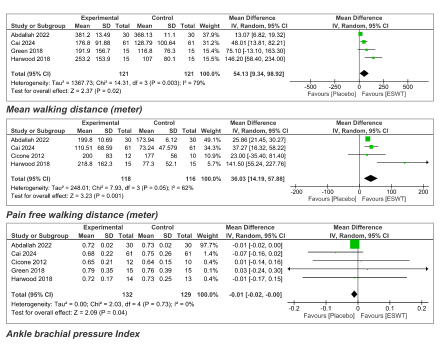
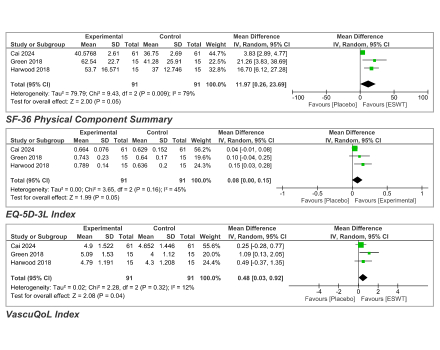
Abstract Body (Do not enter title and authors here): Introduction Extracorporeal shockwave therapy (ESWT) is a non-invasive procedure that may be useful to treat symptomatic peripheral arterial disease (PAD). Trials comparing ESWT with control groups have shown promising results. Methods PubMed, Cochrane, EMBASE, and Google Scholar were searched for randomized controlled trials reporting the efficacy of extracorporeal shockwave therapy versus control in patients with symptomatic PAD. Data from eligible studies was analyzed using the Review Manager 5.4 software. Mean difference (MD) and 95% Confidence intervals (CI) were calculated for continuous outcomes. Inverse variance method and a random effects model were used for pooled estimates. A p-value < 0.05 (Z-test) was considered significant. Results 5 randomized controlled trials with 264 patients were included in our analysis. A significant increase in the mean walking distance (MD: 54.13, 95% CI 9.34 to 98.92, p=0.02), pain-free walking distance (MD: 54.13, 95% CI 14.19, 57.88, p= 0.001), SF-36 physical component summary (MD: 11.97, 95% CI 0.26 to 23.69, p=0.05), EQ-5D-3L index score (MD; 0.08, 95% CI: 0.00 to 0.15, p=0.05) and VascuQoL index ((MD: 0.48, 95% CI 0.03 to 0.92, p= 0.04) was seen with ESWT. A slightly higher ankle brachial pressure index was seen in the control group (MD: -0.01, 95% CI: -0.02 to -0.00, p=0.04). There was no difference in SF-36 physical functioning domain score (MD: 18.58, 95% CI: -0.29 to 37.45, p=0.05) and SF-36 bodily pain score (MD: 9.17, 95% CI: -2.885 to 21.19, p=0.13). Conclusions There was significant improvement in walking distances, exertional symptoms, and quality of life with ESWT. However, ESWT did not translate to an increase in post-treatment ankle-brachial index which was slightly higher in the control group. There is a need for larger randomized controlled trials to substantiate the efficacy of ESWT in treating symptomatic PAD.
Kashif, Talha
(
King Edward Medical University
, Lahore , Pakistan )
Rahman, Ummi Aiman
(
King Edward Medical University
, Lahore , Pakistan )
Qureshi, Ali Akram
(
King Edward Medical University
, Lahore , Pakistan )
Mubashir, Mohammad Maheer
(
King Edward Medical University
, Lahore , Pakistan )
Alvi, Fatima
(
Fatima Jinnah Medical University
, Lahore , Pakistan )
Qureshi, Muhammad Ahmad
(
Henry Ford Jackson Hospital
, Jackson , Michigan , United States )
Author Disclosures:
Talha Kashif:No Answer
| Ummi Aiman Rahman:DO NOT have relevant financial relationships
| Ali Akram Qureshi:DO NOT have relevant financial relationships
| Mohammad Maheer Mubashir:DO NOT have relevant financial relationships
| Fatima Alvi:No Answer
| Muhammad Ahmad Qureshi:DO NOT have relevant financial relationships