Logo

American Heart Association

  13
  0


Final ID: Mo3004

Pulsed-Field vs Radiofrequency Ablation: Evaluation of Outcomes in Recurrent Atrial Fibrillation

Abstract Body (Do not enter title and authors here): Background
Pulsed-field ablation (PFA) has recently been approved in the USA as a new method for treating atrial fibrillation (AF). PFA provides a promising new approach in the treatment of atrial fibrillation (AF), which historically has a high recurrence rate post-ablation. Of significance, PFA has shown promising data in terms of safety and procedural efficiency to radiofrequency ablation (RFA).
Objective
The purpose of this study was to compare the procedural and health outcomes in patients with recurrent AF undergoing ablation using PFA or RFA.
Methods
Consecutive patients with a history of previous radiofrequency ablation and recurrent AF undergoing redo ablation with PFA or RFA were included. Patients were seen for follow-up in the clinic ranging from four months to a year and we reported ablation strategy and arrhythmia type. The primary outcome was recurrence of any atrial arrhythmia after a 90-day blanking period.
Results
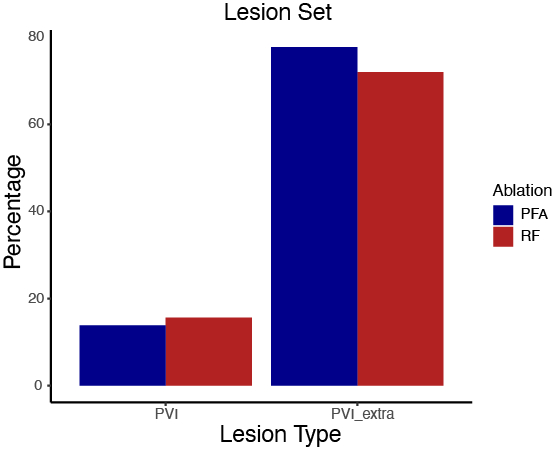
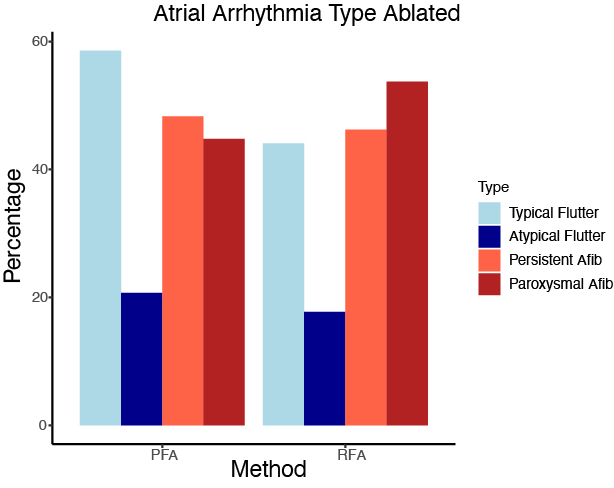
A total of 240 patients with recurrent AF underwent redo ablation using PFA (n = 54, 22.5%) or RFA (n = 186, 77.5%). Patients receiving PFA had an average age of 66 (SD ±11.7), were 69% male, and an average CHADSVASC score of 2.2 (SD ±1.61). This is similar to the demographic of patients receiving RFA, with an average age of 70 (SD ±12.95), 62.3% male, and average CHADSVASC of 3.06 (SD ±1.58). Procedures with PFA guided by fluoroscopy had an average fluoroscopy exposure time of 13.85 minutes compared to RFA procedures with 8.73 min (p = 6.313e-07). Fig 1 identifies the proportions of atrial arrhythmias ablated with each method. A high proportion of lesion sets utilized PVI (pulmonary vein isolation) along with other methods as shown in Fig 2. Of PFA patients who completed follow-up (n=30), 26% had a recurrence of AF. This was less than the 41% of RFA patients (n=49) followed who presented with AF recurrence (HR=0.22, CI 0.08-0.60, p=0.006).
Conclusion
In patients with recurrent AF undergoing redo ablation, patients receiving PFA ablation presented with an 88% lower risk of recurrent AF compared to patients who received RFA.
  • Patel, Vishal  ( University of Colorado , Denver , Colorado , United States )
  • Ashur, Carmel  ( University of Colorado , Denver , Colorado , United States )
  • Zipse, Matthew  ( University of Colorado , Denver , Colorado , United States )
  • Tumolo, Alexis  ( University of Colorado , Denver , Colorado , United States )
  • Garg, Lohit  ( University of Colorado , Denver , Colorado , United States )
  • Sabzwari, Syed Rafay Ali  ( University of Colorado , Aurora , Colorado , United States )
  • Rosenberg, Michael  ( University of Colorado , Denver , Colorado , United States )
  • Tzou, Wendy  ( University of Colorado , Denver , Colorado , United States )
  • Author Disclosures:
    Vishal Patel: DO NOT have relevant financial relationships | Carmel Ashur: No Answer | Matthew Zipse: DO NOT have relevant financial relationships | Alexis Tumolo: DO have relevant financial relationships ; Speaker:Boston Scientific:Active (exists now) ; Other (please indicate in the box next to the company name):Abbott, Education:Active (exists now) ; Speaker:Biosense Webster:Active (exists now) | Lohit Garg: No Answer | Syed Rafay Ali Sabzwari: DO have relevant financial relationships ; Consultant:Medtronic :Active (exists now) ; Speaker:Boston Scientific :Active (exists now) ; Consultant:Abbott :Active (exists now) | Michael Rosenberg: DO NOT have relevant financial relationships | Wendy Tzou: DO have relevant financial relationships ; Independent Contractor:American Heart Association:Active (exists now) ; Consultant:Kardium:Active (exists now) ; Advisor:Medtronic:Active (exists now) ; Speaker:Medtronic:Active (exists now) ; Consultant:Medtronic:Active (exists now) ; Advisor:Boston Scientific:Active (exists now) ; Speaker:Boston Scientific:Active (exists now) ; Consultant:Boston Scientific:Active (exists now) ; Speaker:Abbott:Active (exists now) ; Advisor:Abbott:Active (exists now) ; Consultant:Abbott:Active (exists now) ; Researcher:Biosense Webster/J&J MedTech:Active (exists now) ; Advisor:Biosense Webster/J&J MedTech:Active (exists now) ; Speaker:Biosense Webster/J&J MedTech:Active (exists now) ; Consultant:Biosense Webster/J&J MedTech:Active (exists now)
Meeting Info:

Scientific Sessions 2025

2025

New Orleans, Louisiana

Session Info:

Insights Gained in Pulsed Field Ablation for Atrial Arrhythmias

Monday, 11/10/2025 , 10:30AM - 11:30AM

Abstract Poster Board Session

More abstracts on this topic:
Ablation for Atrial Fibrillation: A Comprehensive Meta-Analysis of Randomized Controlled Trials with Reconstructed Time-to-Event Data

Mi Jiaqi, Katapadi Aashish, Darden Douglas, Uppalapati Sree Varuntej, Kabra Aanya, Katapadi Aashika

Cavo-Tricuspid Isthmus Ablation in Atrial Flutter with Uncorrected Ebstein’s Anomaly: A Scoping Review

Jain Shubhika, Goyal Samarth, Ramesh Prerana, Momin Elina, Vyas Rahul

More abstracts from these authors:
Burden of Premature Ventricular Complexes is Unrelated to Prediction of Cardiomyopathy

Slaven Sarah, Varosy Paul, Sabzwari Syed Rafay Ali, Rosenberg Michael, Garg Lohit, Healy Christina, Tumolo Alexis, Tzou Wendy, Barrett Christopher, Cerbin Lukasz, Zipse Matthew, Sandhu Amneet

What Happens to Automated External Defibrillator Rhythm Strips after a Cardiac Arrest?

Ashur Carmel, Cerbin Lukasz, Saqi Bilal, Varela Daniel, Adewumi Joseph, Zipse Matthew, Tzou Wendy, Aleong Ryan, Zirille Francis, Varosy Paul, Sandhu Amneet, Tumolo Alexis, Rosenberg Michael, Garg Lohit, Sabzwari Syed Rafay Ali, Barrett Christopher

You have to be authorized to contact abstract author. Please, Login
Not Available