Logo

American Heart Association

  21
  0


Final ID: Mo3003

Asymptomatic Brain Injury: A Common Finding After Pulsed Field Ablation of Uncertain Significance — A Systematic Review and Meta-Analysis

Abstract Body (Do not enter title and authors here): Background
Pulsed field ablation (PFA) has become a cornerstone for atrial fibrillation ablation. Multiple platforms have been developed and approved worldwide, and routine screening for asymptomatic brain injury (ABI) has been included in several trials as part of the safety assessment of this technology. The incidence by catheter/platform, predictors of occurrence, and clinical impact remain incompletely understood.

Research Question
In patients with atrial fibrillation undergoing pulmonary vein isolation, does the incidence of ABI vary between different PFA platforms?

Methods
We searched the MEDLINE/PubMed, Embase, and Cochrane Central Register of Controlled Trials databases for studies reporting on patients who underwent PFA and post-procedure brain MRI to screen for ABI. The review was conducted in accordance with PRISMA guidelines. A random-effects proportion meta-analysis was performed, with subgroup analysis based on the PFA platform used. For studies including a thermal ablation control group, risk ratio (RR) was used to compare outcomes. Finally, a meta-regression was conducted to identify potential predictors of ABI incidence.

Results
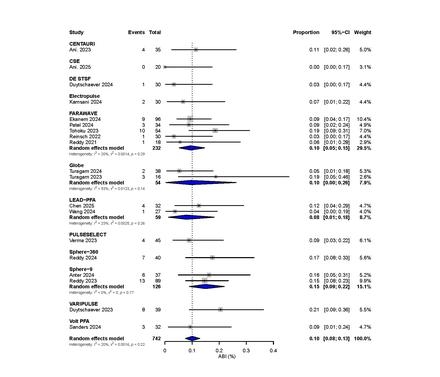
A total of 19 studies reporting data from 742 patients who underwent post-ablation brain MRI were included in this review. The pooled incidence of silent cerebral events (new findings visible only on DWI sequences) and silent cerebral lesions (new findings on both DWI and FLAIR sequences) was 5% each (95% CI, 3%–8%). The pooled incidence of any ABI was 10% (95% CI, 8%–13%). A platform-level subgroup analysis demonstrated comparable outcomes across the platforms with available data (Figure 1). The meta-regression included age, sex, CHA2DS2-VASc score, and incidence of symptomatic stroke/TIA, but no statistically significant associations were identified. In the four studies that included a thermal ablation control group, there was no significant difference in ABI incidence between PFA and thermal ablation (RR: 1.37; 95% CI, 0.68–2.74; P = 0.38; I2 = 16%) (Figure 2). Seven studies reported follow-up MRI in patients who presented with an ABI. Among 20 patients with ABI after ablation, radiologic lesions persisted in 2 patients.

Conclusion
ABI is a relatively frequent finding following PFA; however, current evidence does not reveal significant differences between available platforms. Radiologic findings tend to be transient, suggesting a limited long-term clinical impact.
  • Rodriguez-riascos, Juan  ( Mayo Clinic , Phoenix , Arizona , United States )
  • Mee, Xuan Ci  ( Mayo Clinic , Phoenix , Arizona , United States )
  • Vemulapalli, Hema  ( Mayo Clinic , Phoenix , Arizona , United States )
  • Estrada-mendizabal, Ricardo  ( Mount Sinai NYCHH Elmhurst , Jackson Heights , New York , United States )
  • Mariajohn, Regash  ( American International Medical University , St. Lucia , Saint Lucia )
  • Kalyanasundaram, Bala Vignesh  ( Mayo Clinic , Phoenix , Arizona , United States )
  • Liu, Michael  ( Mayo Clinic , Phoenix , Arizona , United States )
  • Srivathsan, Komandoor  ( Mayo Clinic , Phoenix , Arizona , United States )
  • Author Disclosures:
    Juan Rodriguez-Riascos: DO NOT have relevant financial relationships | Xuan Ci Mee: DO NOT have relevant financial relationships | Hema Vemulapalli: No Answer | Ricardo Estrada-Mendizabal: DO NOT have relevant financial relationships | Regash Mariajohn: DO NOT have relevant financial relationships | Bala Vignesh Kalyanasundaram: DO NOT have relevant financial relationships | Michael Liu: No Answer | Komandoor Srivathsan: No Answer
Meeting Info:

Scientific Sessions 2025

2025

New Orleans, Louisiana

Session Info:

Insights Gained in Pulsed Field Ablation for Atrial Arrhythmias

Monday, 11/10/2025 , 10:30AM - 11:30AM

Abstract Poster Board Session

More abstracts on this topic:
A Comparative Analysis of Esophageal Cooling for Preventing Esophageal Injury Post Atrial Fibrillation Catheter Ablation: A Systematic Review and Meta-analysis

Ibrahim Momen Mohamed, Al Hennawi Hussam, Tanas Yousef, Abourady Youmna, Sewedan Nourhan, Hashem Ahmed Magdy, Motawea Karam R.

A novel risk score predicts the prevalence of left atrial low-voltage areas and rhythm outcome in patients undergoing long-standing persistent atrial fibrillation ablation

Ooka Hirotaka, Nakao Sho, Kusuda Masaya, Ariyasu Wataru, Kudo Satoshi, Fujii Subaru, Mano Toshiaki, Matsuda Yasuhiro, Masuda Masaharu, Okamoto Shin, Ishihara Takayuki, Nanto Kiyonori, Tsujimura Takuya, Hata Yosuke, Uematsu Hiroyuki

More abstracts from these authors:
Reassessing the Blanking Period: Early Recurrence as a Predictor of Late Atrial Fibrillation Recurrence After Pulsed Field Ablation

Rodriguez-riascos Juan, Srivathsan Komandoor, Vemulapalli Hema, Kim James, Sripusanapan Adivitch, Prajapati Poojan, Fatunde Olubadewa, Sorajja Dan, El Masry Hicham, Shen Win

Left Ventricular Function Recovery Following Spontaneous Coronary Artery Dissection: A Multicenter Retrospective Study

Mee Xuan Ci, Ibrahim Ramzi, El Masry Hicham, Lee Kwan, Lim Ghee Kheng, Youssef Amal, Raslan Mohammed Alaa, Abdul Nabi Hussein, Rodriguez-riascos Juan, Vemulapalli Hema, Arunachalam Karikalan Suganya, Tan Min Choon

You have to be authorized to contact abstract author. Please, Login
Not Available