Right Ventricular Free Wall Strain and Clinical Outcomes in Transthyretin Amyloid Cardiomyopathy and Effect of Vutrisiran: the HELIOS-B Study
Abstract Body (Do not enter title and authors here): Introduction: Right ventricular dysfunction is common among patients with transthyretin amyloid cardiomyopathy (ATTR-CM) and is associated with worse prognosis. In HELIOS-B, vutrisiran reduced rates of all-cause mortality (ACM) and recurrent cardiovascular (CV) events among patients with ATTR-CM compared with placebo and had beneficial effects on cardiac structure and function. Its effects on right ventricular free wall strain (RVFWS) are unknown.
Hypotheses: RVFWS is associated with clinical outcomes among patients with ATTR-CM. Vutrisiran has favorable effects on RVFWS.
Methods: HELIOS-B randomized 655 patients with ATTR-CM to vutrisiran (25mg subcutaneously every 12 weeks) or placebo. Echocardiograms were performed serially during follow-up. The association of baseline RVFWS with ACM and recurrent CV events was investigated using a modified Andersen-Gill model, adjusted for age, sex, ATTR disease type, National Amyloidosis Centre (NAC) stage, RV fractional area change (FAC), and tricuspid annular systolic myocardial velocity (RV S’), and stratified by baseline tafamidis use and treatment assignment. Changes in RVFWS from baseline to month 30 were evaluated using linear regression, adjusted for baseline RVFWS and clinical characteristics.
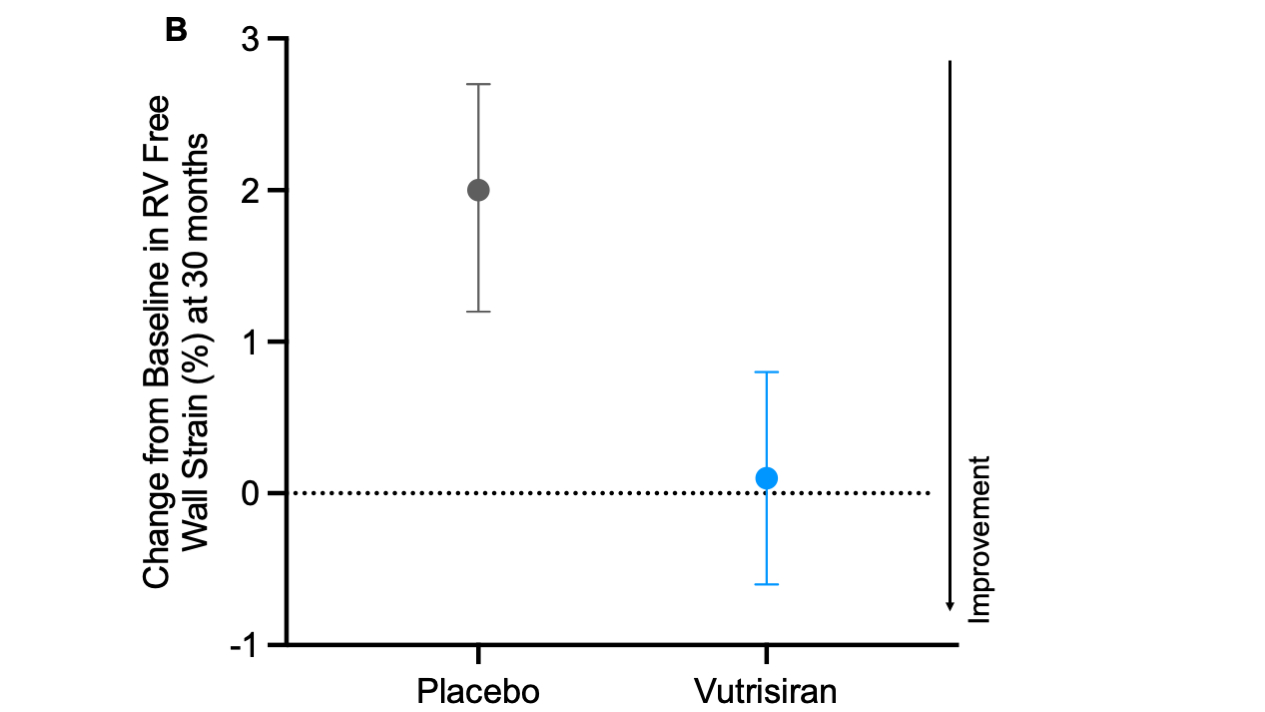
Results: Among 548 (84%) patients with available baseline RVFWS (age 75 ± 7 years, 92% men, 88% wild-type ATTR), mean RVFWS was -14.5± 5.1%. RV dysfunction was prevalent in a greater proportion of patients using RVFWS (>-20%, 85%) as compared with RV S’ (<9.5cm/s, 54%) or RV FAC (<35%, 27%). Patients in the worst RVFWS quartile (>-10.9%, n=137) had more atrial fibrillation, lower eGFR, lower LVEF and worse NYHA class and NAC disease stage. Worse RVFWS at baseline was associated with a heightened risk of ACM and recurrent CV events (adjusted RR 1.38, 95% CI: 1.17 - 1.63), independent of demographic characteristics, ATTR disease type, NAC stage and non-deformation-based metrics of RV function. At 30 months, RVFWS remained stable in the vutrisiran group (0.1%, 95% CI: -0.6, 0.8%) and declined in the placebo group (2.0%, 95% CI:1.2, 2.7), between group difference (-1.6%, 95% CI: -2.6, -0.7%).
Conclusions: RVFWS is markedly impaired among patients with ATTR-CM and is strongly and independently associated with higher risk of ACM and recurrent CV events. Consistent with its beneficial effects on other measures of cardiac structure and function, vutrisiran stabilized RVFWS at 30 months compared with worsening in the placebo group.
Manafi, Alireza
(
Brigham and Women's Hospital
, Boston , Massachusetts , United States )
Jering, Karola
(
Brigham and Women's Hospital
, Boston , Massachusetts , United States )
Fontana, Marianna
(
University College London
, London , United Kingdom )
Bulwer, Bernard
(
Brigham and Women's Hospital
, Boston , Massachusetts , United States )
Roshanali, Farideh
(
Brigham and Women's Hospital
, Boston , Massachusetts , United States )
Jay, Patrick
(
Alnylam Pharmaceuticals
, Wayland , Massachusetts , United States )
Solomon, Scott
(
Brigham and Women's Hospital
, Boston , Massachusetts , United States )
Skali, Hicham
(
Brigham and Womens Hospital
, Boston , Massachusetts , United States )
Author Disclosures:
Alireza Manafi:DO NOT have relevant financial relationships
| Karola Jering:DO NOT have relevant financial relationships
| Marianna Fontana:DO have relevant financial relationships
;
Consultant:Alnylam, Alexion/Caelum Biosciences, Astrazeneca, Bridgbio/Eidos, Prothena, Attralus, Intellia Therapeutics, Ionis Pharmaceuticals, Cardior, Lexeo Therapeutics, Janssen Pharmaceuticals, Prothena, Pfizer, Novonordisk, Bayer, Mycardium:Active (exists now)
; Individual Stocks/Stock Options:Mycardium (shares):Active (exists now)
; Individual Stocks/Stock Options:LexeoTherapeutics (share options):Active (exists now)
; Other (please indicate in the box next to the company name):Alnylam, Bridgbio, Astrazeneca, Pfizer.(research grants):Active (exists now)
| Bernard Bulwer:No Answer
| Farideh Roshanali:DO NOT have relevant financial relationships
| Patrick Jay:DO have relevant financial relationships
;
Employee:Alnylam Pharmaceuticals:Active (exists now)
; Individual Stocks/Stock Options:Alnylam Pharmaceuticals:Active (exists now)
| Scott Solomon:DO have relevant financial relationships
;
Research Funding (PI or named investigator):Alexion, Alnylam, Applied Therapeutics, AstraZeneca, Bellerophon, Bayer, BMS, Boston Scientific, Cytokinetics, Edgewise, Eidos/BridgeBio, Gossamer, GSK, Ionis, Lilly,NIH/NHLBI, Novartis, NovoNordisk, Respicardia, Sanofi Pasteur, Tenaya, Theracos, US2.AI:Active (exists now)
; Consultant:Abbott, Action, Akros, Alexion, Alnylam, Amgen, Arena, Askbio, AstraZeneca, Bayer, BMS, Cardior, Cardurion, Corvia, Cytokinetics, GSK, Intellia, Lilly, Novartis, Roche, Theracos, Quantum Genomics, Tenaya, Sanofi-Pasteur, Dinaqor, Tremeau, CellProThera, Moderna, American Regent, Sarepta, Lexicon, Anacardio, Akros, Valo, Synhale, Recordati:Active (exists now)
| Hicham Skali:DO have relevant financial relationships
;
Research Funding (PI or named investigator):Cytokinetics:Active (exists now)
Tran Dieu Hien, Do Chau, Nguyen Thi Kim Chuc, Pham Ngoc Anh Vu, Phan Hoang Son, Phan Tri Cuong, Han Nguyen Le My, Nguyen Thi Huong Dung, Vo Le Y Nhi, Cao Doan Thi Bich Huyen, Tran Thanh Phong, Truyen Thien Tan Tri Tai, Tran Van Duong, Nguyen Ngoc Huyen, Pham Thanh Phong, Nguyen Minh Nghiem, Nguyen Van Khoa, Vo Phuc Dai, Le Hoang Phuc, Dinh Quang Minh Trí, Vu Loc, Kieu Doan Thi