Cardiovascular Event Rates by Baseline Risk and Age in a Primary Prevention Cohort from the All of Us Research Program
Abstract Body (Do not enter title and authors here): Introduction Among adults without established atherosclerotic cardiovascular disease (ASCVD), risk exists along a continuum, and real-world data characterizing this spectrum, particularly in untreated individuals, remain limited. In this study, we examined the incidence of major adverse cardiovascular events (MACE) in this population among untreated adults enrolled in the All of Us (AOU) Research Program.
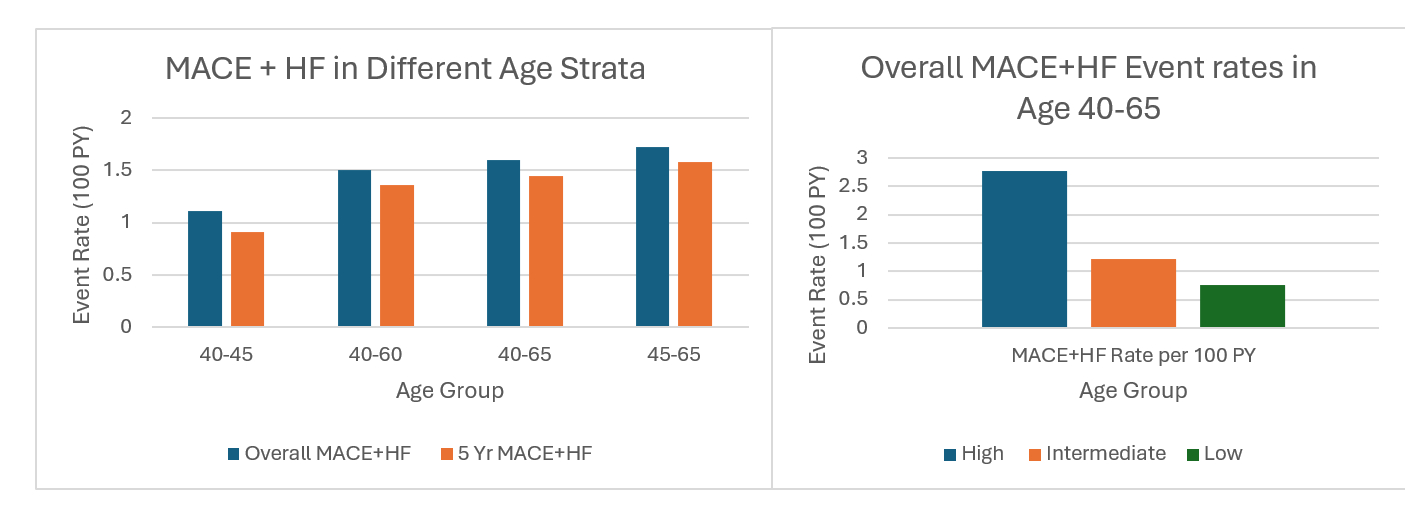
Methods Patients with available EHR from the AOU database (Jan 1, 2000 – Oct 1, 2023) were included if they had no history of ASCVD, HF, lipid-lowering therapy, or blood pressure medications. The eligible cohort was categorized into age groups: 40–64, 45–64, 40–44, and 40–59 years. Participants were stratified into three baseline cardiovascular risk groups: high risk (low-density lipoprotein cholesterol ≥190 mg/dL, systolic blood pressure ≥160 mmHg, or DM), intermediate risk (Pooled Cohort Equation (PCE) score ≥7.5% or SBP 140–159 mmHg, no DM), and low risk (PCE <7.5%, LDL <190 mg/dL, SBP <140 mmHg, no DM). Event rates for MACE were calculated per 100 person-years (PY) across the cohort and risk groups. Results Out of 393,596 individuals with EHR, 40,330 adults aged 40–65 met baseline criteria for primary prevention and were included in the final cohort (median follow-up: 12.4 years). Of these, 36% were high-risk, 31% intermediate-risk, and 33% low-risk. MACE rates were 2.78, 1.21, and 0.75 per 100 person-years (PY) in the high, intermediate, and low risk groups, respectively. MACE rates also increased with age: 1.11 (ages 40–45), 1.50 (40–60), and 1.72 (45–64) per 100 PY. Over a 5-year follow-up, incidence remained consistent at 2.71, 0.98, and 0.58 per 100 PY across high, intermediate, and low risk individuals. Conclusion In this large treatment-naïve primary prevention cohort, MACE event rates varied substantially by baseline risk and age. Even “low-risk” individuals experienced non-trivial event rates, particularly with advancing age. These findings underscore the critical importance of moving beyond a one-size-fits-all approach in primary prevention.
Siddharth, Aditya
(
Houston Methodist Hospital
, Houston , Texas , United States )
Shahid, Izza
(
Houston Methodist Hospital
, Houston , Texas , United States )
Gullapelli, Rakesh
(
Houston Methodist
, HOUSTON , Texas , United States )
Jindal, Sanmit
(
Houston Methodist
, Houston , Texas , United States )
Javed, Zulqarnain
(
Houston Methodist
, Houston , Texas , United States )
Al Rifai, Mahmoud
(
Houston Methodist Hospital
, Houston , Texas , United States )
Patel, Kershaw
(
Houston Methodist Hospital
, Houston , Texas , United States )
Al-kindi, Sadeer
(
Houston Methodist Hospital
, Houston , Texas , United States )
Nasir, Khurram
(
Houston Methodist Hospital
, Houston , Texas , United States )
Author Disclosures:
Aditya Siddharth:DO NOT have relevant financial relationships
| Izza Shahid:No Answer
| Rakesh Gullapelli:No Answer
| Sanmit Jindal:DO NOT have relevant financial relationships
| Zulqarnain Javed:DO NOT have relevant financial relationships
| Mahmoud Al Rifai:No Answer
| Kershaw Patel:DO have relevant financial relationships
;
Consultant:Novo Nordisk:Past (completed)
; Research Funding (PI or named investigator):NIH:Active (exists now)
| Sadeer Al-Kindi:No Answer
| Khurram Nasir:No Answer