Cost-Effectiveness of AI-Enabled Coronary Plaque Analysis for Management of Stable Coronary Artery Disease
Abstract Body (Do not enter title and authors here): Introduction: Recent clinical studies have established that non-calcified plaque in the coronary arteries plays a greater role in risk of myocardial infarction (MI) than calcified plaque. AI-enabled coronary plaque analysis (AI-CPA) derived from coronary computed tomography angiography (CCTA) measures non-calcified plaque in addition to calcified plaque to help guide medical management. The cost-effectiveness of AI-CPA has not been established.
Methods: We developed a Markov cohort model to determine the cost-effectiveness of AI-CPA (Heartflow Inc.) compared to CCTA-only based on data from the FISH&CHIPS study, which consisted of patients undergoing CCTA for suspected stable coronary artery disease (CAD). Total Plaque Volume (TPV) was measured using AI-CPA and divided into stages: 1-100, 101-250, 251-750, >750mm3. TPV stages were used to guide lipid-lowering therapy (Table 1). Cardiovascular (CV) outcomes included all-cause death and MI. Costs were derived from US claims data. Utilities were derived from peer-reviewed literature. Results were reported as incremental cost effectiveness ratios (ICER) over a 5 and 10-year time horizon. Sensitivity analyses were performed to assess the impact of key variables on the model output.
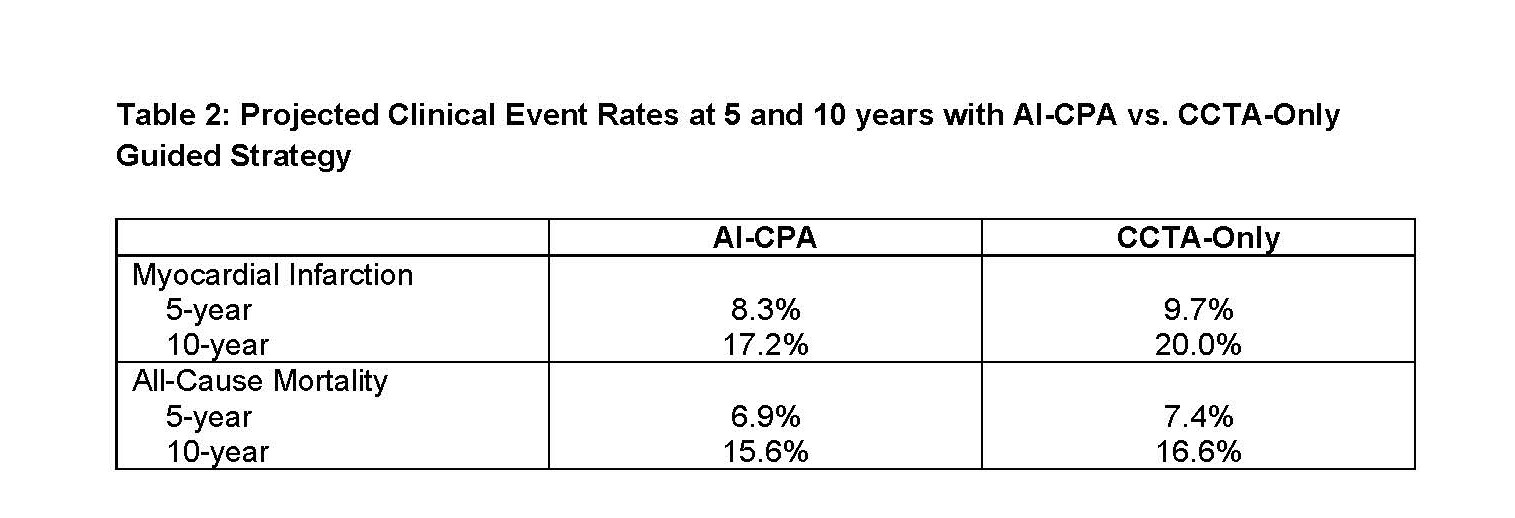
Results: Clinical event rates were projected to be lower with AI-CPA tailored treatment at both 5 years and 10 years (Table 2). AI-CPA patients accrued an average of 0.19 (95% CI: 0.15 to 0.24) and 0.61 QALY (95% CI:0.47 to 0.76) relative to CCTA-only at 5 and 10 years, respectively. Estimated total costs were higher for AI-CPA relative to CCTA-only by $1,519 (95% CI: $1,109 to $1,896) and $1,698 (95% CI: $901 to $2503) at 5 and 10 years, respectively. The ICER at 5 and 10 years was $7,982/QALY and $2,765/QALY, respectively. 100% of the Monte Carlo simulated ICERs were <$100,000/QALY for both time horizons. costs was $17,519 (95% CI: $12,951 to $22,879) and $59,653 (95% CI: $46,358 to $75,690) higher for AI-CPA than CCTA-only at 5 and 10 years, respectively.
Conclusion: An AI-CPA guided approach to medical management of stable CAD may be cost-effective compared to CCTA-only over time due to a reduction in CV events.
Baron, Suzanne
(
Massachusetts General Hospital
, Boston , Massachusetts , United States )
Rogers, Campbell
(
HeartFlow
, Westwood , California , United States )
D'attilio, Daniel
(
HeartFlow
, Westwood , California , United States )
Sengupta, Souma
(
HeartFlow Inc
, Mountain View , California , United States )
Fairbairn, Timothy
(
Liverpool Heart and Chest Hospital
, Lymm , United Kingdom )
Author Disclosures:
Suzanne Baron:DO have relevant financial relationships
;
Research Funding (PI or named investigator):Boston Scientific Corp:Active (exists now)
; Advisor:Edwards LifeSciences:Active (exists now)
; Advisor:Abbott:Active (exists now)
; Advisor:Recor Medical:Active (exists now)
; Research Funding (PI or named investigator):Acarix:Active (exists now)
; Consultant:Janssen:Active (exists now)
; Advisor:Zoll medical:Active (exists now)
; Speaker:Zoll Medical:Active (exists now)
; Consultant:Chiesi:Active (exists now)
; Consultant:Picardia:Active (exists now)
; Speaker:Medtronic:Active (exists now)
; Advisor:Medtronic:Active (exists now)
; Research Funding (PI or named investigator):Abiomed:Active (exists now)
; Advisor:Boston Scientific Corp:Active (exists now)
| Campbell Rogers:DO have relevant financial relationships
;
Employee:Heartflow:Active (exists now)
; Individual Stocks/Stock Options:Heartflow:Active (exists now)
; Executive Role:Heartflow:Active (exists now)
| Daniel D'Attilio:DO NOT have relevant financial relationships
| Souma Sengupta:DO have relevant financial relationships
;
Employee:Heartflow:Active (exists now)
| timothy fairbairn:DO NOT have relevant financial relationships
Jiang Chao, Dong Jianzeng, Cai Jun, Anderson Craig, Du Xin, Tang Yangyang, Han Rong, Song Yanna, Wang Chi, Lin Xiaolei, Yi Yang, Rodgers Anthony, Ma Changsheng