Associations Between Hemodynamics and Plaque Composition in Internal Carotid Artery Stenosis
Abstract Body: Introduction: Internal carotid artery (ICA) plaque morphology and vulnerability are important to understand stroke risk in asymptomatic patients beyond %stenosis. The association of hemodynamic metrics, such as wall shear stress (WSS), oscillatory shear index (OSI), relative residence time (RRT), and pressure ratio (PR) with plaque morphology are poorly understood.
Hypothesis: We hypothesized that hemodynamics are associated with vulnerable plaque features.
Aims: We sought to determine the associations of plaque morphology with local ICA hemodynamics.
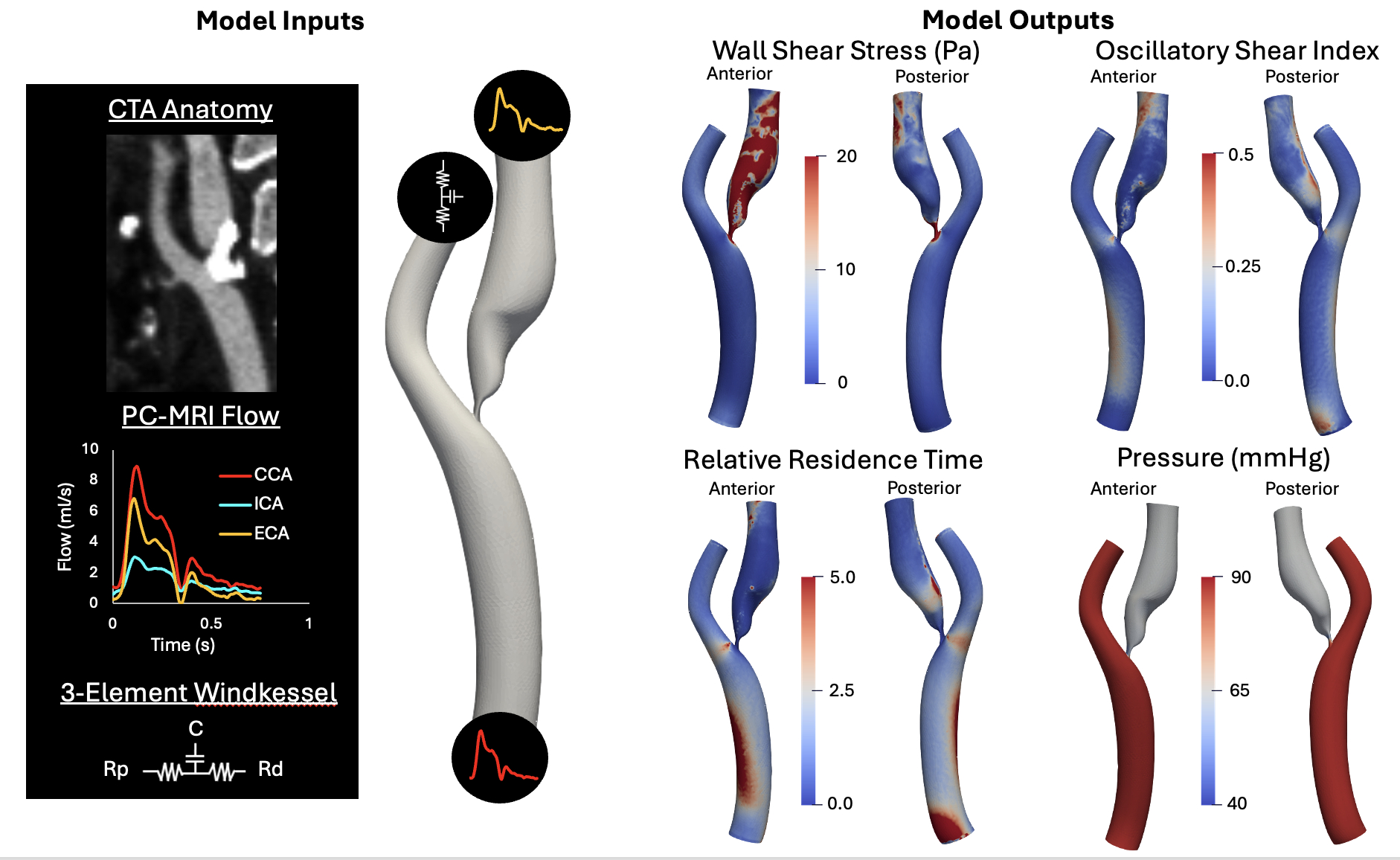
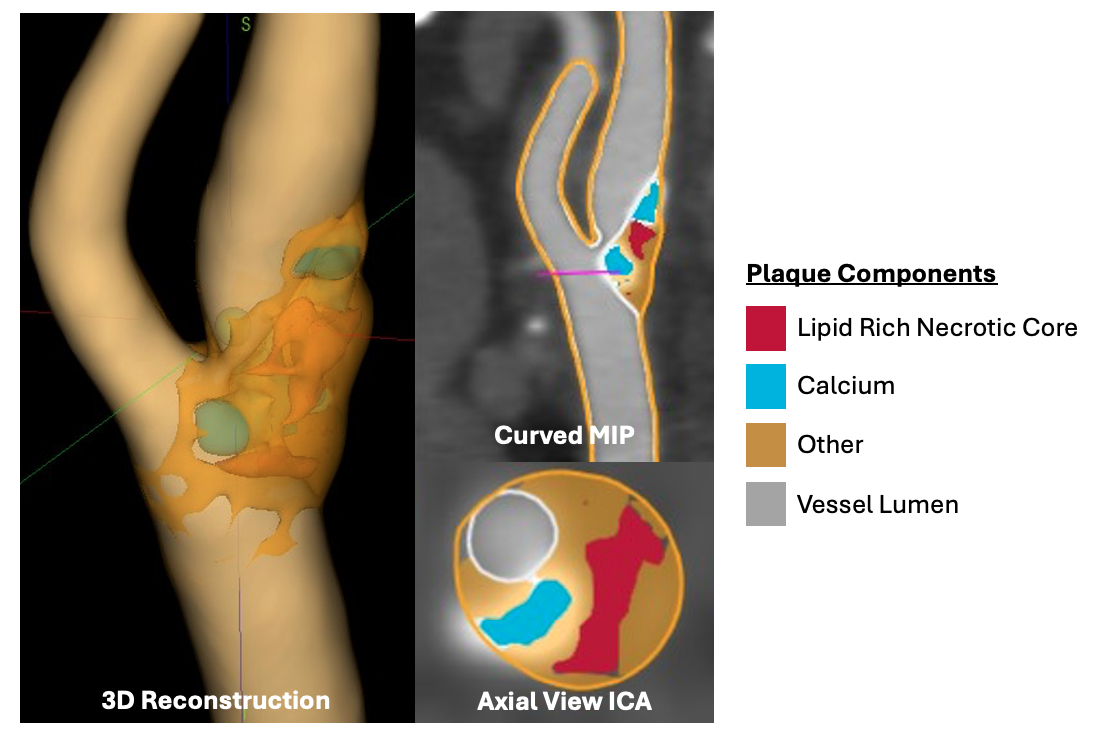
Methods: Patients with asymptomatic 40–99% ICA stenosis on CTA were prospectively enrolled for phase-contrast (PC) MRI and analysis using an MRI-informed computational fluid dynamics (CFD) protocol. Bilateral carotid bifurcation geometries were reconstructed from CTA. PC-MRI flow waveforms were prescribed at the common and external carotid arteries, with a 3-element Windkessel model applied at the ICA outlet. Navier–Stokes equations were solved to estimate velocity and pressure. WSS, OSI, RRT, and PR were quantified (Figure 1). PlaqueID (Elucid, Boston, MA) quantified plaque volume (PV), calcium, and lipid rich necrotic core (LRNC) (Figure 2). Principal component (PC) analysis of standardized hemodynamic metrics was performed to reduce collinearity. Multivariable models assessed associations between hemodynamics and plaque morphology.
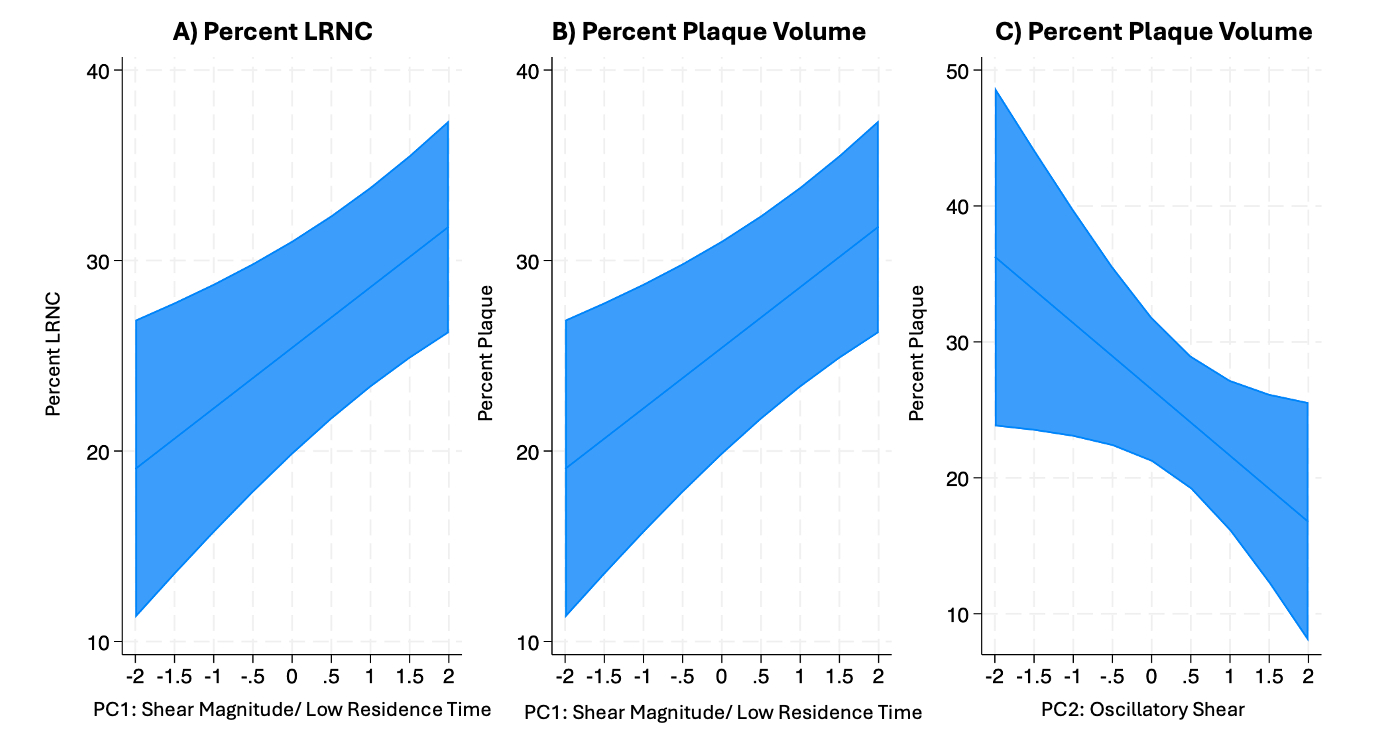
Results: Thirty arteries from 23 patients (78.3% male) were included. Median % of stenosis, PV, LRNC, and calcium were, 75.1(61.9-82.6)%, 23.9(15.4-37.2)%, 11.1(4.4-26.7)%, and 15.3(8.3-29.1)%, respectively. Median WSS was 5.6 (3.7-14.4) Pa, OSI was 0.039 (0.018-0.054), RRT was 0.19 (0.07-0.30), and PR was 0.97 (0.92-0.99). %stenosis was not associated with plaque morphology nor PV. PC1 reflected WSS magnitude and RRT (higher values indicating sustained shear and shorter residence time), while PC2 reflected OSI. PC1 was independently associated with higher LRNC (β=2.49% per SD, p=0.020) and PV (β=3.18% per SD, p=0.002) (Figure 3). PC2 was inversely associated with PV (β=−4.88% per SD, p=0.042) but not LRNC.
Conclusions: ICA hemodynamics are associated with both overall plaque burden and vulnerable features, such as LRNC. Shear-magnitude related forces are strongly linked to plaque and LRNC growth, while oscillatory shear may affect PV without promoting LRNC. Assessment of ICA hemodynamics and plaque morphology may better identify unstable ICA plaques at risk of embolism.
Braet, Drew
(
University of Michigan
, Ann Arbor , Michigan , United States )
Delbono, Luciano
(
University of Michigan
, Ann Arbor , Michigan , United States )
Bhagat, Aryan
(
University of Michigan
, Ann Arbor , Michigan , United States )
Dandu, Vivek
(
University of Michigan
, Ann Arbor , Michigan , United States )
Karam, Aarav
(
University of Michigan
, Ann Arbor , Michigan , United States )
Henke, Peter
(
University of Michigan
, Ann Arbor , Michigan , United States )
Figueroa, C
(
University of Michigan
, Ann Arbor , Michigan , United States )
Author Disclosures:
Drew Braet:DO NOT have relevant financial relationships
| Luciano Delbono:No Answer
| Aryan Bhagat:DO NOT have relevant financial relationships
| Vivek Dandu:No Answer
| Aarav Karam:DO NOT have relevant financial relationships
| Peter Henke:DO NOT have relevant financial relationships
| C Figueroa:No Answer