Logo

American Heart Association

  19
  0


Final ID: 4335849

Improvements in Diagnostic and Therapeutic Cardiovascular Risk Assessment Through Total Plaque Volume Burden: An Analysis of the Fish&Chips Study

Abstract Body (Do not enter title and authors here): Background:
Quantitative coronary plaque analysis from coronary computed tomographic angiography (CCTA) is a promising strategy for individualized cardiovascular disease (CVD) prevention. More population-level data is needed on how plaque burden can inform lipid lowering strategies to reduce CVD risk reduction.

Objectives:
To evaluate the prognostic utility of a total plaque volume (TPV)-based risk staging system and model its use in guiding lipid-lowering therapy in real-world patients undergoing clinically indicated CCTAs for evaluation of chest pain.

Methods:
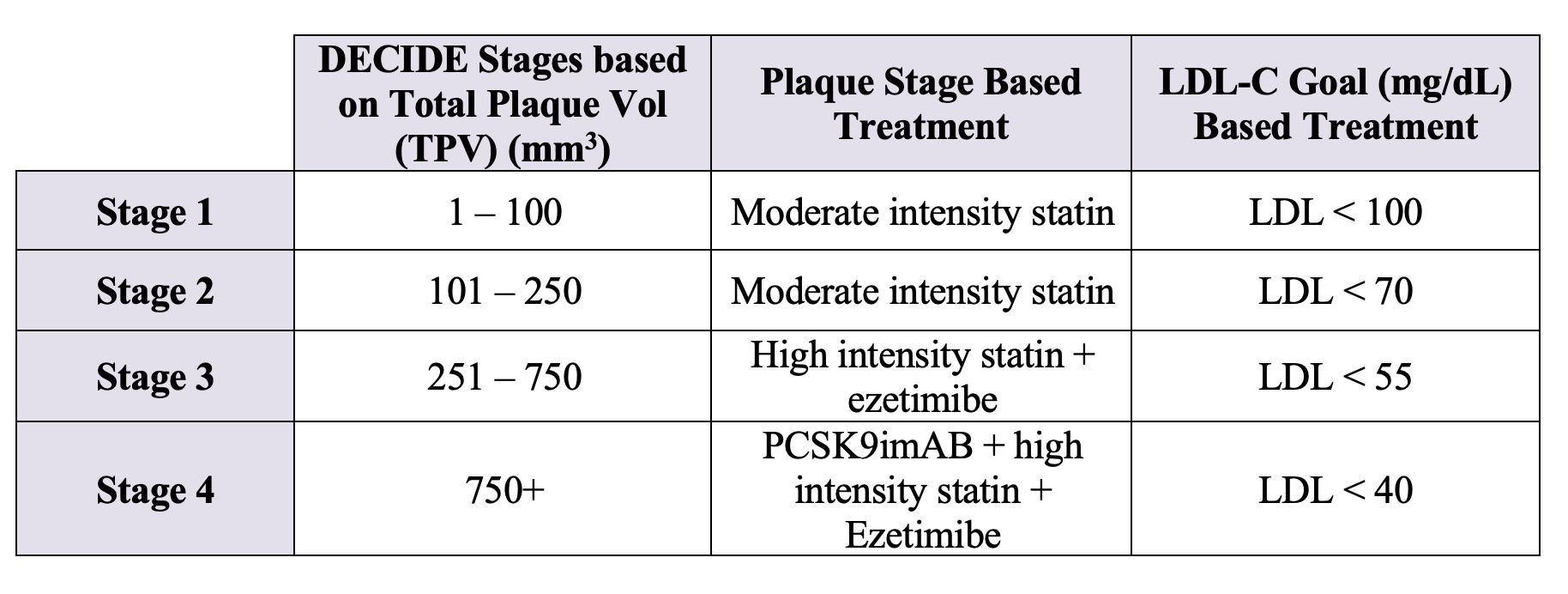
We analyzed adult patients across a single-center NHS site who underwent clinically indicated CCTA with available AI-based quantitative plaque analysis. TPV was categorized into four risk stages (DECIDE 1–4) using predefined thresholds (Table 1). The primary outcome was cardiac death or non-fatal MI. Secondary analyses reclassified prior myocardial infarction (MI) or early revascularization into DECIDE Stage 4. We modeled lipid-lowering strategies using both fixed-intensity treatment by DECIDE stage and stage-specific LDL-C goals to estimate risk reduction and number needed to treat (NNT) over 3-to-10-year durations.

Results:
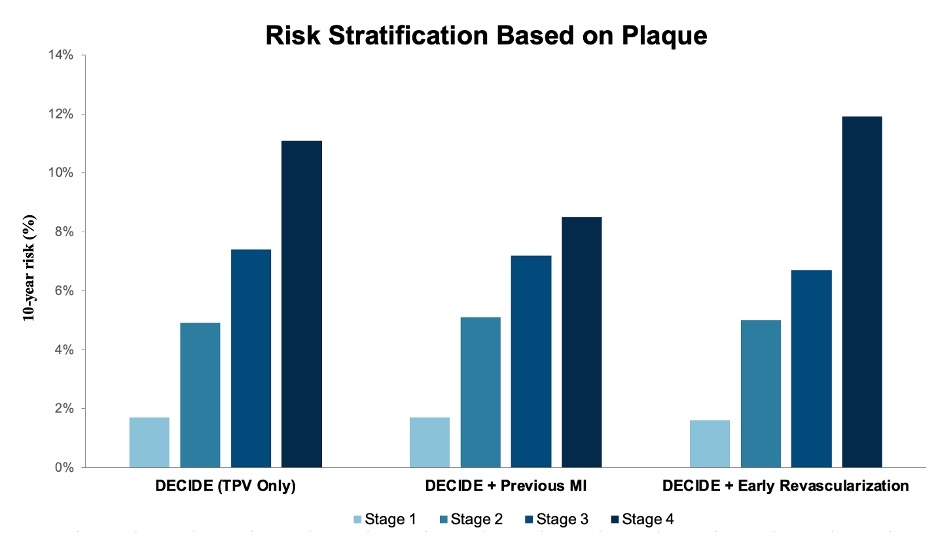
Among the 2,827 patients, mean (SD) age was 58 (13) years, and 51.1% were female. Higher TPV stages were associated with progressively increased risk of CV death or MI (1.7%, 4.9%, 7.4%, 11.1% for stages 1–4, respectively) (Figure 1). The fixed intensity strategy yielded a 10-year NNT of 52, which improved to 42 when using a stage-specific LDL-C goal strategy guided by plaque burden.

Conclusions:
Quantitative plaque burden measured by AI-enabled CCTA identifies patients at elevated long-term cardiovascular risk and may inform a personalized lipid-lowering strategy to mitigate risk.
  • Parsa, Shyon  ( Stanford University Hospital , Stanford , California , United States )
  • Peng, Allison  ( Johns Hopkins School of Medicine , Baltimore , Maryland , United States )
  • Fairbairn, Timothy  ( Liverpool Heart and Chest Hospital , Liverpool , United Kingdom )
  • Bell, Jack  ( Liverpool Heart and Chest Hospital , Liverpool , United Kingdom )
  • Sengupta, Souma  ( Heartflow , San Carlos , California , United States )
  • Mullen, Sarah  ( Heartflow , San Carlos , California , United States )
  • Rogers, Campbell  ( HeartFlow , Westwood , California , United States )
  • Martin, Seth  ( Johns Hopkins School of Medicine , Baltimore , Maryland , United States )
  • Rodriguez, Fatima  ( Stanford University Hospital , Stanford , California , United States )
  • Author Disclosures:
    Shyon Parsa: DO NOT have relevant financial relationships | Allison Peng: DO NOT have relevant financial relationships | Timothy Fairbairn: No Answer | Jack Bell: No Answer | Souma Sengupta: DO have relevant financial relationships ; Employee:Heartflow:Active (exists now) | Sarah Mullen: DO have relevant financial relationships ; Employee:Heartflow:Active (exists now) | Campbell Rogers: DO have relevant financial relationships ; Employee:Heartflow:Active (exists now) ; Individual Stocks/Stock Options:Heartflow:Active (exists now) ; Executive Role:Heartflow:Active (exists now) | Seth Martin: DO have relevant financial relationships ; Consultant:Amgen, Arrowhead Pharmaceuticals, AstraZeneca, Care Access, Chroma, Bristol Myers Squibb, Heartflow, Kaneka, Merck, NewAmsterdam Pharma, Novartis, Novo Nordisk, Premier, Sanofi, Verve Therapeutics, :Past (completed) ; Ownership Interest:Corrie Health, Prevent Medical:Active (exists now) ; Other (please indicate in the box next to the company name):American Heart Association (Immediate Past Chair, EPI Statistics Committee):Active (exists now) ; Other (please indicate in the box next to the company name):National Lipid Association (SELA President):Active (exists now) ; Other (please indicate in the box next to the company name):Editorial Board Member (AJPC, EJPC, JCL):Active (exists now) ; Research Funding (PI or named investigator):National Institutes of Health, Patient-Centered Outcomes Research Institute, American Heart Association, American College of Cardiology:Active (exists now) ; Employee:Johns Hopkins School of Medicine :Active (exists now) ; Other (please indicate in the box next to the company name):National Institutes of Health Data Safety and Monitoring Board:Active (exists now) | Fatima Rodriguez: DO have relevant financial relationships ; Consultant:HealthPals:Past (completed) ; Consultant:Cleerly Health:Active (exists now) ; Consultant:Amgen:Active (exists now) ; Consultant:iRhythm:Active (exists now) ; Consultant:HeartFlow:Active (exists now) ; Consultant:Arrowhead Pharmaceuticals:Active (exists now) ; Consultant:Edwards:Active (exists now) ; Consultant:Inclusive Health:Active (exists now) ; Consultant:Esperion Therapeutics:Past (completed) ; Consultant:Kento Health:Active (exists now) ; Consultant:Movano Health:Active (exists now) ; Consultant:NovoNordisk:Past (completed) ; Consultant:Novartis:Active (exists now)
Meeting Info:

Scientific Sessions 2025

2025

New Orleans, Louisiana

Session Info:
More abstracts on this topic:
More abstracts from these authors:
Cost-Effectiveness of AI-Enabled Coronary Plaque Analysis for Management of Stable Coronary Artery Disease

Baron Suzanne, Rogers Campbell, D'attilio Daniel, Sengupta Souma, Fairbairn Timothy

Treatment Implications of LDL-Cholesterol and Apolipoprotein B Discordance: Insights from the Very Large Database of Lipids (VLDbL) and the National Health and Examination Survey (NHANES)

Peng Allison, Blumenthal Roger, Martin Seth, Zahid Sohail, Gianos Eugenia, Shapiro Michael, Navar Ann Marie, Marvel Francoise, Rodriguez Fatima, Soffer Daniel, Morris Pamela

You have to be authorized to contact abstract author. Please, Login
Not Available