Logo

American Heart Association

  19
  0


Final ID: MP1788

Novel Foundation Models for Detecting and Generating Text Reports of Atrial Fibrillation from 12-lead ECGs in a Large Registry

Abstract Body (Do not enter title and authors here): Background:
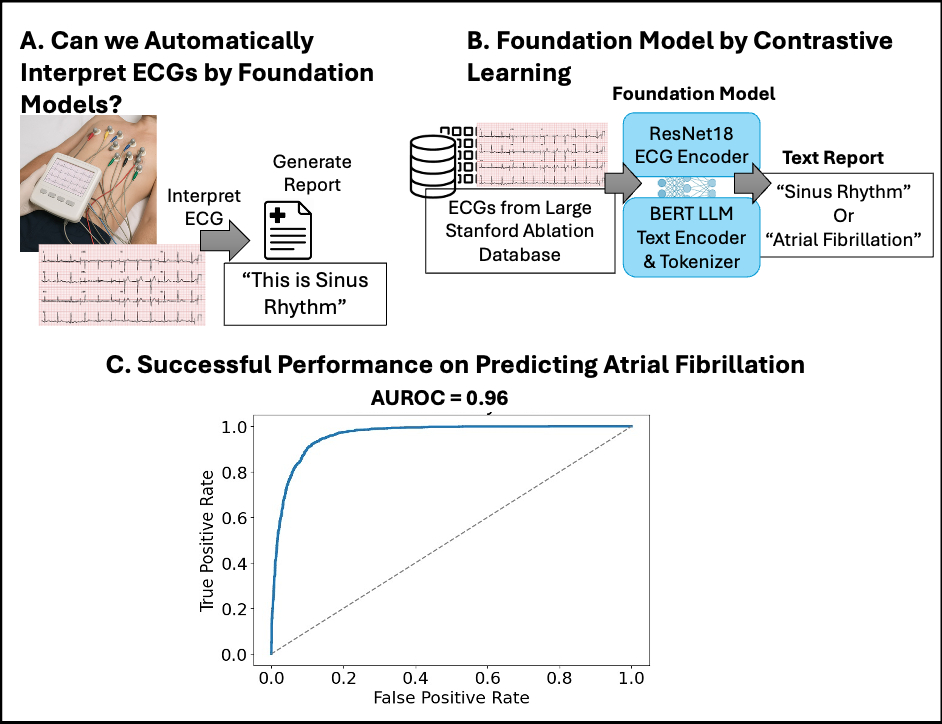
Foundation models have shown strong potential for clinical tasks in early studies. However, few foundation models have been reported that automatically detect atrial fibrillation (AF) in patients with abnormal electrocardiograms (ECGs) such as patients with prior ablation or structural heart disease (fig. A).

Objective:
To develop a joint ECG- free text generative model, developed from pre-trained foundation models using 12-lead ECGs in a large registry of patients with prior ablation, advanced AF in sinus rhythm (SR) and using antiarrhythmic medications, to classify and produce text reports of “sinus rhythm” or “atrial fibrillation”.

Methods:
We collected N=6,302 12-lead ECGs in a registry of N=803 patients undergoing catheter ablation for AF. 73% ECGs were recorded in SR and 27% as AF. We split the dataset into 70% for training and 30% for hold-out testing. We developed a custom ECG-text model using ResNet-18 based model for ECG encoding, and BERT foundation model for text encoding and tokenization (Fig. B). We integrated the embeddings of ECG and text into a 256-D joint embedding space using a MLP projection head. Model performance was assessed on hold-out test set by comparing the output text to the rhythm diagnosis in ECG report.

Results:
The population had age 65.3+/-10.6 years, and 28.0% were female, 61.8% non-paroxysmal AF, and 35.9% had previous ablation. The model showed successful classification performance on the test set with accuracy of 93.3% and F1 score of 0.919 compared to the clinical readings of experts (fig. C). AUROC for predicting atrial fibrillation was 0.961, and sensitivity, specificity, PPV and NPV were 0.958, 0.924, 0.821, 0.984 respectively.

Conclusion:
A novel foundation model was able to accurately classify and generate text reports of AF from the 12-lead ECG in patients with predominantly abnormal baseline ECGs. Such foundation models may be more generalizable than traditional deep learning AI-models, and could be used for screening and as the basis for clinical predictions.
  • Ganesan, Prasanth  ( Stanford Medicine , Palo Alto , California , United States )
  • Perino, Alexander  ( Stanford University , Stanford , California , United States )
  • Niederer, Steven  ( Imperial College London , London , United Kingdom )
  • Narayan, Sanjiv  ( STANFORD MEDICINE , Stanford , California , United States )
  • Peralta, Esteban  ( Stanford Medicine , Palo Alto , California , United States )
  • Ruiperez-campillo, Samuel  ( ETH Zurich , Zurich , Switzerland )
  • Bandyopadhyay, Sabyasachi  ( Stanford University , Palo Alto , California , United States )
  • Rogers, Albert  ( Stanford University , Redwood City , California , United States )
  • Chang, Hui Ju  ( Stanford University , Stanford , California , United States )
  • Brennan, Kelly  ( Stanford University , San Francisco , California , United States )
  • Sillett, Charlie  ( Imperial College London , London , United Kingdom )
  • Clopton, Paul  ( Stanford Medicine , Palo Alto , California , United States )
  • Author Disclosures:
    Prasanth Ganesan: DO have relevant financial relationships ; Royalties/Patent Beneficiary:Florida Atlantic University:Active (exists now) | Alexander Perino: DO have relevant financial relationships ; Consultant:J&J Medtech:Active (exists now) ; Research Funding (PI or named investigator):Orchestra Med:Active (exists now) ; Research Funding (PI or named investigator):Boston Scientific:Active (exists now) ; Consultant:Biotronik:Past (completed) ; Other (please indicate in the box next to the company name):Medtronic: Episode Review Committee:Past (completed) ; Other (please indicate in the box next to the company name):Abbott: Speaker, Research funding:Active (exists now) | Steven Niederer: DO have relevant financial relationships ; Research Funding (PI or named investigator):EBR systems:Past (completed) ; Research Funding (PI or named investigator):Ansys :Active (exists now) | Sanjiv Narayan: DO have relevant financial relationships ; Consultant:Lifesignals.ai:Active (exists now) ; Consultant:Abbott, Inc.:Past (completed) ; Consultant:PhysCade, Inc.:Active (exists now) | Esteban Peralta: DO NOT have relevant financial relationships | Samuel Ruiperez-Campillo: DO have relevant financial relationships ; Consultant:Physcade Inc:Active (exists now) ; Individual Stocks/Stock Options:Physcade Inc:Active (exists now) | Sabyasachi Bandyopadhyay: DO have relevant financial relationships ; Consultant:Linus Health Inc.:Past (completed) | Albert Rogers: DO have relevant financial relationships ; Research Funding (PI or named investigator):National Institutes of Health:Active (exists now) ; Advisor:YorLabs Inc:Active (exists now) ; Advisor:WearLinq Inc.:Active (exists now) ; Research Funding (PI or named investigator):American Heart Association:Active (exists now) | Hui Ju Chang: DO NOT have relevant financial relationships | Kelly Brennan: DO NOT have relevant financial relationships | Charlie Sillett: DO NOT have relevant financial relationships | Paul Clopton: No Answer
Meeting Info:

Scientific Sessions 2025

2025

New Orleans, Louisiana

Session Info:

Innovations and Safety Considerations in Cardiac Implantable Electronic Devices

Sunday, 11/09/2025 , 03:15PM - 04:30PM

Moderated Digital Poster Session

More abstracts on this topic:
A Novel Composite Artificial Intelligence-Electrocardiography Risk Score Is Independently Associated with Mortality in Chronic Tricuspid Regurgitation

Ciobanu Andrea, Pellikka Patricia, Kane Garvan, Pislaru Sorin, Anand Vidhu, Naser Jwan, Wood Julia, Friedman Paul, Vinereanu Dragos, Nkomo Vuyisile, Pislaru Cristina, Lara-breitinger Kyla, Thaden Jeremy

A Rare Case of Genetic Cardiomyopathy: SCN5A mutation-associated Multifocal Ectopic Premature Purkinje-related Complexes Syndrome with Heart Failure with Improved Ejection Fraction

Osei Albert, Howard Ato, Bhonsale Aditya, Hickey Gavin

More abstracts from these authors:
Large Language Models Detect Ventricular Tachycardia Recurrence in Clinical Notes and Enable Prediction of Clinical Outcomes at Scale

Sadri Shirin, Wang Paul, Clopton Paul, Rogers Albert, Narayan Sanjiv, Brennan Kelly, Bandyopadhyay Sabyasachi, Desai Yaanik, Ganesan Prasanth, Peralta Esteban, Feng Ruibin, Sillett Charlie, Ruiperez-campillo Samuel

AI-based prediction of mortality in patients with ventricular tachycardia

Bandyopadhyay Sabyasachi, Narayan Sanjiv, Sadri Shirin, Brennan Kelly, Ganesan Prash, Clopton Paul, Ruiperez-campillo Samuel, Peralta Esteban, Sillett Charlie, Rogers Albert

You have to be authorized to contact abstract author. Please, Login
Not Available