Large Language Models Detect Ventricular Tachycardia Recurrence in Clinical Notes and Enable Prediction of Clinical Outcomes at Scale
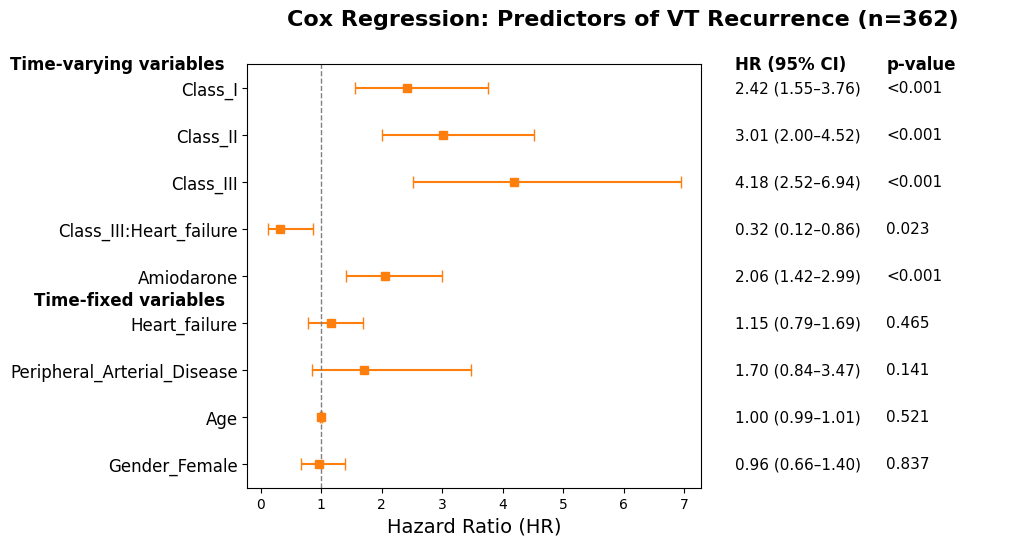
Abstract Body (Do not enter title and authors here): Introduction: Predicting recurrence in patients with Ventricular Tachycardia (VT) remains challenging, and manual screens of clinical notes are laborious. Advances in natural language processing, particularly Large Language Models (LLMs), offer potential solutions for automating VT detection from notes on large scale, and correlating clinical outcomes. Hypothesis: LLMs can detect VT recurrence events - as opposed to baseline VT - from clinical notes with accuracy comparable to physicians, and LLM-based detection can facilitate large-scale outcome prediction. Methods: A VT ablation registry of clinical notes of N=362 patients (20,303 Notes, 25.2% female, mean age 58.6±14.0 years) was examined. A development cohort of 100 notes was independently annotated by 3 board-certified physician reviewers for reference. Using a HIPAA compliant GPT-4o, we evaluated 4 prompt variations in this subset against physician annotations, then applied the optimal prompt to the full 20,203 notes. Baseline demographics were assessed at time of VT diagnosis, and quarterly use of AADs 3 years post-VT was assessed. Predictors of first VT recurrence were evaluated using multivariate Cox regression with time-varying medication use. Results: Inter-rater reliability in the development cohort was substantial with a Cohen's kappa of 0.74. The optimal prompt achieved an accuracy of 92%, sensitivity of 94%, specificity of 90%, positive predictive value 90%, negative predictive value 94%, and F1 score of 92%. Applying the optimized prompt to the entire cohort, we identified a total of 232 of patients with first VT recurrence 515±889 days from diagnosis. Using LLM-generated detection of VT recurrence, Cox regression revealed that the strongest predictor of VT recurrence was time-varying exposure to class I (hazard ratio [HR] 2.42, 95% CI 1.55-3.76, p<0.001), class II (HR 3.01, 95%CI 2.00-4.52, p<0.001), class III (HR 4.18, 95%CI 2.52-6.94, p<0.001), and amiodarone (HR 2.06, 95%CI 1.42-2.99, p<0.001). A significant negative interaction between class III agents and heart failure was found, indicating a lower-risk heart failure subgroup of patients on class IIIs. Conclusions: LLM can enable the study of VT recurrence and associated factors at scale. Anti-arrhythmics were predictors of recurrence with evidence of effect modification considering co-morbidity in a large registry. This approach may enable targeted interventions and personalized patient management strategies to improve clinical outcomes.
Sadri, Shirin
(
Stanford University
, Mountain View , California , United States )
Brennan, Kelly
(
Stanford University
, San Francisco , California , United States )
Bandyopadhyay, Sabyasachi
(
Stanford University
, Palo Alto , California , United States )
Desai, Yaanik
(
STANFORD FALK CVRC
, Stanford , California , United States )
Ganesan, Prasanth
(
Stanford Medicine
, Palo Alto , California , United States )
Peralta, Esteban
(
Stanford University
, Mountain View , California , United States )
Feng, Ruibin
(
Stanford University
, Palo Alto , California , United States )
Sillett, Charlie
(
Stanford University
, Mountain View , California , United States )
Ruiperez-campillo, Samuel
(
Stanford University
, Mountain View , California , United States )
Wang, Paul
(
Stanford University
, Stanford , California , United States )
Clopton, Paul
(
Stanford University
, Stanford , California , United States )
Rogers, Albert
(
Stanford University
, Redwood City , California , United States )
Narayan, Sanjiv
(
STANFORD MEDICINE
, Stanford , California , United States )
Author Disclosures:
Shirin Sadri:DO NOT have relevant financial relationships
| Paul Wang:DO have relevant financial relationships
;
Individual Stocks/Stock Options:Soneira:Active (exists now)
; Ownership Interest:EndoEpiAF:Active (exists now)
; Ownership Interest:HrtEx:Active (exists now)
| Paul Clopton:No Answer
| Albert Rogers:DO have relevant financial relationships
;
Research Funding (PI or named investigator):National Institutes of Health:Active (exists now)
; Advisor:YorLabs Inc:Active (exists now)
; Advisor:WearLinq Inc.:Active (exists now)
; Research Funding (PI or named investigator):American Heart Association:Active (exists now)
| Sanjiv Narayan:DO have relevant financial relationships
;
Consultant:Lifesignals.ai:Active (exists now)
; Consultant:Abbott, Inc.:Past (completed)
; Consultant:PhysCade, Inc.:Active (exists now)
| Kelly Brennan:DO NOT have relevant financial relationships
| Sabyasachi Bandyopadhyay:DO have relevant financial relationships
;
Consultant:Linus Health Inc.:Past (completed)
| Yaanik Desai:No Answer
| Prasanth Ganesan:DO have relevant financial relationships
;
Royalties/Patent Beneficiary:Florida Atlantic University:Active (exists now)
| Esteban Peralta:DO NOT have relevant financial relationships
| Ruibin Feng:No Answer
| Charlie Sillett:DO NOT have relevant financial relationships
| Samuel Ruiperez-Campillo:DO have relevant financial relationships
;
Consultant:Physcade Inc:Active (exists now)
; Individual Stocks/Stock Options:Physcade Inc:Active (exists now)