A Population-based Multi-Scale Drug-Induced Cardiotoxicity Detection Platform
Abstract Body (Do not enter title and authors here): BACKGROUND: The cardiotoxicity of drugs, which often leads to fatal arrhythmias such as torsade de pointes (TdP), is a major cause of drug recalls. The current detection of human ether-a-go-go-related gene (hERG) potassium channels is excessively sensitive, creating an urgent need for an effective and rapid in vitro evaluation tool. Despite progress in population models of cardiomyocytes, there is a lack of direct evaluation with electrophysiological multi-scale population models.
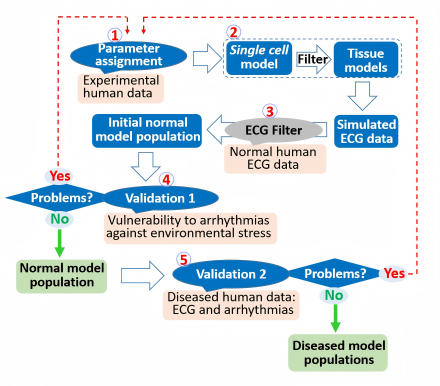
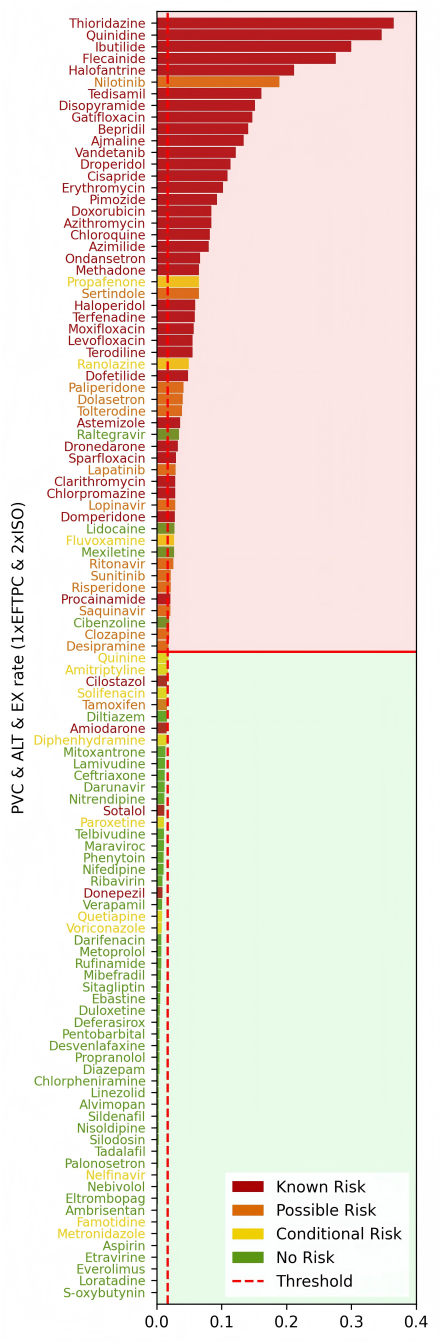
METHODS AND RESULTS: We developed a multi-scale cardiac electrophysiological simulation platform to directly evaluate the cardiac toxicity of generic drugs. This platform consists of 1D cable, 2D tissue, and 3D organ scales. Initially, we stochastically generated parameters within ranges constrained by literature searches, such as ion channel conductance, and subsequently assessed pseudo-ECG morphology, myocardial cell membrane voltage, etc., to eliminate aberrant samples. We then incorporated isoprenaline (ISO) and paced at various cycle periods to evaluate the robustness of individual samples under different physiological conditions like exercise or sleep. After passing all these tests, a remaining cohort of over 400,000 individuals was identified, virtually representing the drug-free normal population. We utilized a dataset comprising 109 drugs for experimental purposes, considering the impact of these drugs on multiple ion channels. We used the ratio of individuals observed with premature ventricular contractions (PVCs) to those without PVCs as the metric to evaluate drug risk. To test the generality of this method, we also performed pipeline simulations with different cardiac models and diverse effective free therapeutic plasma concentrations (EFTPC). For example, at 1xEFTPC and 2xISO, the ToR-ORd model achieved an accuracy of 89.0%, a specificity of 93.1%, and a sensitivity of 90.2%. Further increases in EFTPC generally resulted in improved overall performance. We investigated and explained the outliers of prediction.
CONCLUSIONS: Our platform presents a novel approach for detecting drug-induced cardiotoxicity. We established a robust population dataset for detecting drug toxicity via rigorous filtration. Although the cardiac model types, drug EFTPC, and specific IC50 values influence the result accuracy, our platform performance is sufficiently reliable to effectively identify high-risk drugs during early-stage development, thereby reducing costs and shortening timelines.
Song, Zhen
(
Pengcheng Laboratory
, Shenzhen , China )
Sui, Fengze
(
Harbin Institute of Technology
, Shenzhen , China )
Huang, Xiaodong
(
South China University of Technology
, Guangzhou , China )
Liu, Michael
(
Stanford University
, Stanford , California , United States )
Qu, Zhilin
(
UCLA
, Los Angeles , California , United States )
Author Disclosures:
Zhen Song:DO NOT have relevant financial relationships
| Fengze Sui:DO NOT have relevant financial relationships
| Xiaodong Huang:DO NOT have relevant financial relationships
| Michael Liu:No Answer
| Zhilin Qu:DO NOT have relevant financial relationships