A Novel Composite Artificial Intelligence-Electrocardiography Risk Score Is Independently Associated with Mortality in Chronic Tricuspid Regurgitation
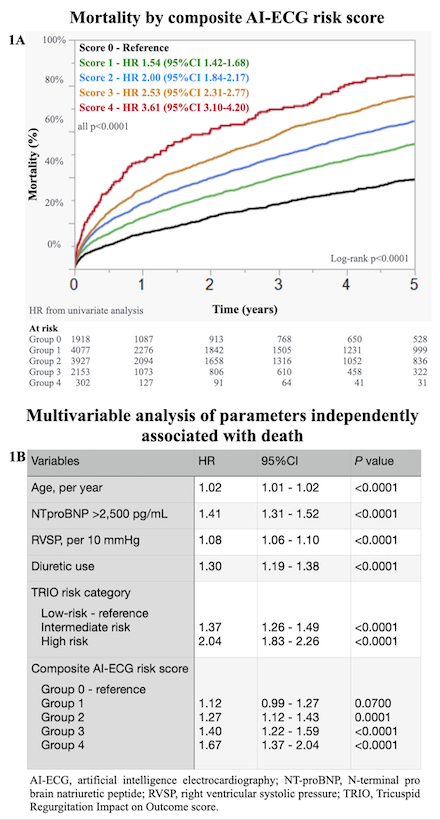
Abstract Body (Do not enter title and authors here): Background. Tricuspid regurgitation (TR) is associated with significant morbidity, but individualized treatment and timing of intervention are yet to be defined. We previously proposed and validated artificial intelligence electrocardiography (AI-ECG) scores for various diseases. Whether incorporating AI-ECG information adds to risk stratification above and beyond classical clinical parameters is unknown. Objectives. To identify AI-ECG scores independently associated with all-cause mortality in chronic TR and to create a composite AI-ECG risk score. Methods. Patients with a first echocardiographic diagnosis of ≥moderate TR between 2005-2016 and an ECG within ±15 days were included. The Tricuspid Regurgitation Impact on Outcome (TRIO) score was calculated as previously described based on 8 simple parameters (age, sex, severe TR, heart failure, lung disease, heart rate, creatinine and AST). AI-ECG probabilities of low ejection fraction, aortic stenosis, amyloid, cirrhosis, atrial fibrillation and hypertrophic cardiomyopathy were estimated by existing algorithms; the first 4 were associated with all-cause mortality and a composite AI-ECG risk score was calculated (0-4; 1 point for each AI-ECG above specific threshold). Results. A total of 12,377 pts were included (age 72±13 yrs, 55% women). Over a median follow-up of 1.3 yrs (IQR 0.1 to 4.4), 7,121 pts (58%) died. Mortality risk increased significantly with higher composite AI-ECG risk score (Fig. 1A). On multivariable analysis (proportional hazards method), the composite AI-ECG risk score remained independently associated with death, even after adjusting for age, sex, high NT-proBNP levels (>2,500 pg/mL), right ventricular systolic pressure (RVSP), diuretic use and TRIO risk score category (Fig. 1B). Conclusions. Patients with ≥moderate TR show progressively worse survival with increasing composite AI-ECG risk score. Incorporating AI-derived information from a simple and inexpensive ECG may identify patients with the highest risk of mortality beyond clinical risk scores as TRIO or classical clinical, laboratory and echocardiographic parameters. Prospective validation of this approach needs to be tested in future trials.
Ciobanu, Andrea
(
Mayo Clinic
, Rochester , Minnesota , United States )
Naser, Jwan
(
Mayo Clinic
, Rochester , Minnesota , United States )
Wood, Julia
(
Mayo Clinic
, Rochester , Minnesota , United States )
Friedman, Paul
(
Mayo Clinic
, Rochester , Minnesota , United States )
Vinereanu, Dragos
(
University and Emergency Hospital Bucharest
, Bucharest , Romania )
Nkomo, Vuyisile
(
Mayo Clinic
, Rochester , Minnesota , United States )
Pislaru, Cristina
(
Mayo Clinic
, Rochester , Minnesota , United States )
Lara-breitinger, Kyla
(
Mayo Clinic
, Rochester , Minnesota , United States )
Thaden, Jeremy
(
Mayo Clinic
, Rochester , Minnesota , United States )
Pellikka, Patricia
(
Mayo Clinic
, Rochester , Minnesota , United States )
Kane, Garvan
(
Mayo Clinic
, Rochester , Minnesota , United States )
Pislaru, Sorin
(
Mayo Clinic
, Rochester , Minnesota , United States )
Anand, Vidhu
(
Mayo Clinic
, Rochester , Minnesota , United States )
Author Disclosures:
Andrea Ciobanu:DO NOT have relevant financial relationships
| Patricia Pellikka:DO have relevant financial relationships
;
Research Funding (PI or named investigator):Edwards Lifesciences:Past (completed)
; Royalties/Patent Beneficiary:UpToDate:Active (exists now)
; Advisor:Alnylam:Active (exists now)
; Advisor:Astellas:Past (completed)
; Research Funding (PI or named investigator):Ultromics:Active (exists now)
| Garvan Kane:DO NOT have relevant financial relationships
| Sorin Pislaru:No Answer
| Vidhu Anand:No Answer
| Jwan Naser:No Answer
| Julia Wood:No Answer
| Paul Friedman:DO have relevant financial relationships
;
Other (please indicate in the box next to the company name):Anumana:Active (exists now)
; Other (please indicate in the box next to the company name):Eko Health:Active (exists now)
; Other (please indicate in the box next to the company name):AliveCor:Active (exists now)
| Dragos Vinereanu:No Answer
| Vuyisile Nkomo:No Answer
| Cristina Pislaru:No Answer
| Kyla Lara-Breitinger:No Answer
| Jeremy Thaden:No Answer