Evaluating Aldosterone Synthase Inhibitors in Hypertension: A Meta-Analysis of Efficacy, Safety, and Subgroup Outcomes Across Novel Agents
Abstract Body (Do not enter title and authors here): Background: Hypertension remains a leading risk factor for cardiovascular disease and mortality. Aldosterone, a critical mineralocorticoid hormone, regulates salt, water balance, and blood pressure. Aldosterone synthase inhibitor (ASI) are a novel class of drugs targeting this pathway to control blood pressure.
Hypothesis: This study is focused on the efficacy and safety of ASIs in the treatment of hypertension, with subgroup analysis based on drug type and patient population.
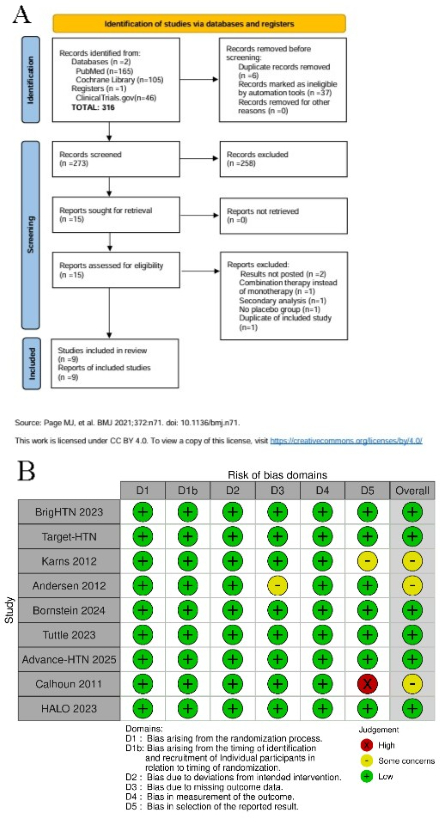
Methods: A comprehensive literature search was conducted using PubMed, Cochrane Library, and ClinicalTrials.gov for randomized controlled trials (RCT) published up to May 2025. Only RCTs comparing ASIs and placebo in adults (age > 18) with hypertension were included. Four different ASIs - lorundrostat, osilodrostat, baxdrostat, and vicadrostat- were evaluated across the included trials. Data analysis was performed on RevMan 5.4 using random-effects model with the Mantel-Haenszel statistical method to estimate the mean difference (MD) and 95 % confidence intervals between the drugs and placebo groups.
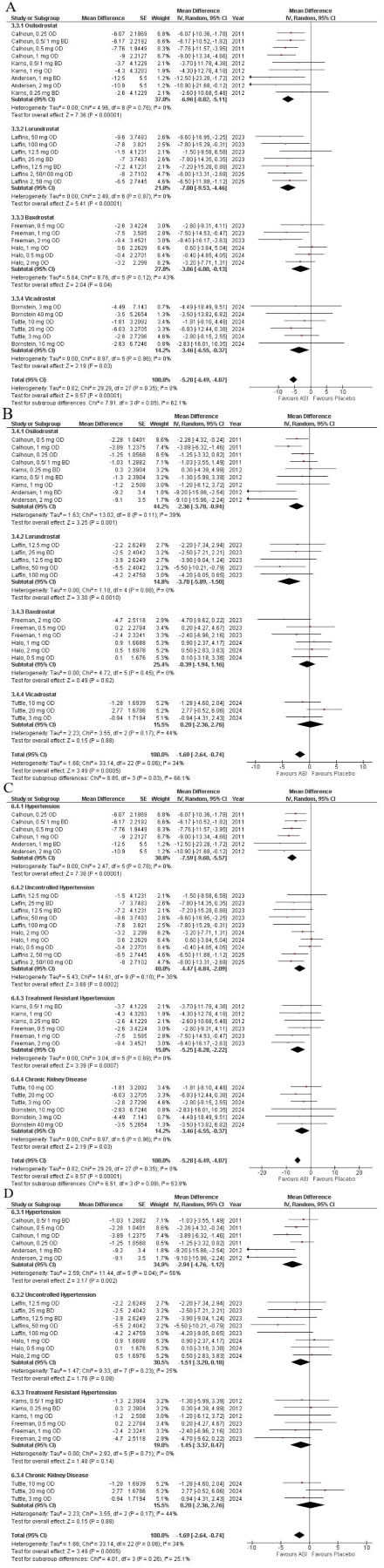
Results: Nine RCTs were included with a total of 1774 patients with hypertension (354 lurondrostat, 500 osilodrostat, 391 baxdrostat, 260 vicadrostat and 469 placebo). Pooled analysis found that ASIs significantly reduced systolic (MD: -5.28, 95% CI: -6.49, -4.07: p<0.00001) and diastolic BP (MD: -1.69, 95% CI: –2.64, -0.74: p=0.0005) with efficacy varying by agent and population. Among different agents, lorundrostat showed the most pronounced reduction in SBP (MD: -7.00, 95% CI: -9.53, -4.46: p<00001) and DBP (MD: -3.70, 95% CI: -5.89, -1.50: p=0.0010) while Baxdrostat showed the least reduction in SBP(MD: -3.06, 95% CI: -6.00, -0.13: p=0.04) and DBP(MD: -0.39, 95% CI: -1.94, 1.16: p=0.62) respectively. Amongst the patient population, SBP reduction was the highest in patients with essential hypertension (MD: -7.59, 95% CI: -9.60, -5.57; p<0.00001) and lowest in CKD patients (MD: -3.46, 95% CI: -6.55, -0.37; p=0.0010). Overall, the ASIs were well tolerated with no serious (RR: 0.81, 95% CI: 0.44, 1.49: p=0.49) or any adverse events (RR: 1.01, 95% CI: 0.83,1.24: p=0.90).
Conclusion: ASIs appear to be effective and well-tolerated antihypertensive agents, offering significant BP reduction across diverse patient groups, with lorundrostat demonstrating the strongest efficacy. These findings support further large-scale head-to-head trials to better define their role in hypertension management.
Italiya, Kevin
(
GMERS medical college, Valsad
, Surat , India )
Akhter, Haji Abdul Rehman
(
CMH Multan Institute of Medical Sciences
, Multan , Punjab , Pakistan )
Khan, Sheraz
(
Khyber Medical College Peshawar
, Peshawar , Pakistan )
Senk Juh, Amadej
(
University of Ljubljana
, Ljubljana , Slovakia )
Malik, Hammad Khalid
(
CMH Multan Institute of Medical Sciences
, Multan , Punjab , Pakistan )
Sivasubramanian, Dhiran
(
Children's Hospital of Philadelphia
, Philadelphia , Pennsylvania , United States )
Memon, Sibgha Fawad
(
Peoples Medical University
, Nawabshah , Pakistan )
Author Disclosures:
Kevin Italiya:DO NOT have relevant financial relationships
| Haji Abdul Rehman Akhter:DO NOT have relevant financial relationships
| Sheraz Khan:DO NOT have relevant financial relationships
| Shaurya Kamboj:DO NOT have relevant financial relationships
| Amadej Senk Juh:DO NOT have relevant financial relationships
| Hammad Khalid Malik:DO NOT have relevant financial relationships
| Dhiran Sivasubramanian :DO NOT have relevant financial relationships
| Sibgha Fawad Memon:DO NOT have relevant financial relationships