Logo

American Heart Association

  29
  0


Final ID: Su3004

Left Bundle Branch Area Pacing versus Biventricular Pacing in Cardiac Resynchronization Therapy: An Updated Systematic Review and Meta-Analysis

Abstract Body (Do not enter title and authors here): Background:
Left bundle branch area pacing (LBB-P) has emerged as a physiologically targeted alternative to biventricular pacing (BiV-P) for cardiac resynchronization therapy (CRT). We conducted an updated systematic review and meta-analysis to compare the impact of LBBAP versus BiV-P on clinical and procedural outcomes in patients undergoing CRT.
Research Question:
Does left bundle branch area pacing (LBBAP) provide superior clinical and procedural outcomes compared to biventricular pacing (BiV-P) in patients receiving cardiac resynchronization therapy?
Methods:
A systematic search of PubMed, Embase, and Cochrane Central was conducted in February 2025 to identify studies comparing LBB-P and BiV-P in patients undergoing CRT. Eligible studies included randomized and observational designs. Primary outcomes were all-cause mortality and heart failure–related hospitalization. Secondary outcomes included changes in QRS duration, Left ventricular ejection fraction (LVEF). Meta-analyses were performed using inverse-variance random-effects models. Heterogeneity was assessed using I2 and sensitivity was evaluated with leave-one-out analysis. Effect sizes were reported as relative risks (RR) or mean differences (MD) with corresponding 95% confidence intervals (CI).
Results:
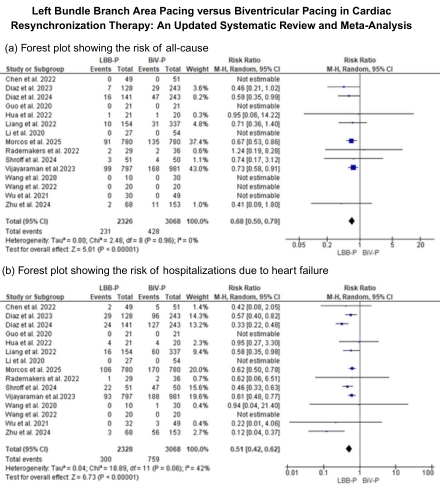
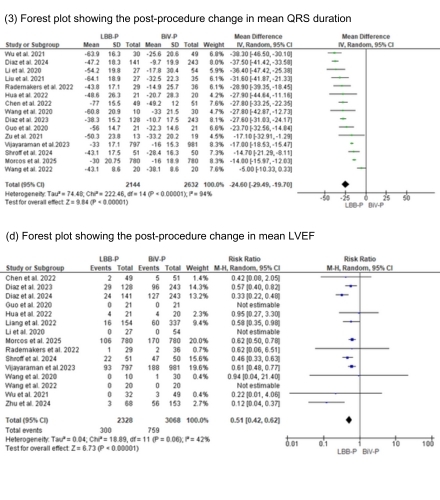
Nineteen studies (18 observational and 1 randomized controlled trial) encompassing 5605 patients (LBB-P= 2428 and BiV-P= 3177) were included in this meta-analysis. Compared to BiV-P, LBB-P was associated with a significantly lower risk of all-cause mortality (RR = 0.68, 95% CI: 0.59–0.79; p < 0.00001) and HF-related hospitalization (RR = 0.51, 95% CI: 0.42–0.62; p < 0.00001). LBB-P was also associated with a greater narrowing of QRS duration (mean difference: –24.60 ms, 95% CI: –29.49 to –19.70; p < 0.00001) and greater improvement in LVEF (mean difference: 4.71%, 95% CI: 3.80 to 5.61; p < 0.0001).
Conclusion:
This updated meta-analysis demonstrates that LBB-P is associated with significantly lower all-cause mortality and HF-related hospitalizations compared to BiV-P in patients undergoing CRT. LBB-P also offers procedural advantages and greater improvements in electrical and functional cardiac parameters. Further large-scale randomized trials are warranted to confirm these findings.
  • Kumar, Nomesh  ( DMC-Wayne State University , Detroit , Michigan , United States )
  • Kumar, Akash  ( Liaquat University of Medical and Health Sciences , Jamshoro , Pakistan )
  • Khan, Ahmed Ali  ( FUMC, Islamabad , Rawalpindi , Pakistan )
  • Ram, Fnu  ( Liaquat University of Medical and Health Sciences , Jamshoro , Pakistan )
  • Kumari, Nisha  ( Dow University of Health Sciences , Karachi , Pakistan )
  • Memon, Burhan  ( OSF Saint Francis Medical Center , Peoria , Illinois , United States )
  • Rana, Jamal  ( KAISER PERMANENTE , Oakland , California , United States )
  • Shah, Siddharth  ( University of Illinois College of Medicine , Peoria , Illinois , United States )
  • Alraies, M Chadi  ( Detroit Medical Center , Detroit , Michigan , United States )
  • Author Disclosures:
    Nomesh Kumar: DO NOT have relevant financial relationships | Akash Kumar: DO NOT have relevant financial relationships | Ahmed Ali Khan: DO NOT have relevant financial relationships | FNU RAM: DO NOT have relevant financial relationships | Nisha Kumari: No Answer | Burhan Memon: DO NOT have relevant financial relationships | Jamal Rana: DO NOT have relevant financial relationships | Siddharth Shah: No Answer | M Chadi Alraies: DO NOT have relevant financial relationships
Meeting Info:

Scientific Sessions 2025

2025

New Orleans, Louisiana

Session Info:

Conduction System Pacing: Shaping the Future of Physiologic Pacing

Sunday, 11/09/2025 , 11:30AM - 12:30PM

Abstract Poster Board Session

More abstracts on this topic:
Device Dislodgement and Embolization associated with a New Leadless Pacemaker

Bahbah Ali, Sengupta Jay, Witt Dawn, Zishiri Edwin, Zakaib John, Abdelhadi Raed, Hauser Robert


Conduction System Pacing: Short and Long-Term Clinical Outcomes in a Developing Country

Soares Sousa Daniel, Nascimento Bruno, Mesquita Leonardo, Diniz Thulio, Tostes Paulo, Silva Barbosa Rodrigo, Miranda Carlos, Brito Mitermayer, Andrade Yane, Lelis Sarah

More abstracts from these authors:
Closing or Widening the Gap? Racial, Demographic and Geographic Mortality Disparities in Heart Diseases and Cerebrovascular Diseases Across Two Decades in the U.S. (1999–2020)

Nankani Avinash, Alraies M Chadi, Mari Tahreem, Rizvi Syed, Khan Saifullah, Arshad Hassaan, Kumar Ajay, Kumar Nomesh, Sagheer Usman, Raheja Prafull

Catheter-Directed Intervention for High-Risk Acute Pulmonary Embolism in Chronic Kidney Disease

Kumar Manoj, Ricciardi Mark, Arman Qamar, Ali Shafaqat, Jamshed Aneeza, Murthi Mukunthan, Kumar Nomesh, Kumar Sanjay, Kumari Rinkle, Alraies M Chadi, Gomez Valencia Javier

You have to be authorized to contact abstract author. Please, Login
Not Available