Clinical Outcomes of Conduction System Pacing Versus Right Ventricular Pacing: A Systematic Review and Meta-Analysis of Initial Pacemaker Implantation
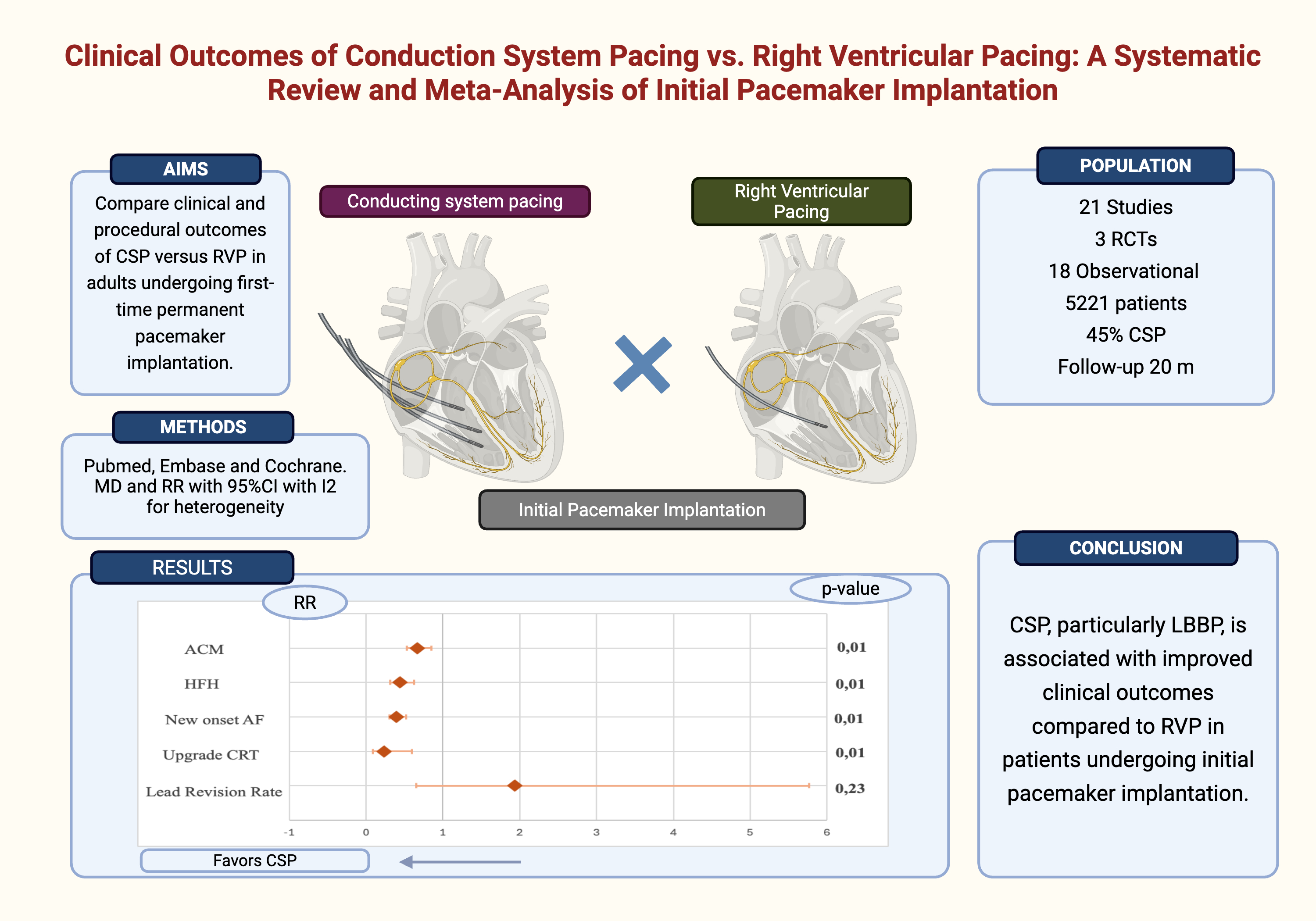
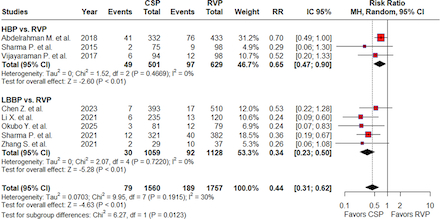
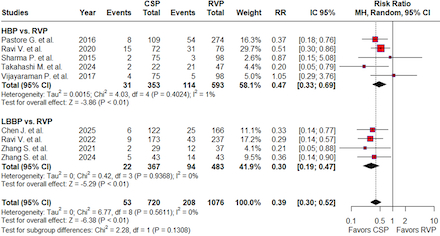
Abstract Body (Do not enter title and authors here): Background: Right ventricular pacing (RVP) is the standard approach for bradyarrhythmia but is linked to adverse outcomes like pacing-induced cardiomyopathy and heart failure. Conduction system pacing (CSP), including His bundle pacing (HBP) and left bundle branch pacing (LBBP), offers a more physiologic alternative. However, its comparative effectiveness and safety versus RVP remain uncertain. Research question: Does CSP improve clinical outcomes compared to RVP in patients receiving their first pacemaker? Aims: To compare clinical and procedural outcomes of CSP versus RVP in adults undergoing first-time permanent pacemaker implantation. Methods: We performed a systematic review and meta-analysis comparing CSP (HBP or LBBP) with RVP. Searches were conducted in PubMed, Embase, and Cochrane Library through April 2025. Outcomes included heart failure hospitalization (HFH), all-cause mortality, new-onset AF, upgrade to cardiac resynchronization therapy (CRT), left ventricular ejection fraction (LVEF) at follow-up, and lead revision rates. Random-effects models in R software (v4.4.1) were used to estimate risk ratios (RRs) or mean differences (MDs) with 95% confidence intervals (CIs). Subgroup analyses by pacing type (LBBP vs. HBP) were conducted. Results: Twenty-one studies (3 RCTs and 18 observational studies) comprising 5,232 patients were included, of whom 2,360 (45%) underwent CSP. Seven studies evaluated HBP (1,822 patients), and 14 evaluated LBBP (3,399 patients). The mean follow-up was 20 months. CSP was associated with significantly lower risks of HFH (RR 0.44; 95% CI 0.31–0.62; p < 0.01; Figure 2), new-onset AF (RR 0.39; 95% CI 0.30–0.52; p<0.01; Figure 3), all-cause mortality (RR 0.67; 95% CI 0.53–0.85; p=0.01), and upgrade to CRT (RR 0.23; 95% CI 0.09–0.60; p<0.01). LVEF was significantly higher in the CSP group (MD 2.13%; 95% CI 0.48–3.79; p=0.01). No significant difference was observed in lead revision rates (RR 1.94; 95% CI 0.65–5.77; p=0.23). Subgroup analyses showed the superiority of LBBP over HBP for all outcomes (pinteraction<0.01), except for new-onset AF and LVEF improvement (pinteraction>0.05). HBP was associated with a higher lead revision rate than LBBP (pinteraction<0.01). Conclusion: CSP, particularly LBBP, is associated with improved clinical outcomes compared to RVP in patients undergoing initial pacemaker implantation. These findings support CSP as a more physiologic pacing strategy with a favorable safety and efficacy profile.
Fernandes Oliveira Amador, Wellgner
(
Universidade Federal de Campina Grande
, Cajazeiras , Brazil )
Iqbal, Asad
(
Bacha Khan Medical College
, Mardan , Pakistan )
Oliveira Fonseca, Pandora Eloa
(
Universidade Federal de Campina Grande
, Cajazeiras , Brazil )
Bisneto, Oscar
(
Universidade Federal de Campina Grande
, Cajazeiras , Brazil )
Itaya, Eduardo Dan
(
University of Connecticut
, Farmington , Connecticut , United States )
Oliveira Carneiro, Alexandre
(
Federal University of Uberlandia
, Uberlandia , Brazil )
Giorgi, Juliana
(
HOSPITAL SIRIO LIBANES
, Sao Paulo , Brazil )
Assis, Theodora
(
State University of Campinas
, Campinas , Brazil )
Cruz Akabane, Maria Antonia
(
Federal University of Juiz de Fora
, Juiz de Fora , Brazil )
Queiroga, Flavia
(
Emory University School of Medicine
, Atlanta , Georgia , United States )
Arrighini, Giang Son
(
University of Bologna
, Bologna , Italy )
Odozynski, Gabriel
(
Harvard-Thorndike Electrophysiology Institute, Beth Israel Deaconess Medical Center, Harvard Medical School
, Boston , Massachusetts , United States )
Author Disclosures:
Wellgner Fernandes Oliveira Amador:DO NOT have relevant financial relationships
| Flavia Queiroga:DO NOT have relevant financial relationships
| Giang Son Arrighini:DO NOT have relevant financial relationships
| Gabriel Odozynski:No Answer
| Asad Iqbal:No Answer
| Pandora Eloa Oliveira Fonseca:No Answer
| Oscar Bisneto:No Answer
| Eduardo Dan Itaya:DO NOT have relevant financial relationships
| Alexandre Oliveira Carneiro:DO NOT have relevant financial relationships
| Juliana Giorgi:DO NOT have relevant financial relationships
| Theodora Assis:DO NOT have relevant financial relationships
| Maria Antonia Cruz Akabane:DO NOT have relevant financial relationships