Impact of Glucagon-like peptide-1 receptor agonists (GLP-1 RAs) on patients with Heart failure with Preserved Ejection Fraction and End Stage renal disease on dialysis. A propensity-matched analysis
Abstract Body (Do not enter title and authors here): Background: Patients with end stage renal disease (ESRD) on dialysis who also have heart failure with preserved ejection fraction (HFpEF) face disproportionately high rates of cardiovascular morbidity and mortality. Glucagon-like peptide-1 receptor agonists (GLP-1 RAs) have demonstrated cardiovascular benefit in HFpEF and CKD populations, but their impact in ESRD patients is not well defined, as these patients are usually excluded from randomized controlled trials.
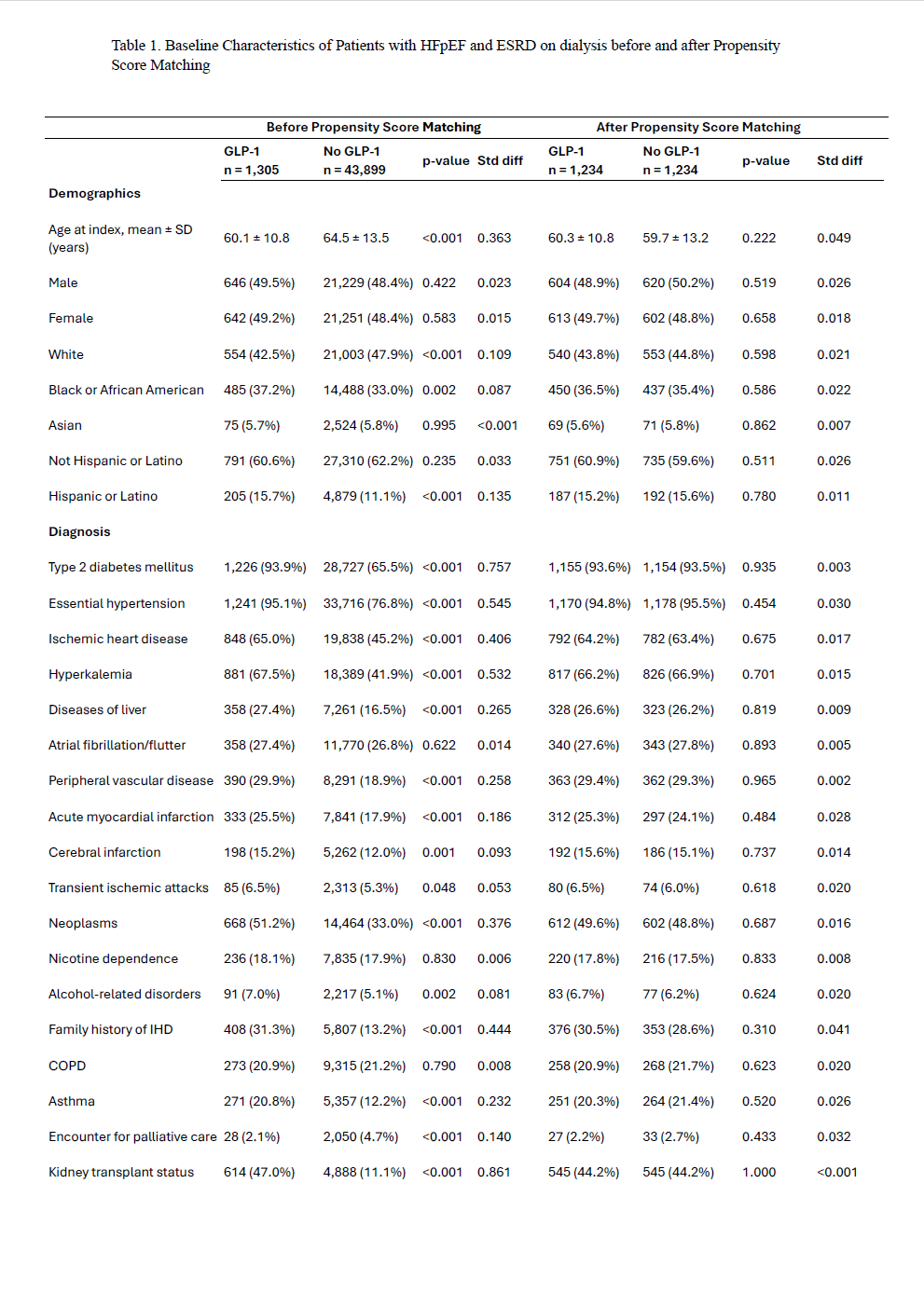
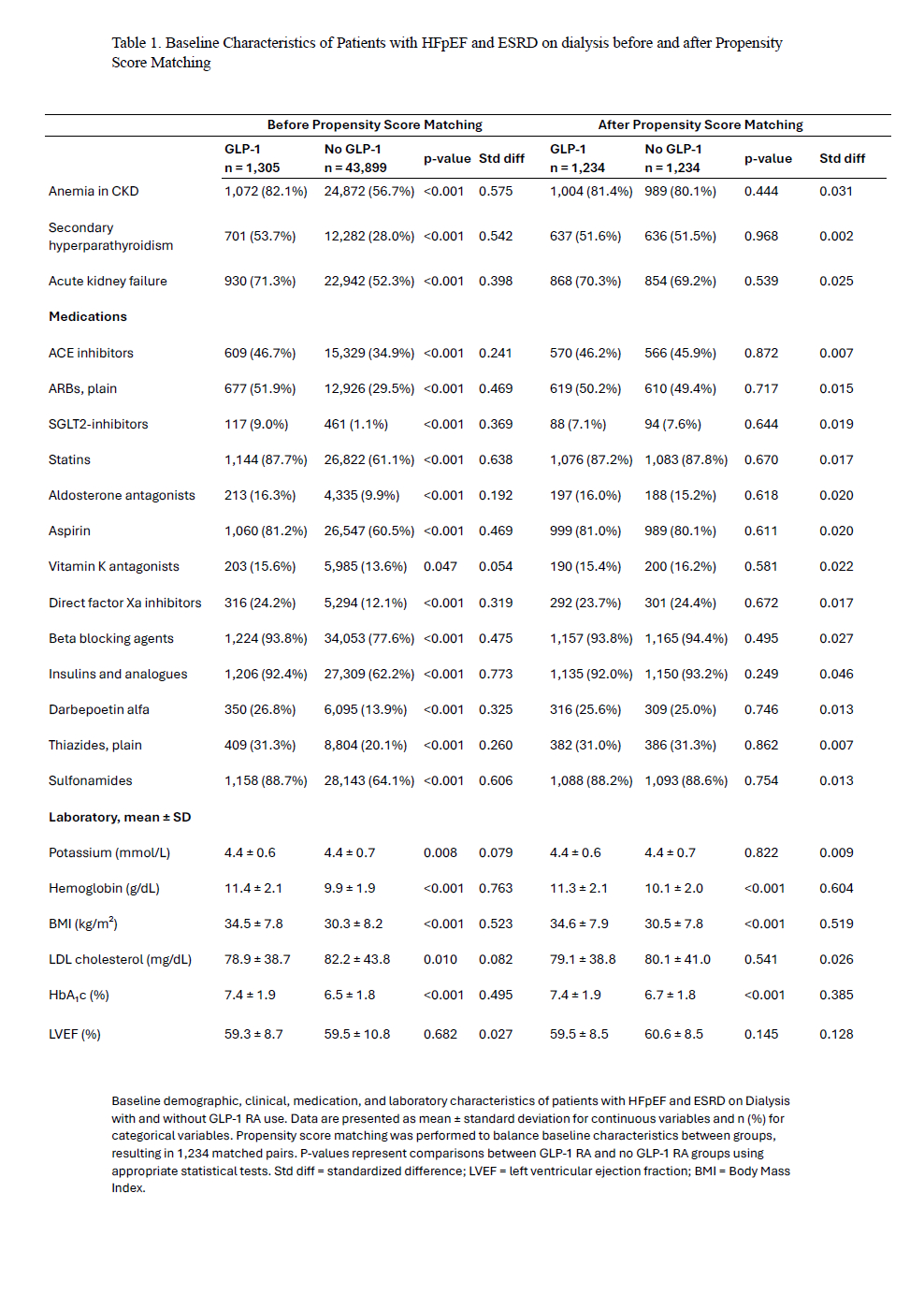
Methods: We queried the TriNetX US Collaborative Network to identify adults (≥ 18 years) with a diagnosis of HFpEF and ESRD on dialysis with a recorded eGFR ≤ 15 mL/min/1.73 m2 between January 1, 2004, and December 31, 2023. Cohort A included patients who received any GLP-1 RA on or after being on dialysis (n = 1,305). Cohort B comprised patients who never received a GLP-1 RA (n = 43,899). Patients with prior GLP-1 RA use were excluded. Propensity score matching (PSM)1:1 was used to balance baseline characteristics, yielding 1,234 matched pairs. Outcomes were assessed for 2 years after first time GLP-1 initiation. The primary outcome included all-cause mortality and 3-point major cardiovascular event (MACE: acute myocardial infarction, cerebral infarction, or cardiac arrest). Secondary endpoints were all-cause hospitalization and hyperkalemia. Kaplan-Meier survival estimates and hazard ratios (HR) were calculated.
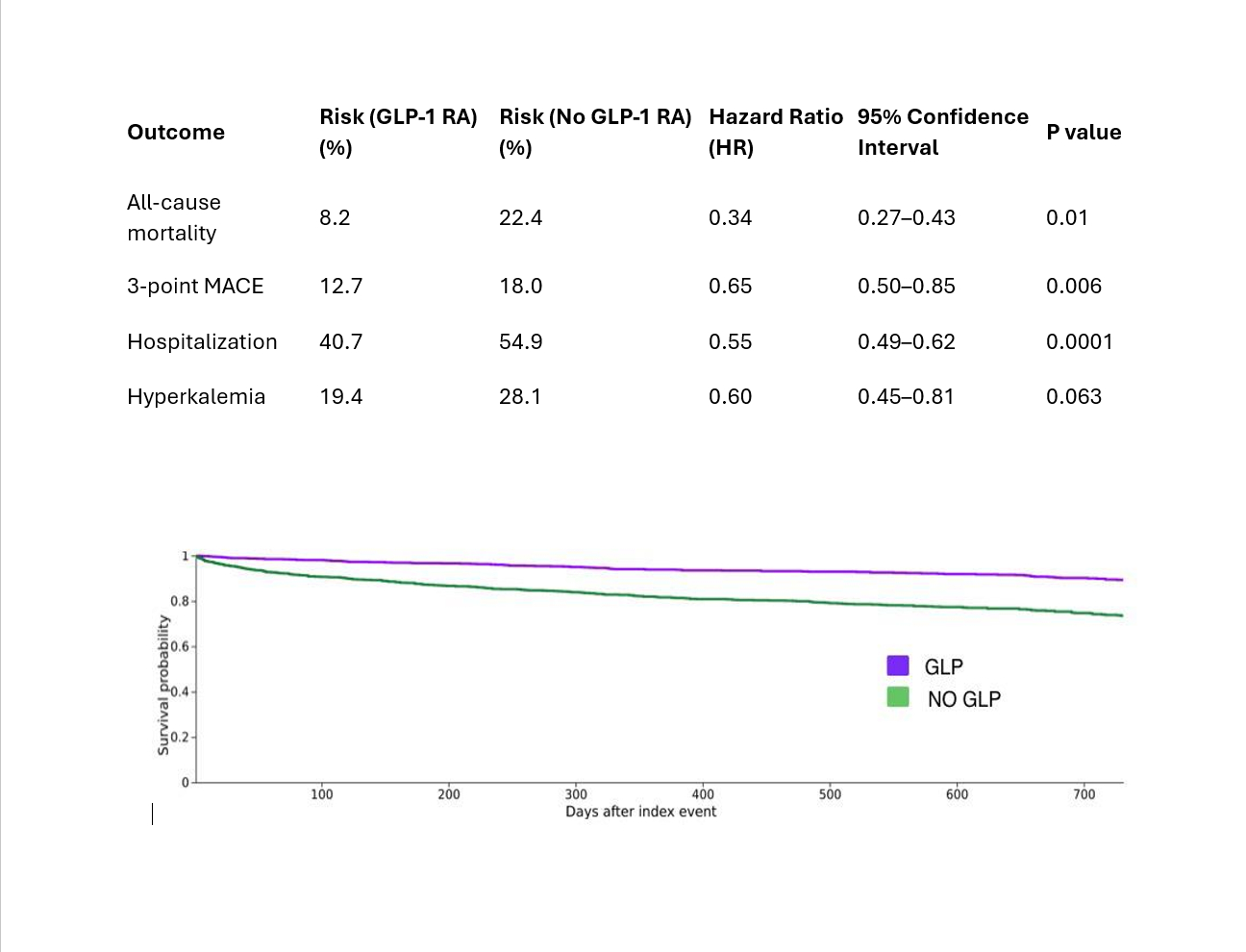
Results: After PSM, baseline characteristics were well balanced (mean age 60.3 ± 10.8 vs 59.7 ± 13.2 years; 49% female in both groups). At 2 years, GLP-1 RA users had significantly lower mortality (8.2% vs 22.4%; HR 0.34, 95% CI 0.27–0.43; p = 0.01). The 3-point MACE rate was also reduced in the GLP-1 RA group (12.7% vs 18%; HR 0.65, 95% CI 0.50–0.85; p < 0.006). Hospitalization occurred in 40.7% of GLP-1 RA patients vs 54.9% (HR 0.55, 95% CI 0.49–0.62; p < 0.0001). Hyperkalemia was less frequent among GLP-1 RA users (19.4% vs 28.1%; HR 0.6, 95% CI 0.45–0.81; p = 0.06). Kaplan-Meier curve showed a higher 2-year survival probability of 89.3% vs 73.5%.
Conclusions: In this large, real-world cohort of ESRD patients on dialysis with HFpEF, GLP-1 RA therapy was associated with a substantial reduction in 2-year all-cause mortality, MACE, and hospitalizations. These data suggest that GLP-1 RAs may confer significant cardioprotective benefits in the highest-risk ESRD with HFpEF population and warrant prospective randomized trials to confirm efficacy and safety in this setting.
Okorigba, Efeturi
(
West Virginia University
, Morgantown , West Virginia , United States )
Mensah, Samuel
(
West Virginia University
, Morgantown , West Virginia , United States )
Olayiwola, Olalekan
(
Saint Peter's University Hospital
, New Brunswick , New Jersey , United States )
Hassan, Abdulraheem
(
Saint Peter's University hospital
, NEW BRUNSWICK , New Jersey , United States )
Vaughan, Megan
(
West Virginia University
, Morgantown , West Virginia , United States )
Otabor, Emmanuel
(
Jefferson Einstein Philadelphia
, Philadelphia , Pennsylvania , United States )
Aghasili, Chukwuemeka
(
Geisinger Health System
, Wilkes-Barre , Pennsylvania , United States )
Onigbanjo, Haroun
(
Queen Alexandra Hospital, Portsmouth Hospitals University NHS Trust
, Portsmouth , United Kingdom )
Thyagaturu, Harshith
(
West Virginia University
, Morgantown , West Virginia , United States )
Author Disclosures:
Efeturi Okorigba:DO NOT have relevant financial relationships
| Samuel Mensah:DO NOT have relevant financial relationships
| Olalekan Olayiwola:DO NOT have relevant financial relationships
| Abdulraheem Hassan:DO NOT have relevant financial relationships
| Megan Vaughan:No Answer
| Emmanuel Otabor:DO NOT have relevant financial relationships
| Chukwuemeka Aghasili:DO NOT have relevant financial relationships
| Haroun Onigbanjo:DO NOT have relevant financial relationships
| Harshith Thyagaturu:No Answer
Kane Jamie, Collins Jeremy, Lee Timmy, Misra Sanjay, Singh Prabh, Kilari Sreenivasulu, Baranwal Gaurav, Naskar Atanu, Montonye Dan, Lutgens Esther, Wang Ying, Negm Ahmed