Cardiac and renal expression of angiotensin II type 1 receptor and its association with fibrosis and heart function in ischemic heart failure rat models
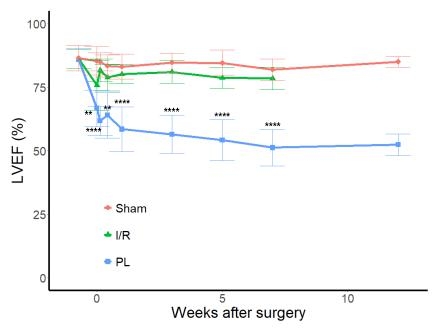
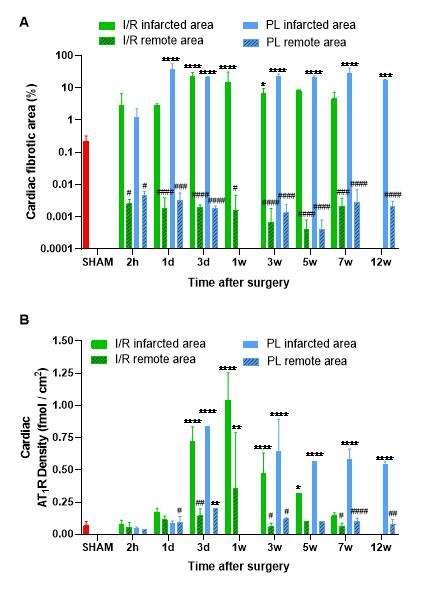
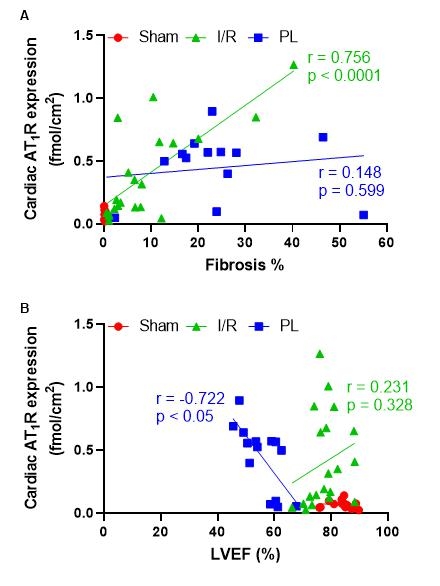
Abstract Body (Do not enter title and authors here): Introduction: Despite the growing interest in the role of Angiotensin II type 1 receptor (AT1R) in left ventricular remodeling and heart failure, little is known about its association with heart function and fibrosis. This study evaluated temporal changes in myocardial and renal AT1R expression in ischemic heart failure rat models, and evaluated its potential as an early diagnostic marker for heart failure. Hypothesis: Upregulation of cardiac and renal AT1Rs occurs during early ventricular remodeling, prior to a reduction in left ventricular function as measured by echocardiography. Methods: Male Sprague-Dawley rats (n=55, 200-250g) were randomized and subjected to the following surgeries: Sham, Ischemia/Reperfusion (I/R, 20 min ligation) and Permanent Ligation (PL) of the left anterior descending artery. Heart function was assessed by weekly echocardiography for 12 weeks. AT1R expression and fibrosis levels in the heart (infarct and remote areas) and kidneys (cortex and medulla) were assessed at 2 hours, 1 and 3 days; 1, 3, 5, 7 and 12 weeks post-surgery using in vitro125I-[Sar1, Ile8]-Angiotensin II autoradiography and picrosirius red staining, respectively. One-Way ANOVA, t-test and Pearson’s correlation tests were used for the association of AT1R, fibrosis and heart function. Results: Left ventricular ejection fraction was reduced by 19% (p<0.01) at 2 hours and 35% (p<0.0001) by week-7 in PL animals, while remaining unchanged in I/R. Compared to Shams, the highest increase (p<0.0001) in cardiac fibrosis in the infarcted area was observed at day-3 (+10,055%) in I/R and at day-1 (+17,850%) in PL. In Shams, renal cortex and medulla exhibited 50-fold higher (p<0.0001) AT1R levels compared to the heart. The highest increase (p<0.0001) in cardiac AT1R levels in I/R was at week-1 (+1,386%) and at day-3 (+1,100%) in PL. Infarct areas consistently had higher AT1R levels and fibrosis than remote areas. Renal AT1R expression and fibrosis remained unchanged across all groups. Cardiac AT1R levels strongly correlated with fibrosis in I/R (r=0.756, p<0.0001) and with LVEF in PL (r=-0.722, p<0.05). Conclusions: Cardiac AT1R expression reflects early cardiac remodeling and fibrosis in I/R animal models and may potentially be a more sensitive marker for detecting and studying at a molecular level cardiac remodeling than echocardiographic parameters. Unchanged renal AT1R expression indicates limited sensitivity of renal AT1R as a marker for heart failure detection.
Petrenyov, Daniil
( Centre de Recherche du Centre Hospitalier de l'Université de Montréal
, Montréal
, Quebec
, Canada
)
Chen, Cen
( Centre de Recherche du Centre Hospitalier de l'Université de Montréal
, Montréal
, Quebec
, Canada
)
Der Sarkissian, Shant
( Université de Montréal / CRCHUM
, Montr?al
, Quebec
, Canada
)
Tournoux, Francois
( Centre Hospitalier de l'Université de Montréal / CRCHUM
, Montréal
, Quebec
, Canada
)
Noiseux, Nicolas
( Centre Hospitalier de l'Université de Montréal / CRCHUM
, Montréal
, Prince Edward Island
, Canada
)
Dasilva, Jean
( Université de Montréal / CRCHUM
, Montr?al
, Quebec
, Canada
)
Author Disclosures:
Gergana Drumeva:DO NOT have relevant financial relationships
| Daniil Petrenyov:No Answer
| Cen Chen:DO NOT have relevant financial relationships
| Shant Der Sarkissian:DO NOT have relevant financial relationships
| Francois Tournoux:No Answer
| Nicolas NOISEUX:DO NOT have relevant financial relationships
| Jean DaSilva:No Answer