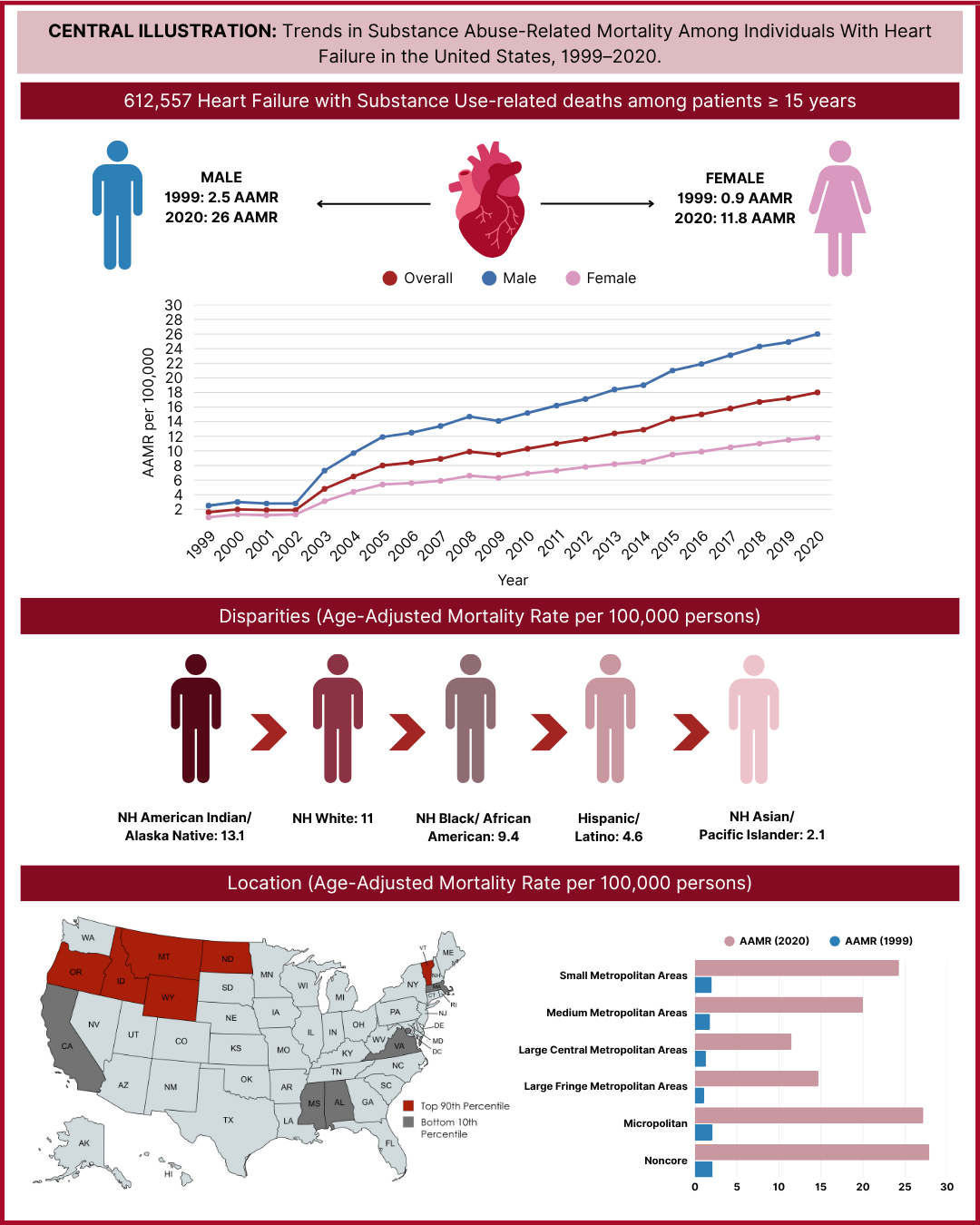
Trends in Substance Use-Related Mortality Among Adults With Heart Failure in the United States from 1999 to 2020: A CDC WONDER Analysis
Abstract Body (Do not enter title and authors here): Introduction Substance use (SU) contributes to adverse cardiovascular outcomes, including myocardial toxicity, arrhythmia, and hemodynamic stress, which can lead to the development and progression of heart failure (HF). With a lifetime HF risk now approaching 24%, the parallel rise in SU disorders poses a growing public health concern. However, national data evaluating long-term trends and disparities in HF-related mortality linked to SU remain limited.
Methods We analyzed death certificate data from the CDC WONDER database to assess HF-related mortality linked to substance use among individuals aged 15 and older in the U.S. from 1999 to 2020. Age-adjusted mortality rates (AAMRs) per 100,000 individuals were calculated and standardized to the 2000 U.S. standard population. Rates were stratified by year, age group, sex, race/ethnicity, geographic region, and urbanization level. Temporal trends were examined using Jointpoint regression analysis to estimate Annual Percent Changes (APC) and corresponding 95% confidence intervals.
Results A total of 1,225,114 deaths among heart failure individuals with substance use were recorded in the United States from 1999 to 2020. During this period, the AAMR increased from 1.6 to 9.2 (AAPC: 12.1%, 95% CI: 10.2%–14.1%; p < 0.0001). Both females and males experienced marked rises, with the AAMR in females increasing from 1.2 to 7.8 and in males from 2.1 to 11.1; although the AAMR was consistently higher in males, the relative increase over time (AAPC: 12.8% for females vs. 11.8% for males; p < 0.0001 for both) was slightly greater in females. All racial and ethnic groups showed significant increases, with non-Hispanic White individuals exhibiting the most rapid rise (AAPC: 13.9%). State-level burden increased across the country, ranging from highest in Oregon (AAMR: 4.9 to 30.0) to lowest in California (AAMR: 0.7 to 2.5). Rural areas had the greatest increase, with the AAMR rising from 2.3 to 16.2 (AAPC: 14.5%), though substantial upward trends were seen across all urbanization strata. Inpatient facilities remained the most common place of death (34.4%), followed by home (32.4%), with hospice deaths increasing over time.
Conclusion Over the past two decades, SU-related mortality among HF patients has risen substantially, with consisent rises across all sexes, age groups, and ethnic populations. These findings highlight the urgent need for focused public health strategies to address this escalating burden and reduce disparities.
Alkhateeb, Mohammad
(
University of Missouri-Columbia
, Columbia , Missouri , United States )
Mohamed Siraj, Hashim
(
Tbilisi State University
, Tbilisi , Georgia )
Pant, Nivedita
(
David Tvildiani Medical University
, Tbilisi , Georgia )
Usaid, Mohammed
(
Tbilisi State University
, Tbilisi , Georgia )
Husnain Ahmad, Muhammad
(
St Tentishev Asian Medical Institute
, Kant , Kyrgyzstan )
Balasubramanian, Anand
(
HCA Houston Healthcare Northwest
, Houston , Texas , United States )
Author Disclosures:
Mohammad Alkhateeb:DO NOT have relevant financial relationships
| Hashim Mohamed Siraj:DO NOT have relevant financial relationships
| Nivedita Pant:DO NOT have relevant financial relationships
| Mohammed Usaid:DO NOT have relevant financial relationships
| Muhammad Husnain Ahmad:DO NOT have relevant financial relationships
| Anand Balasubramanian:No Answer