SENSE-FM: A SEmi-supervised Noise-agnostic Signal Encoder Foundation Model that Enables Label-Efficient Development of AI-ECG models for Wearables
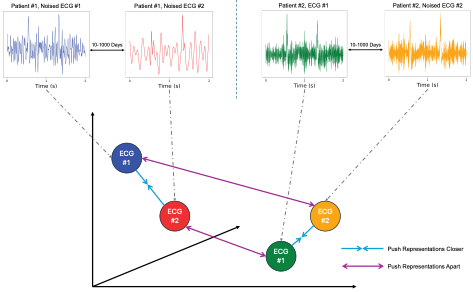
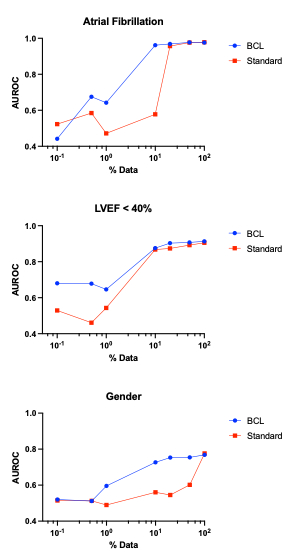
Abstract Body (Do not enter title and authors here): Background: Artificial intelligence (AI) can diagnose a wide array of cardiac conditions from electrocardiograms (ECGs). Wearable and portable ECG devices may enable expanded AI-based screening for cardiovascular conditions, but (i) acquired signals are frequently noisy, (ii) there are no large, labeled datasets to develop models. We present SENSE-FM, a novel foundational model that leverages hidden biometric signatures of 2 ECGs from the same person to develop a noise-agnostic ECG encoder, enabling model development in limited labeled datasets with noisy single-lead ECGs. Methods: To train SENSE-FM, we used 78,288 pairs of lead I ECGs, with the 2 ECGs from the same person separated 10-1000 days, from a large tertiary care health system (2000-2015). We developed a convolutional network tasked to identify ECG pairs from the same patient from other ECG pairs (Figure 1). To simulate real-world wearable data, we augmented clean lead I ECG signals during training with randomly generated, frequency-banded Gaussian noise. Subsequently, SENSE-FM was fine-tuned on downstream tasks, including the detection of atrial fibrillation (AF) and for hidden labels, including sex and left ventricular ejection fraction (LVEF) < 40%, using sequentially larger labeled subsets of a separate dataset of 456,927 noise-augmented ECG signals from 2015-2021. These subsets were also used to train a standard model without pretraining. The held-out test set of ECG signals from 2015-2021 was augmented with real-world, portable ECG noise to evaluate all models. Results: In the validation set of 4,904 single-lead ECGs, SENSE-FM, with AUROCs of 0.976, 0.913, and 0.768 for AF, LVEF < 40%, and sex, respectively, performed comparably to the standard model. When fine-tuned on smaller subsets, SENSE-FM consistently outperformed the standard model (Figure 2). With just 0.5% of the labeled data, SENSE-FM achieved AUROCs of 0.675 and 0.678 for AF and LVEF < 40%, respectively, whereas the standard model reached AUROCs of 0.585 and 0.461. With 10% of the labeled data, SENSE-FM reached an AUROC of 0.962 for AF, compared with 0.578 for the standard models. Conclusions: The SENSE-FM pretraining strategy significantly improves the label efficiency and performance of AI models for downstream diagnostic tasks. This approach helps overcome the key limitation of scarce labeled data from wearable devices, enabling the development of more accessible and widespread AI-driven cardiovascular screening tools.
Khunte, Akshay
(
Yale School of Medicine
, New Haven , Connecticut , United States )
Sangha, Veer
(
Yale Universty
, New Haven , Connecticut , United States )
Pedroso, Aline
(
Yale School of Medicine
, New Haven , Connecticut , United States )
Khera, Rohan
(
Yale School of Medicine
, New Haven , Connecticut , United States )
Author Disclosures:
Akshay Khunte:DO NOT have relevant financial relationships
| Veer Sangha:DO have relevant financial relationships
;
Ownership Interest:Ensight AI:Active (exists now)
| Aline Pedroso:DO NOT have relevant financial relationships
| Rohan Khera:DO have relevant financial relationships
;
Research Funding (PI or named investigator):Bristol-Myers Squibb:Active (exists now)
; Research Funding (PI or named investigator):NovoNordisk:Active (exists now)
; Research Funding (PI or named investigator):BridgeBio:Active (exists now)