
Logo

American Heart Association

  18
  0


Final ID: Mo2020

Artificial Intelligence Analysis of Free-Text Discharge Summaries Facilitates Automated Risk Stratification for Cardiac Surgery Readmissions

Abstract Body (Do not enter title and authors here): Background: Cardiac surgery patients at high risk of readmission can be identified using risk calculators that rely on structured features requiring time-consuming manual chart review. We aimed to develop a cardiac surgery-specific artificial intelligence (AI) model to predict 30-day readmission using a large language model (LLM) to analyze electronic clinical notes. Secondary aims were to evaluate temporal trends in model performance, given changes in practice and the increasing use of short-stay units, and to correlate risk-predicted scores with readmission length of stay (LOS).

Methods: We fine-tuned a general medical LLM developed at our institution using discharge summaries of 8,275 adult cardiac surgery patients (2014-2024). We implemented strict temporal validation by reserving post-June 2021 cases (n=3,031) as a pseudo-prospective test cohort. To evaluate temporal generalization, we assessed performance degradation over time (2022-2024) and investigated recalibration approaches. The model's potential as a general biomarker of post-cardiac surgery risk was evaluated by testing discrimination between observation stays (<48 hours) versus inpatient readmissions, and analyzing relationships between predicted risk scores and readmission LOS.

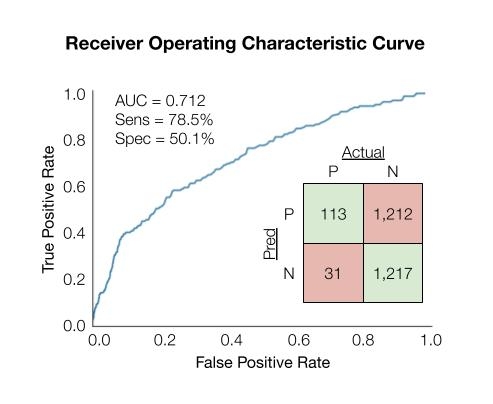
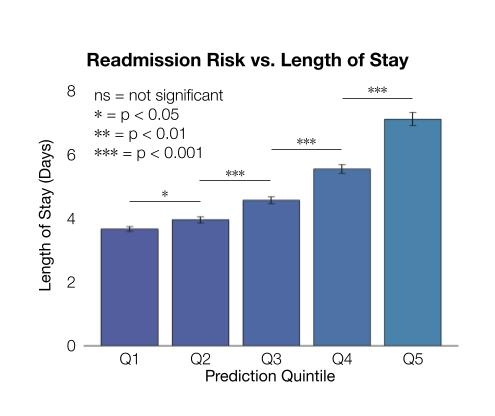
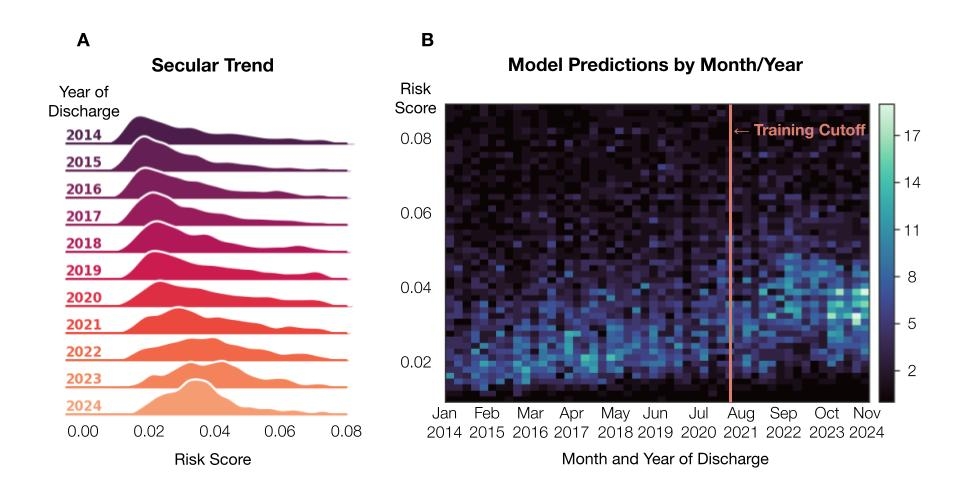
Results: Our model achieved a temporal area under the receiver operating characteristic curve (AUC) of 0.71, with sensitivity 78.5% and specificity 50.1% (Figure 1). Performance showed temporal degradation (AUC 0.78 to 0.67) from 2022-2024, mitigated via recalibration. Risk scores predicted readmission LOS (p<0.001) and discriminated between observation and inpatient stays (AUC 0.69). We observed a bimodal risk distribution, suggesting distinct readmission risk phenotypes. Figure 2 shows that patients in the highest risk quintile experienced a mean LOS 1.9 times longer than the lowest quintile (7.1 vs. 3.7 days, p<0.001). Predicted risk scores increased annually, suggesting documentation drift may impact model performance (Figure 3).

Conclusions: This study demonstrates that a cardiac-specific AI model, using analysis of unstructured clinical notes, predicted 30-day readmissions and captured key features of patient risk profiles without task-specific fine-tuning. Our analyses support the use of recalibration methods to mitigate data drift in a realistic deployment setting. By developing an LLM using postoperative cardiac surgery records, automated screening for high-risk readmissions becomes possible before discharge.
  • Alber, Daniel  ( New York University (NYU) Grossman School of Medicine , New York , New York , United States )
  • Phillips, Katherine  ( NYU Langone Health , New York , New York , United States )
  • Oermann, Eric  ( NYU Langone Health , New York , New York , United States )
  • Grossi, Eugene  ( NYU Langone Health , New York , New York , United States )
  • Mosca, Ralph  ( NYU Langone Health , New York , New York , United States )
  • Author Disclosures:
    Daniel Alber: DO NOT have relevant financial relationships | Katherine Phillips: No Answer | Eric Oermann: No Answer | Eugene Grossi: No Answer | Ralph Mosca: No Answer
Meeting Info:

Scientific Sessions 2025

2025

New Orleans, Louisiana

Session Info:

AI Under the Hood: Performance, Precision, and Model Accuracy

Monday, 11/10/2025 , 01:00PM - 02:00PM

Abstract Poster Board Session

More abstracts on this topic:
Booster Training and Self-Efficacy of ICU Staff for Resuscitation of Postoperative CABG Patients

Wiley Janey

A large-scale multi-view deep learning-based assessment of left ventricular ejection fraction in echocardiography

Jing Linyuan, Metser Gil, Mawson Thomas, Tat Emily, Jiang Nona, Duffy Eamon, Hahn Rebecca, Homma Shunichi, Haggerty Christopher, Poterucha Timothy, Elias Pierre, Long Aaron, Vanmaanen David, Rocha Daniel, Hartzel Dustin, Kelsey Christopher, Ruhl Jeffrey, Beecy Ashley, Elnabawi Youssef

You have to be authorized to contact abstract author. Please, Login
Not Available