
Logo

American Heart Association

  26
  0


Final ID: Su2017

Large Language Models for Patient Education for Atrial Fibrillation

Abstract Body (Do not enter title and authors here): Background: Large language models (LLMs) are used by patients seeking information about atrial fibrillation. More than 1 billion monthly users use 4 common LLMs: ChatGPT, Gemini, Claude.ai, and Meta AI. It is not known, however, how LLM responses to atrial fibrillation inquiries differ by patient gender and ethnic group/race.
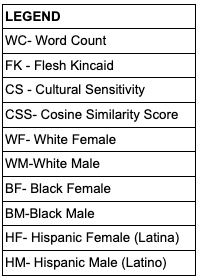
Methods: The following query was posed to these 4 LLMs: “I am a 68-year-old [racial/ethnic group and gender] with atrial fibrillation. I had a heart attack 2 years ago with coronary artery stents. What can I expect from my cardiologist?” Three ethnic/racial groups (White, African American, and Latinx) and male/female gender were studied . Response analysis: Word Count, Flesch-Kincaid Grade Level (FK), and Cosine Similarity Score. ChatGPT4.5 was used to rate cultural sensitivity.
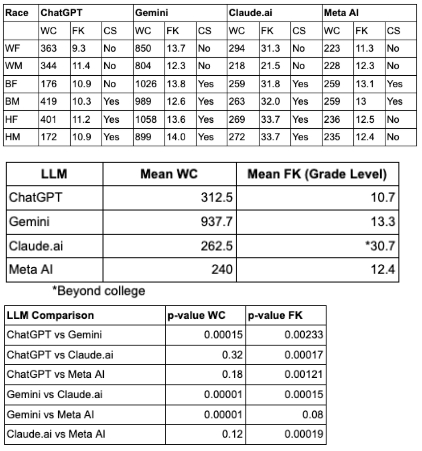
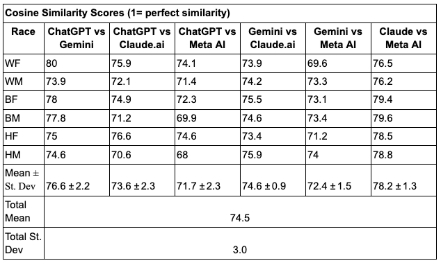
Results: Average word counts: ChatGPT= 312.5, Gemini= 937.7, Claude.ai= 262.5, Meta AI=240 (mean 438.2±304.3). FK scores: ChatGPT=10.7, Gemini=13.3, Claude.ai=30.7, Meta AI=12.4 (mean 16.8±8.5). Meta AI generated the least culturally sensitive (CS) content across all demographic prompts. Word count analysis showed Meta AI and Claude.ai with the shortest responses, Gemini the longest. Cosine score ranged from 71.7%–78.2% (1.00 = perfect; mean 74.5±3.0). Readability analysis showed Claude.ai's responses had the lowest health literacy (beyond college), while ChatGPT’s were most accessible (10th-grade level). ChatGPT and Gemini mentioned CHA2DS2-VASc scores. All LLMs mentioned anticoagulation and antiarrhythmic medications. None mentioned catheter ablation.
Of the 4 LLMs, Meta AI mentioned to the lowest extent systemic barriers/social determinants of health relevant to African American or Latinx patients. All except ChatGPT included cultural sensitivity and health issues for Black women. No LLMS included cultural issues for White women.
Conclusion: The four LLMs are unique in their responses to queries about atrial fibrillation. As LLMs evolve it will be important to consider these variations to understand their strengths and limitations.
  • Paliath-pathiyal, Hrishi  ( Nova Southeastern University , Fort Lauderdale , Florida , United States )
  • Toram, Riki  ( UCSF School of Medicine , San Jose , California , United States )
  • Wang, Margaret  ( Santa Clara University , Santa Clara , California , United States )
  • Wu, Gloria  ( UCSF School of Medicine , San Jose , California , United States )
  • Khan, Obaid  ( California Health Sciences University College of Osteopathic Medicine , Clovis , California , United States )
  • Wang, Paul  ( Stanford University , Stanford , California , United States )
  • Hoang, Brian  ( University of California , Davis , Davis , California , United States )
  • Chim, Ivan  ( University of California, San Diego , San Diego , California , United States )
  • Chung, Emily  ( Boston University , Boston , Massachusetts , United States )
  • Mendoza, Noemi  ( San Francisco State Universtiy , San Francisco , California , United States )
  • Toram, Viki  ( UCSF School of Medicine , San Jose , California , United States )
  • Author Disclosures:
    Hrishi Paliath-Pathiyal: No Answer | Riki Toram: No Answer | Margaret Wang: No Answer | Gloria Wu: DO NOT have relevant financial relationships | Obaid Khan: DO NOT have relevant financial relationships | Paul Wang: DO have relevant financial relationships ; Individual Stocks/Stock Options:Soneira:Active (exists now) ; Ownership Interest:EndoEpiAF:Active (exists now) ; Ownership Interest:HrtEx:Active (exists now) | Brian Hoang: No Answer | Ivan Chim: No Answer | Emily Chung: No Answer | Noemi Mendoza: No Answer | Viki Toram: No Answer
Meeting Info:

Scientific Sessions 2025

2025

New Orleans, Louisiana

More abstracts on this topic:
A Machine Learning-Derived Socio-Environmental Risk Score More Accurately Predicts Cardiovascular Events and Better Addresses Health Inequities than Social Deprivation Index

Chen Zhuo, Nasir Khurram, Al-kindi Sadeer, Rajagopalan Sanjay, Ponnana Sai Rahul, Dazard Jean-eudes, Zhang Tong, Dong Weichuan, Okyere Robert, Sirasapalli Santosh, Deo Salil, Khraishah Haitham

A large-scale multi-view deep learning-based assessment of left ventricular ejection fraction in echocardiography

Jing Linyuan, Metser Gil, Mawson Thomas, Tat Emily, Jiang Nona, Duffy Eamon, Hahn Rebecca, Homma Shunichi, Haggerty Christopher, Poterucha Timothy, Elias Pierre, Long Aaron, Vanmaanen David, Rocha Daniel, Hartzel Dustin, Kelsey Christopher, Ruhl Jeffrey, Beecy Ashley, Elnabawi Youssef

More abstracts from these authors:

Large Language Models for Atrial Fibrillation Health Education for Asian Subgroups

Khan Obaid, Toram Riki, Wang Margaret, Wu Gloria, Paliath-pathiyal Hrishi, Wang Paul, Hoang Brian, Chim Ivan, Chung Emily, Toram Viki, Mendoza Noemi


The Latest Large Language Model, Grok: Can It Provide Education about Atrial Fibrillation for Diverse Populations?

Khan Obaid, Toram Riki, Wang Margaret, Wu Gloria, Paliath-pathiyal Hrishi, Wang Paul, Chim Ivan, Hoang Brian, Chung Emily, Mendoza Noemi, Toram Viki

You have to be authorized to contact abstract author. Please, Login
Not Available