
Logo

American Heart Association

  34
  0


Final ID: Mo2002

Large Language Models for Atrial Fibrillation Health Education for Asian Subgroups

Abstract Body (Do not enter title and authors here): Background: Large language models (LLMs) are used by atrial fibrillation patients. Cardiovascular outcomes may vary by Asian subgroup. Asians comprise 6% of the American population. However, it is not known whether LLM responses vary for atrial fibrillation when specifying an Asian user in the prompt.

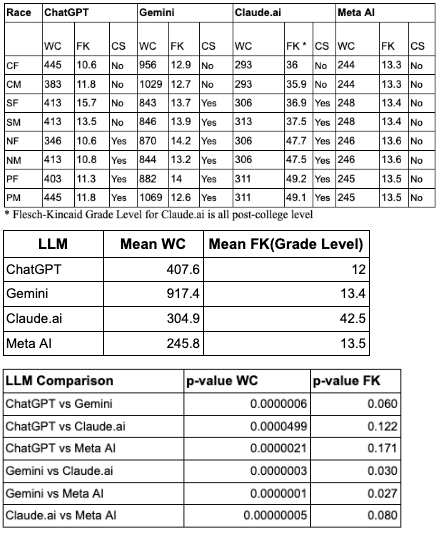
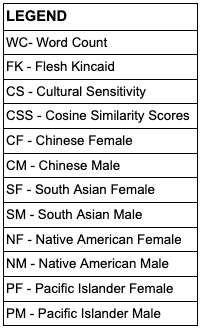
Methods: We used in the search prompt the query to ChatGPT, Gemini, Claude.ai, and Meta AI: “I am a 68-year-old [Asian subgroup] [male/female] with atrial fibrillation. I had a heart attack 2 years ago with stents. What can I expect from my cardiologist?” Subgroups used: Chinese, South Asian, Native American and Pacific Islander; male/female gender. Response analysis: Word Count (WC), Flesch-Kincaid Grade Level (FK), and Cosine Similarity Score. Responses were reviewed by ChatGPT4.5 for cultural sensitivity.

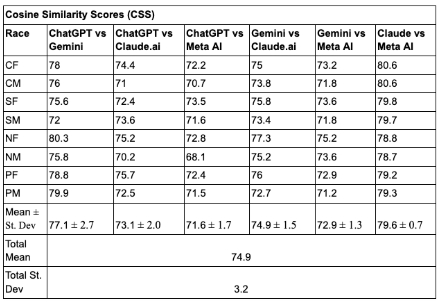
Results: Average word counts: ChatGPT 407.6, Gemini 917.4, Claude.ai 304.9, Meta AI 245.8 (mean 468.9±273.4). FK scores: ChatGPT 12.0, Gemini 13.4, Claude.ai 42.5, Meta AI 13.5 (mean 20.3±13.4). Gemini produced the longest responses across all groups (WC avg=917.4); Meta AI and Claude.ai generated the shortest word counts. Claude.ai’s responses were the least readable (post-college), while ChatGPT’s were the most accessible (grade 12.0). Cosine similarity scores ranged from 68.1%–80.6% (1.00 = perfect; mean 74.9±3.2). Meta AI showed the least number of cultural sensitivity responses of the LLMs. Claude.ai was the only LLM to mention Indian Health Service for Native Americans. CHA2DS2-VASc and HAS-BLED scores were mentioned in ChatGPT and Gemini, but not in Claude.ai or Meta AI. All LLMs except Meta AI, mentioned use of antiarrhythmics. Anticoagulation medications were mentioned in all 4 LLMs. Catheter ablation was mentioned in ChatGPT and Gemini only. Gemini had the highest word count for Pacific Islander Male/Female prompts. Claude.ai had the highest reading level for Pacific Islanders.

Conclusion: The LLMs answers for atrial fibrillation were beyond 6th grade, at college or beyond. Claude.ai used the most complicated medical terms. ChatGPT and Gemini answered the questions for the atrial fibrillation patients most completely.
  • Khan, Obaid  ( California Health Sciences University College of Osteopathic Medicine , Clovis , California , United States )
  • Toram, Riki  ( UCSF School of Medicine , San Jose , California , United States )
  • Wang, Margaret  ( Santa Clara University , Santa Clara , California , United States )
  • Wu, Gloria  ( UCSF School of Medicine , San Jose , California , United States )
  • Paliath-pathiyal, Hrishi  ( Nova Southeastern University , Fort Lauderdale , Florida , United States )
  • Wang, Paul  ( Stanford University School of Medicine , Palo Alto , California , United States )
  • Hoang, Brian  ( University of California, Davis , Davis , California , United States )
  • Chim, Ivan  ( University of California, San Diego , San Diego , California , United States )
  • Chung, Emily  ( Boston University , Boston , Massachusetts , United States )
  • Toram, Viki  ( UCSF School of Medicine , San Jose , California , United States )
  • Mendoza, Noemi  ( San Francisco State University , San Franscisco , California , United States )
  • Author Disclosures:
    Obaid Khan: DO NOT have relevant financial relationships | Riki Toram: No Answer | Margaret Wang: No Answer | Gloria Wu: DO NOT have relevant financial relationships | Hrishi Paliath-Pathiyal: No Answer | Paul Wang: DO have relevant financial relationships ; Individual Stocks/Stock Options:Soneira:Active (exists now) ; Ownership Interest:EndoEpiAF:Active (exists now) ; Ownership Interest:HrtEx:Active (exists now) | Brian Hoang: No Answer | Ivan Chim: No Answer | Emily Chung: No Answer | Viki Toram: No Answer | Noemi Mendoza: No Answer
Meeting Info:

Scientific Sessions 2025

2025

New Orleans, Louisiana

Session Info:

Innovations in Cardiovascular Care Delivery: AI, Digital Tools, and Population-Centered Approaches

Monday, 11/10/2025 , 10:30AM - 11:30AM

Abstract Poster Board Session

More abstracts on this topic:
A novel risk score predicts the prevalence of left atrial low-voltage areas and rhythm outcome in patients undergoing long-standing persistent atrial fibrillation ablation

Ooka Hirotaka, Nakao Sho, Kusuda Masaya, Ariyasu Wataru, Kudo Satoshi, Fujii Subaru, Mano Toshiaki, Matsuda Yasuhiro, Masuda Masaharu, Okamoto Shin, Ishihara Takayuki, Nanto Kiyonori, Tsujimura Takuya, Hata Yosuke, Uematsu Hiroyuki

A ChatGLM-based stroke diagnosis and prediction tool

Song Xiaowei, Wang Jiayi, Ma Weizhi, Wu Jian, Wang Yueming, Gao Ceshu, Wei Chenming, Pi Jingtao

More abstracts from these authors:

The Latest Large Language Model, Grok: Can It Provide Education about Atrial Fibrillation for Diverse Populations?

Khan Obaid, Toram Riki, Wang Margaret, Wu Gloria, Paliath-pathiyal Hrishi, Wang Paul, Chim Ivan, Hoang Brian, Chung Emily, Mendoza Noemi, Toram Viki

Large Language Models for Patient Education for Atrial Fibrillation

Paliath-pathiyal Hrishi, Toram Riki, Wang Margaret, Wu Gloria, Khan Obaid, Wang Paul, Hoang Brian, Chim Ivan, Chung Emily, Mendoza Noemi, Toram Viki

You have to be authorized to contact abstract author. Please, Login
Not Available