
Logo

American Heart Association

  15
  0


Final ID: MP2714

Left Ventricular Chamber Stiffness Progressively Increases Despite the Normalization of Blood Pressure After Brief Repetitive Left Ventricular Pressure Overload

Abstract Body (Do not enter title and authors here): Background: Sustained systolic hypertension can produce LV hypertrophy and interstitial fibrosis that leads to increased LV stiffness and the development of HFpEF. Nevertheless, the blood pressure in most patients with established HFpEF is controlled and up to 40% of patients have a structurally normal heart. Swine subjected to daily 30-minute episodes of transient hypertension develop a similar phenotype suggesting that labile rather than sustained hypertension may play a major role in increasing LV stiffness.
Objective: Determine whether the increased LV stiffness arising from brief blood pressure transients is reversible 4-weeks after the normalization of blood pressure.
Methods: Swine (n=6) were subjected to brief repetitive pressure overload (BRPO) with daily 30-minute infusions of phenylephrine (PE; 400 µg/min) to raise LV systolic pressure from 114±3 to 207±6 mmHg and LVEDP from 12±1 to 32±2 mmHg. Serial LV chamber stiffness (ΔLVEDP/ΔLVEDV) was determined using echocardiography at baseline, after 2-weeks of BRPO and 4-weeks after normalization of blood pressure (Post-BRPO) in the closed chest propofol sedated state.
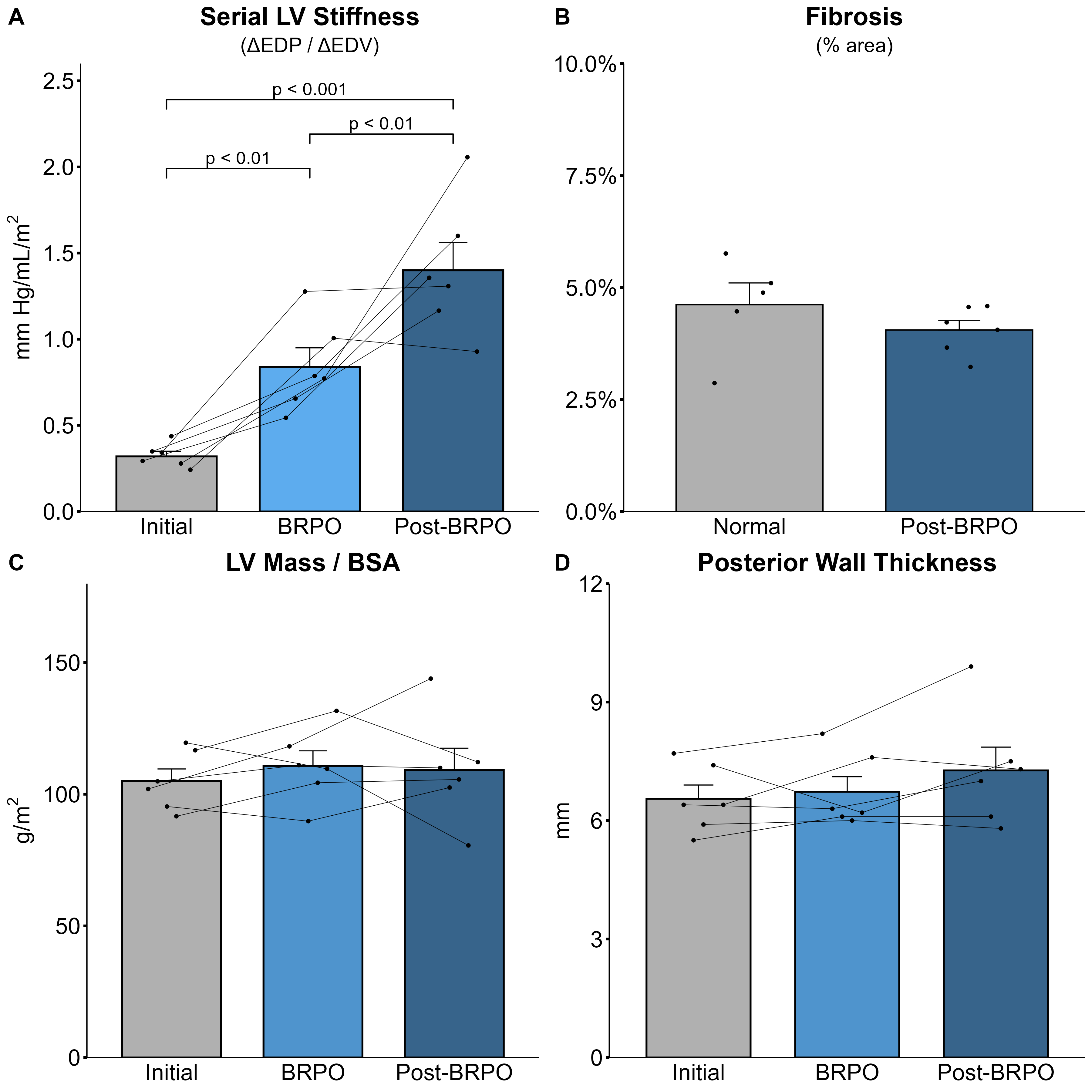
Results: Two weeks of intermittent hypertension increased LV chamber stiffness from 0.32±0.03 to 0.84±0.11 mmHg/mL/m2 (p<0.01, Figure A). Surprisingly, this continued to increase when reassessed after the normalization of pressure overload 4-weeks later (Post-BRPO 1.4±0.16 mmHg/mL/m2; p<0.01). The increase in LV chamber stiffness was not associated with increased interstitial fibrosis (normal control 4.65±0.48%, Post-BRPO 4.05±0.22%) (Figure B), increased indexed LV mass (Baseline 105±4.6 g/m2, BRPO 111±5.7 g/m2, Post-BRPO 109±8.4 g/m2) (Figure C) or increased posterior wall thickness (Figure D).
Conclusion: BRPO leads to an increased LV chamber stiffness that is not associated with LV hypertrophy or interstitial fibrosis. Nevertheless, despite a structurally normal heart, LV chamber stiffness continues to rise 4-weeks after cessation of BRPO and normalization of blood pressure. This suggests a self-sustaining positive feedback mechanism that further exacerbates diastolic dysfunction and indicates a potential role of blood pressure transients in effecting long lasting increases in LV stiffness.
  • Graser, Luke  ( University at Buffalo , Buffalo , New York , United States )
  • Weil, Brian  ( University at Buffalo , Buffalo , New York , United States )
  • Canty, John  ( UNIVERSITY AT BUFFALO , Buffalo , New York , United States )
  • Author Disclosures:
    Luke Graser: DO NOT have relevant financial relationships | Brian Weil: DO NOT have relevant financial relationships | John Canty: DO NOT have relevant financial relationships
Meeting Info:

Scientific Sessions 2025

2025

New Orleans, Louisiana

Session Info:

Mechanisms and Modulation of Cardiomyopathy and Diastolic Dysfunction

Monday, 11/10/2025 , 09:15AM - 10:30AM

Moderated Digital Poster Session

You have to be authorized to contact abstract author. Please, Login
Not Available