Brown Adipose Tissue-Heart Crosstalk Attenuates Adverse Cardiac Remodeling
Abstract Body (Do not enter title and authors here): Abstract BACKGROUND: While brown adipose tissue (BAT) is recognized to attenuate the incidence of cardiovascular disease, its specific role in adverse cardiac remodeling and related inter-organ signaling pathways remain poorly defined.
METHODS: In myocardial infarction (MI) mouse models receiving BAT transplantation, cardiac function and fibrosis were evaluated to assess the effects of BAT on post-MI adverse cardiac remodeling. The transfer of mitochondria-derived-vesicles (MDVs) transfer from BAT to the heart was visualized and verified using organelle-targeted reporter mice. In adipocytes, the MDV cargo sorting mechanism was investigated using immunofluorescent imaging and flow cytometry. Quantitative proteomics was used to identify cardioprotective molecules in anti-fibrotic MDVs.
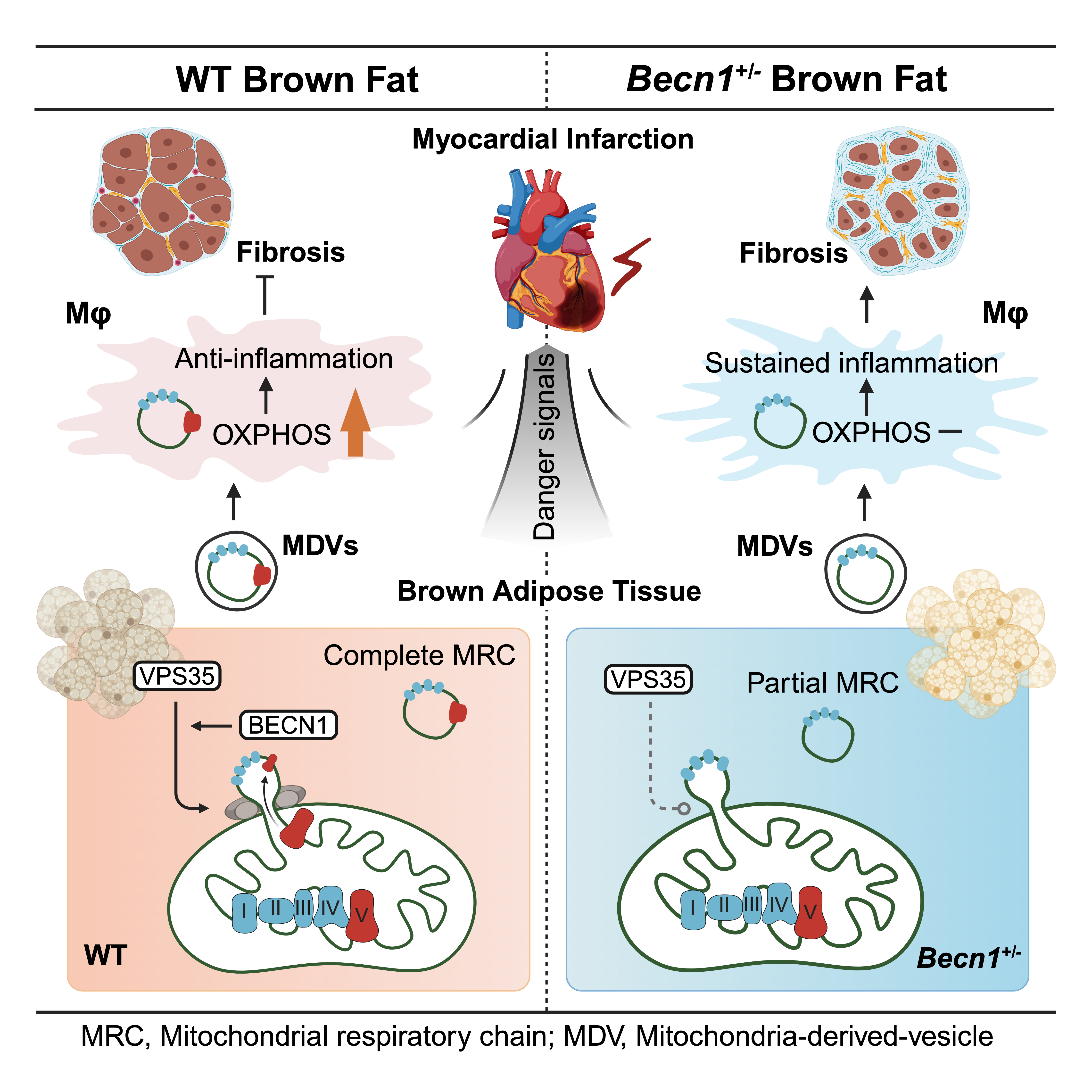
RESULTS: Mice receiving BAT transplantation demonstrated improved cardiac function and attenuated fibrosis post-MI. Concurrently, active MDVs trafficking from the BAT graft to the cardiac macrophages was observed. Isolated MDVs from BAT exhibited fibrosis-restricting effects by suppressing inflammatory responses. Mechanistically, adipocyte VPS35 responded to danger signals, translocating to mitochondria to facilitate MDV biogenesis. Genetic ablation of Becn1 disrupted VPS35 translocation, resulting in aberrant cargo sorting within MDVs. This defective packaging abolished the cardioprotective effects conferred by BAT and its MDVs. Proteomic profiling identified mitochondrial respiratory chain ATP synthase (Complex V) as a defining characteristic of functional MDVs. By enhancing oxidative phosphorylation, ATP synthase-rich MDVs potentiate anti-inflammatory response in recipient macrophages.
CONCLUSIONS: Our findings highlight the role and mechanism of functional mitochondrial components trafficking in cardiac repair and provide BAT mitochondria as promising biological products against adverse cardiac remodeling post-MI.
Shi, Tingting
( Tongji University
, Shanghai
, China
)
Chen, Yang
( Tongji University
, Shanghai
, China
)
Che, Wenliang
( Tongji University
, Shanghai
, China
)
Xiang, Yaozu
( Tongji University
, Shanghai
, China
)
Author Disclosures:
Tingting Shi:DO NOT have relevant financial relationships
| Yang Chen:No Answer
| Wenliang Che:No Answer
| Yaozu Xiang:No Answer