
Logo

American Heart Association

  20
  0


Final ID: MP56

25-Year Decline in Aortic Aneurysm and Dissection Mortality in the U.S.: Impact of Endovascular Repair and Forecast to 2030

Abstract Body (Do not enter title and authors here):
Introduction: Aortic aneurysm and dissection are rare but life-threatening conditions, with an incidence of 5–30 cases per million annually. The introduction of endovascular aneurysm repair (EVAR) has markedly improved outcomes. This study analyzes 25-year U.S. mortality trends (1999–2023) and forecasts rates through 2030.

Methodology: We analyzed national mortality data from the CDC WONDER database (1999–2023) using ICD-10 codes I71.0–I71.9 to identify deaths due to aortic aneurysm and dissection. Age-adjusted mortality rates (AAMRs) were stratified by demographics and geography, based on NCHS urban–rural and U.S. Census regional classifications. Trends were assessed using Joinpoint regression to estimate Annual and Average Annual Percentage Changes (APC/AAPC) with 95% confidence intervals. ARIMA models with Box-Cox transformation were fitted after ADF/KPSS tests
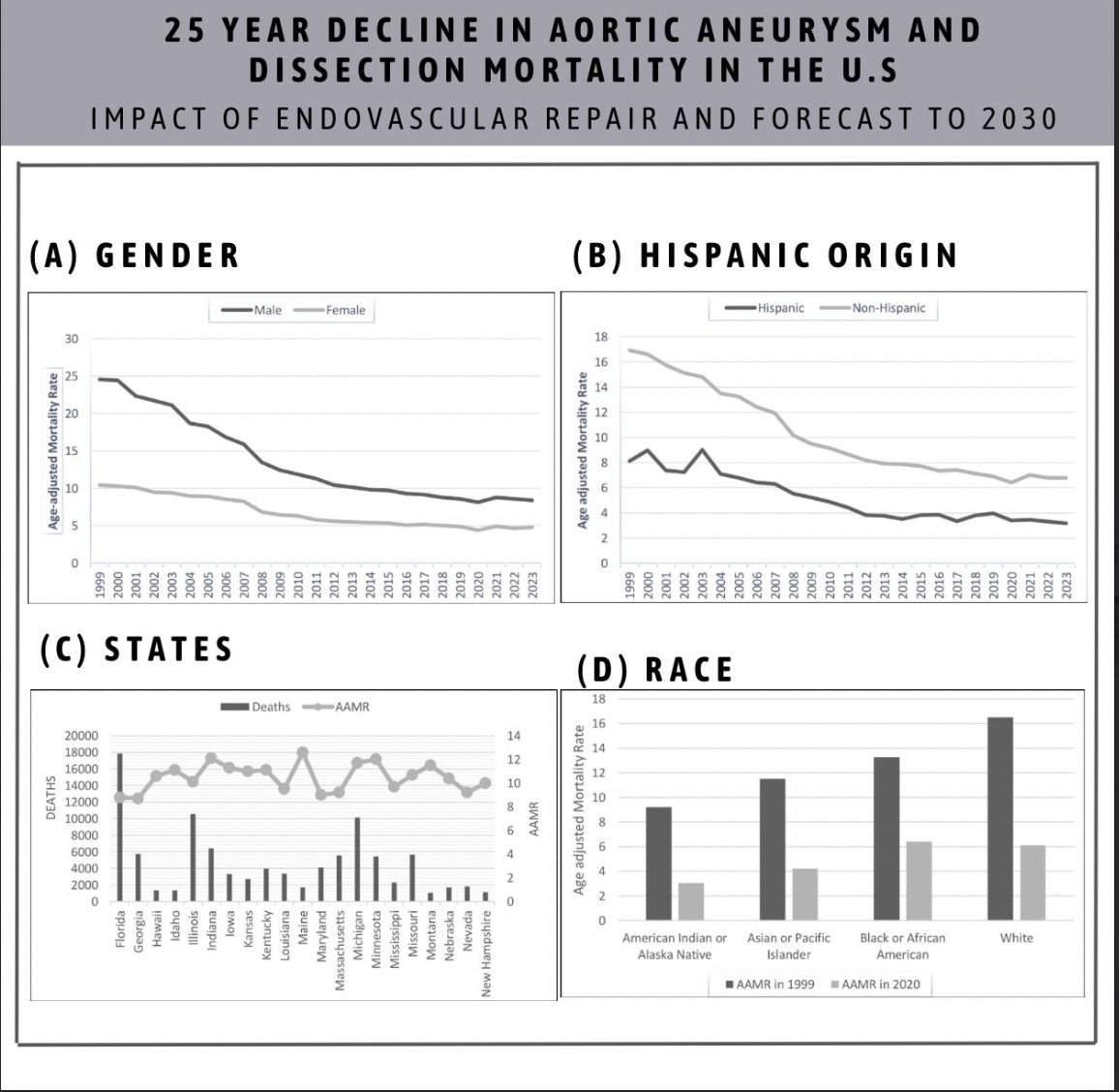
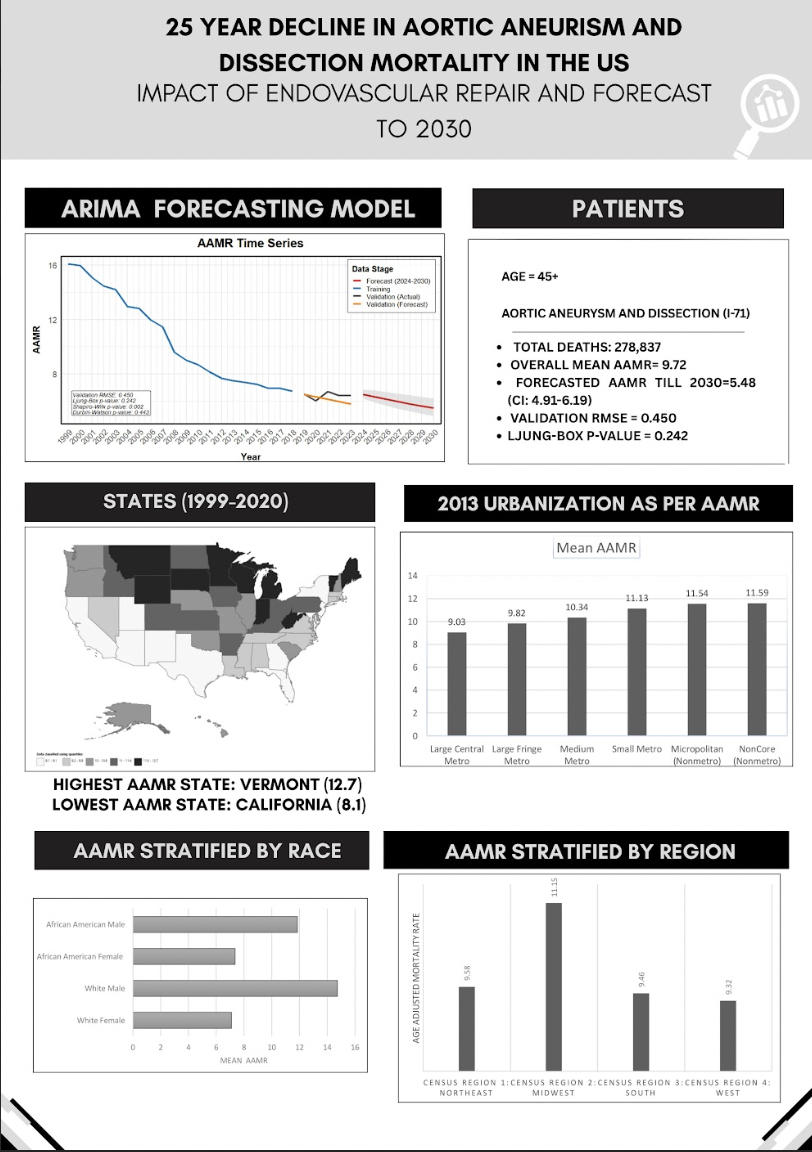
Results: From 1999 to 2023, the age-adjusted mortality rate (AAMR) for aortic aneurysm and dissection in the U.S. declined markedly from 15.88 to 6.6 per 100,000. ARIMA modeling forecasted an AAMR of 6.32 (95% CI: 5.90–6.79) in 2025 and 5.48 (95% CI: 4.92–6.19) in 2030, with good model fit (RMSE = 0.450; Ljung-Box p = 0.242). Joinpoint regression identified the most rapid decline between 2006 and 2009 (Annual Percent Change [APC] = –10.78), coinciding with the widespread adoption of endovascular aneurysm repair (EVAR), despite its initially delayed adoption into clinical practice. Urban–rural disparities were evident, with the most significant decline observed in large central metro areas (AAMR: 14.52 to 5.16) compared to non-core rural areas (18.25 to 7.38). Regionally, the Midwest had the highest mortality in 1999 and experienced the steepest decline over time. Racial disparities persisted, with White individuals accounting for the highest number of deaths but also demonstrating the most pronounced decline (AAMR: 16.5 to 6.12; APC = –5.35). Non-Hispanic males had the highest mortality rates overall (AAMR: 24.55 to 8.39; AAPC = –4.61), while Hispanic females consistently had the lowest.
Conclusions: From 1999 to 2023, mortality from aortic aneurysm and dissection declined significantly, driven by advances such as endovascular aneurysm repair (EVAR) and improved clinical care. However, notable disparities by race, sex, and region remain despite these advances, highlighting the need for patient-centered selection, ongoing outcome reevaluation, and an equitable approach to care delivery.
  • Ali, Manzer  ( Pakistan Institue of Medical Sciences , Islamabad , Pakistan )
  • Umar, Haddaya  ( University of South Dakota , Sioux Falls , South Dakota , United States )
  • Nazir, Tahira  ( Ch Pervaiz Elahi Institute of Cardiology , Multan , Pakistan )
  • Nizam, Muhammad  ( Trinity Health Livonia Hospital , Canton , Michigan , United States )
  • Steafo, Lark  ( William Beaumont University Hosp , Sterling Heights , Michigan , United States )
  • Sharif, Ayesha  ( William Beaumont Hospital , Royal Oak , Michigan , United States )
  • Jehangir, Hanzala  ( Sheikh Zayed Medical College , Bahawalpur , Pakistan )
  • Arham, Muhammad  ( Sheikh Zayed Medical College , Multan , Pakistan )
  • Hamza, Anfal  ( Sheikh Zayed Medical College , Bahawalpur , Pakistan )
  • Hassan, Arbaz  ( Sheikh Zayed Medical College , Rahim Yar Khan , Pakistan )
  • Amjad, Ans  ( Sheikh Zayed Medical College , Rahim Yar Khan , Pakistan )
  • Ali, Iman  ( Shahida Islam Medical Complex , Lodhran , Pakistan )
  • Zuha, Zuha  ( Sheikh zayed medical college , Rahim yar khan , Pakistan )
  • Author Disclosures:
    Manzer Ali: DO NOT have relevant financial relationships | Haddaya Umar: DO NOT have relevant financial relationships | Tahira Nazir: DO NOT have relevant financial relationships | Muhammad Nizam: DO NOT have relevant financial relationships | Lark Steafo: DO NOT have relevant financial relationships | Ayesha Sharif: DO NOT have relevant financial relationships | Hanzala Jehangir: DO NOT have relevant financial relationships | Muhammad Arham: DO NOT have relevant financial relationships | Anfal Hamza: DO NOT have relevant financial relationships | Arbaz Hassan: DO NOT have relevant financial relationships | Ans Amjad: DO NOT have relevant financial relationships | Iman Ali: DO NOT have relevant financial relationships | Zuha Zuha: DO NOT have relevant financial relationships
Meeting Info:

Scientific Sessions 2025

2025

New Orleans, Louisiana

Session Info:

Critical Care Under Pressure: Hemodynamics, Sedation, and Survival in Cardiogenic Shock and Beyond

Saturday, 11/08/2025 , 12:15PM - 01:15PM

Moderated Digital Poster Session

More abstracts on this topic:
Angio-IMR - A Novel Angiography-Derived Index of Microcirculatory Resistance for Assessment of Coronary Microvascular Dysfunction

O'brien Joseph, Ford Tom, Wong Dennis, Zhang Jun Michael, Yong Andy, Easey Kelly, Redwood Eleanor, Rehan Rajan, Ravindran Jayant, Brown Adam, Chew Derek

Anomalous Origin Of Left Circumflex Artery From Right Pulmonary Artery Resulting In Heart Failure: A Rare Vascular Steal Phenomenon

Chander Yogesh, Bhardwaj Rajeev, Nandal Rajesh, Mittal Saurav, Pruthi Taniya, Singh Subeg

More abstracts from these authors:
Trends in Heart Failure Mortality Among Patients With Standard Modifiable Cardiovascular Risk Factors: A Retrospective Analysis (1999–2020)

Abdul Malik Mohammad Hamza Bin, Haq Ali, Hassan Arbaz, Jehangir Hanzala, Abdul Malik Muhammad Awais Bin, Arham Muhammad, Hamza Anfal, Ihsan Ayesha, . Abdullah, Eltawansy Sherif

The Overlapping Burden: Trends in Cerebrovascular Mortality with Underlying Alzheimer’s Disease in the United States; A nationwide analysis (1999-2023) using CDC Wonder and ARIMA approach

Hassan Arbaz, Yousaf Saqlain, Sajjad Talha, Bukhari Syed, Arham Muhammad, Hamza Anfal, Sharif Aleena, Zubair Ali, Mehmood Asad, Zaheer Minahil, Uzair Muhammad, Batool Aneeha

You have to be authorized to contact abstract author. Please, Login
Not Available