
Logo

American Heart Association

  24
  0


Final ID: 4365618

Angio-IMR - A Novel Angiography-Derived Index of Microcirculatory Resistance for Assessment of Coronary Microvascular Dysfunction

Abstract Body (Do not enter title and authors here): Background:
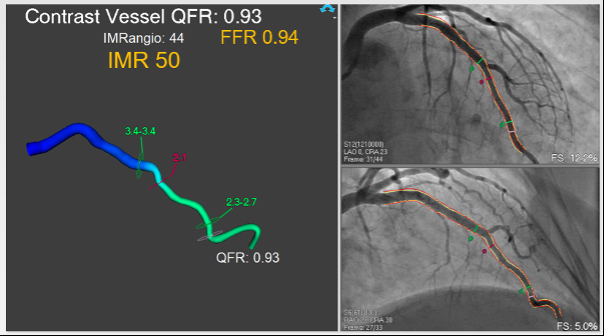
Approximately 50% of patients with angina who undergo invasive coronary angiography (ICA) do not exhibit obstructive epicardial coronary artery disease. A significant subset of these patients has coronary microvascular dysfunction (CMD). The current gold standard for diagnosing CMD is the invasive Index of Microcirculatory Resistance (IMR), which requires administration of adenosine and pressure wire instrumentation, carrying procedural risks. Angiography-derived IMR (Angio-IMR) is a novel, non-invasive, machine learning-based method that applies computational fluid dynamics to standard ICA images to emulate hyperemic microvascular assessment.

Hypothesis:
Angio-IMR is an accurate predictor of CMD when compared with invasively measured IMR.

Methods:
This prospective, multicentre study was conducted across three tertiary Australian hospitals. Patients undergoing ICA were assessed using both invasive IMR and Angio-IMR. Angio-IMR analyses were performed centrally and blinded, using manual frame counting with Medis QFR software (version 3.1). Patients were stratified into derivation and validation cohorts. Diagnostic performance of Angio-IMR was assessed using ROC analysis, with invasive IMR > 25 was used as the threshold for significant CMD.

Results:
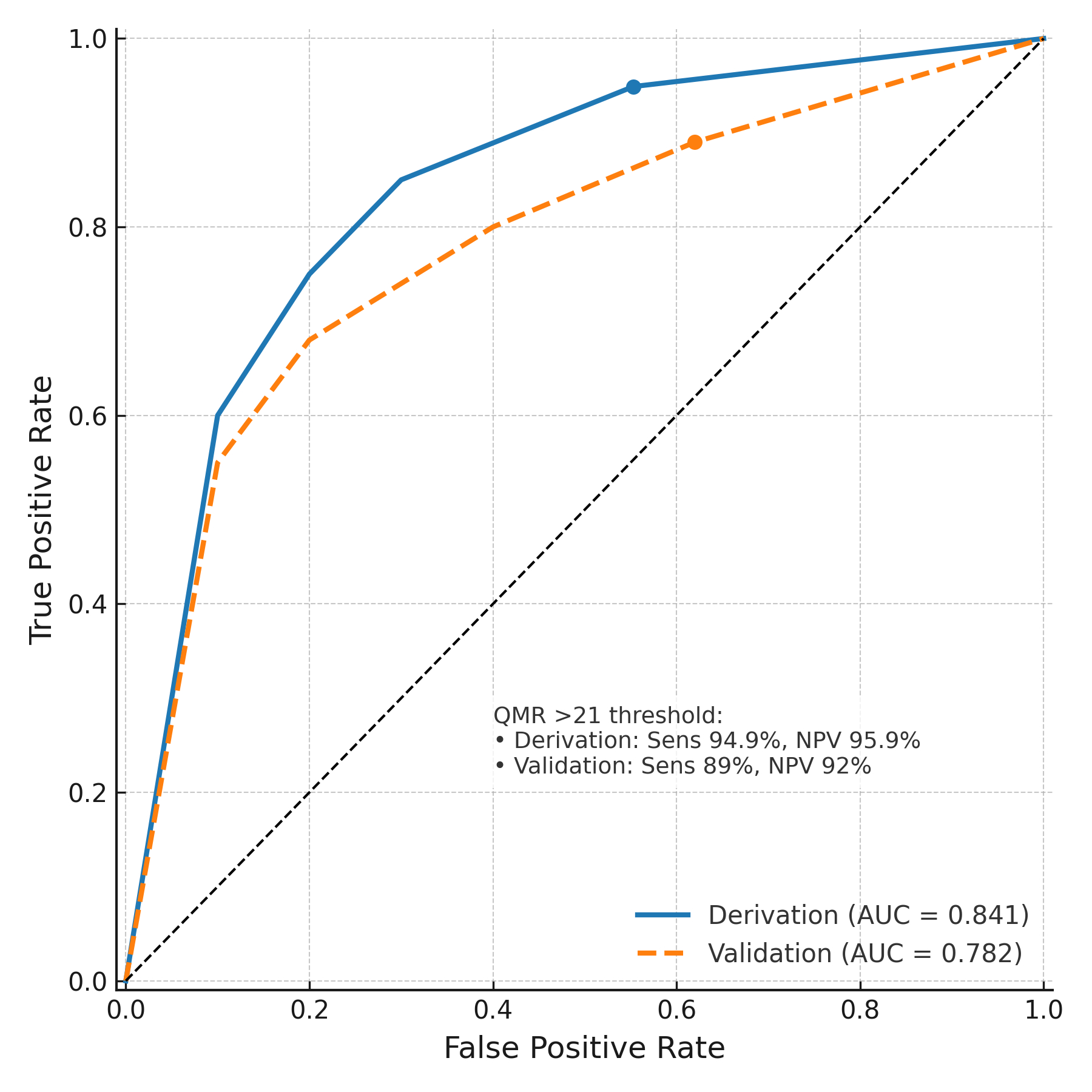
A total of 335 patients (63 ± 10.6 years; 56% male), encompassing 394 vessels, were included. In the derivation (n = 124) and validation (n = 124) cohorts, significant CMD (IMR > 25) was present in 27% and 23% of vessels respectively. Angio-IMR showed moderate correlation with invasive IMR (r = 0.47 in derivation; r = 0.33 in validation). Angio-IMR predicted significant CMD with an area under the ROC curve (AUC) of 0.82 and 0.76 (both p < 0.001) in the derivation and validation cohorts, respectively. An Angio-IMR threshold of > 21 optimized sensitivity and specificity. At this cutoff, sensitivity and negative predictive value (NPV) were 94.9% and 95.9% in the derivation cohort, and 89.0% and 92.0% in the validation cohort, respectively.

Conclusion:
Angio-IMR is a promising non-invasive tool for the detection of CMD, demonstrating strong diagnostic performance, particularly in ruling out disease. Its high sensitivity and NPV support its use as a gatekeeper to invasive IMR, potentially reducing need for pressure wire-based assessments in low-risk patients. This study establishes Angio-IMR as a clinically valuable adjunct in the assessment of microvascular coronary disease.
  • O'brien, Joseph  ( Monash Health , Melbourne , Victoria , Australia )
  • Ford, Tom  ( University of Glasgow , Glasgow , United Kingdom )
  • Wong, Dennis  ( Melbourne Cardiovascular and Diabet , MOUNT WAVERLEY , Victoria , Australia )
  • Zhang, Jun Michael  ( Monash Health , Melbourne , Victoria , Australia )
  • Yong, Andy  ( Concord Hospital , Sydney , New South Wales , Australia )
  • Easey, Kelly  ( Gosford Hospital , Gosford , New South Wales , Australia )
  • Redwood, Eleanor  ( Gosford Hospital , Gosford , New South Wales , Australia )
  • Rehan, Rajan  ( Concord Hospital , Sydney , New South Wales , Australia )
  • Ravindran, Jayant  ( Concord Hospital , Sydney , New South Wales , Australia )
  • Brown, Adam  ( Monash Health , Melbourne , Victoria , Australia )
  • Chew, Derek  ( Victorian Heart Hospital , Clayton , Victoria , Australia )
  • Author Disclosures:
    Joseph O'Brien: DO have relevant financial relationships ; Researcher:National Heart Foundation of Australia:Active (exists now) | Tom Ford: DO NOT have relevant financial relationships | Dennis Wong: No Answer | Jun Michael Zhang: No Answer | Andy Yong: DO have relevant financial relationships ; Speaker:Abbott:Active (exists now) ; Other (please indicate in the box next to the company name):Philips:Past (completed) ; Research Funding (PI or named investigator):Abbott:Active (exists now) | Kelly Easey: No Answer | Eleanor Redwood: No Answer | Rajan Rehan: No Answer | Jayant Ravindran: No Answer | Adam Brown: No Answer | Derek Chew: No Answer
Meeting Info:

Scientific Sessions 2025

2025

New Orleans, Louisiana

Session Info:

State-of-the-Art Coronary Imaging & Hemodynamic Physiology

Sunday, 11/09/2025 , 08:00AM - 09:15AM

Abstract Oral Session

More abstracts on this topic:
Late Gadolinium Enhancement-Derived Heart Digital Twins Non-Invasively Predict Ventricular Tachycardia Risk in Duchenne Muscular Dystrophy

Tso Justin, Dellefave-castillo Lisa, Villa Chet, Kertesz Naomi, Mcnally Elizabeth, Wagner Kathryn, Calkins Hugh, Leung Doris, Cripe Linda, Barth Andreas, Trayanova Natalia, Prakosa Adityo, Zhang Kelly, Kholmovski Eugene, Vasquez Nestor, Yanek Lisa, Beckman Brian, Bibat Genila, Yep Mary

A Contemporary Machine Learning-Based Risk Stratification for Mortality and Hospitalization in Heart Failure with Preserved Ejection Fraction Using Multimodal Real-World Data

Fudim Marat, Weerts Jerremy, Patel Manesh, Balu Suresh, Hintze Bradley, Torres Francisco, Micsinai Balan Mariann, Rigolli Marzia, Kessler Paul, Touzot Maxime, Lund Lars, Van Empel Vanessa, Pradhan Aruna, Butler Javed, Zehnder Tobias, Sauty Benoit, Esposito Christian, Balazard Félix, Mayer Imke, Hallal Mohammad, Loiseau Nicolas

You have to be authorized to contact abstract author. Please, Login
Not Available