
Logo

American Heart Association

  23
  0


Final ID: 4368894

The efficacy of computerized cognitive training in patients with coronary heart disease and cognitive impairment, no dementia: a randomized controlled trial (COG-T CHD)

Abstract Body (Do not enter title and authors here): Background Adaptive digital therapy can improve the effect of cognitive training compared to traditional methods, but there is no related evidence in patients with coronary heart disease (CHD) and cognitive impairment without dementia.
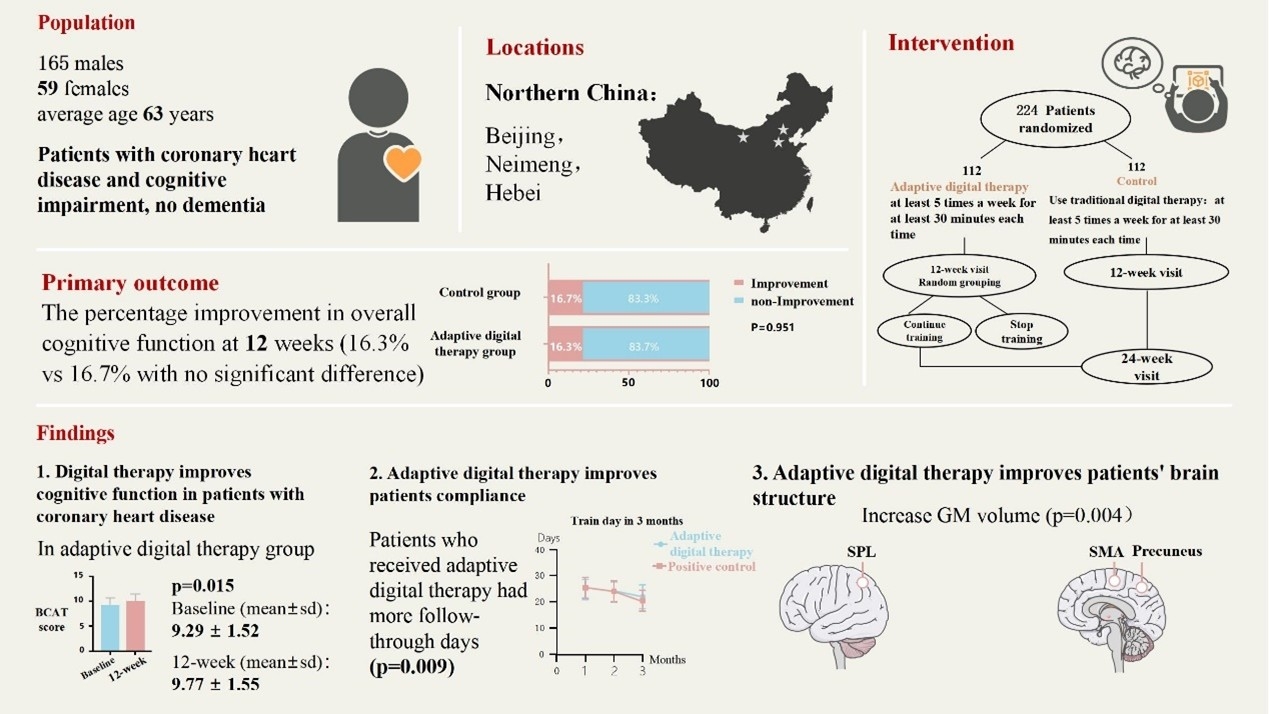
Methods A randomized, active-control design was used with either adaptive (intervention) or traditional nonadaptive (positive control) computerized cognitive training (CCT) was carried out among people CHD and cognitive impairment without dementia. Each training lasted for 30 minutes/session, five sessions per week, for a total of 12 (intervention and positive control groups) or 24 (intervention group) weeks. Patients’ cognitive ability, emotion, and quality of life were assessed at baseline and after training. The primary outcome was the proportion of patients who improved in overall cognitive function as measured with the Basic Cognitive Ability Test (BCAT) after 12 weeks of training relative to baseline. Secondary outcomes included the change in overall cognitive function and the proportion of patients who improved in individual cognitive domains after 12 or 24 weeks of training. This study was registered with ClinicalTrials.gov (NCT05735041).
Findings A total of 224 patients were recruited from eight medical centers in China. The patients were randomly (1:1) assigned to the adaptive CCT group (n = 112) or the traditional CCT (n = 112) group. After 12 weeks of training, the patients’ cognitive abilities improved in both the intervention and positive control groups compared with baseline (P = 0.015 and P = 0.016). The proportion of patients with improvement in the BCAT score in the intervention group did not significantly differ from that in the positive control group (P = 0.951). The patients in the adaptive CCT group showed remarkably better compliance to training (P = 0.009) and exhibited a significant increase in gray-matter volume in the left supplementary motor area, right precuneus, and right superior parietal lobule compared with the positive control group (Pfamily-wise error = 0.004).
Interpretation Both adaptive and traditional CCT improve cognitive function in patients with CHD accompanied by cognitive impairment without dementia. Although the efficacy of adaptive digital therapy in improving cognitive function is comparable to that of traditional CCT, patients in the adaptive CCT group show better compliance and greater structural changes in the brain.
  • Chen, Qing  ( Beijing Anzhen Hospital , Beijing , China )
  • Ye, Yi  ( Beijing Anzhen Hospital , Beijing , China )
  • Liu, Xiaoping  ( Ordos Central Hospital , Ordos , China )
  • Ding, Yaodong  ( Beijing Anzhen Hospital , Beijing , China )
  • Zeng, Yong  ( Beijing Anzhen Hospital , Beijing , China )
  • Author Disclosures:
    Qing Chen: No Answer | Yi Ye: DO NOT have relevant financial relationships | Xiaoping Liu: DO NOT have relevant financial relationships | Yaodong Ding: DO NOT have relevant financial relationships | Yong Zeng: DO NOT have relevant financial relationships
Meeting Info:

Scientific Sessions 2025

2025

New Orleans, Louisiana

Session Info:

Brain, Heart, and Risk: Advancing Cognitive and Cardiovascular Protection

Saturday, 11/08/2025 , 01:30PM - 02:35PM

Abstract Oral Session

You have to be authorized to contact abstract author. Please, Login
Not Available