Adaptation of digital nudges to promote healthy food choices in online food pantries using community co-design
Abstract Body: Background: Evidence-based behavioral nudges have the potential to increase healthy food choice in charitable food settings. Food choice nudges have been used in-person in grocery stores and cafeterias, different decision environments from online food pantries. A co-design process can inform adaptation of digital nudges in online food pantries while maintaining fidelity to nudge theory.
Methods: We used an iterative co-design process with adults who had ordered from (“shoppers”) or worked/volunteered (“staff”) at online food pantries. To inform prototype testing, semi-structured interviews explored the context and opinions on various nudges drawn from behavioral science literature. Next, in 3 rounds of focus groups, we shared and refined prototypes. All interviews and focus groups were transcribed, translated (for Spanish interviews), and underwent content analysis to identify strengths, concerns, and feedback to guide intervention design decisions.
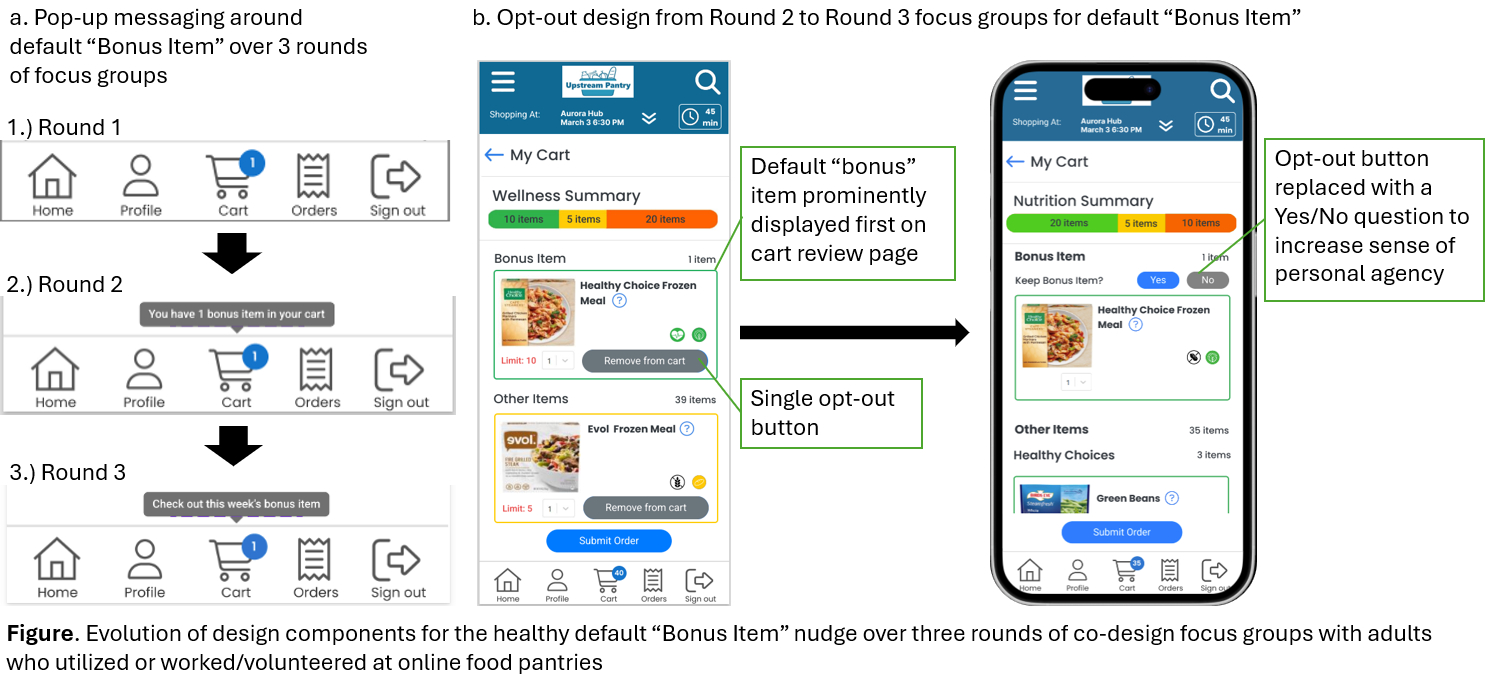
Results: Interviews (n=32) and focus groups (n=9) included 30 shoppers and 10 staff. In interviews, participants identified contextual factors underpinning concerns related to using nudges, especially historical lack of agency over choices and pervasive stigma in charitable settings. Interview feedback indicated that traffic light and icon labels, defaults, product organization, and filters were acceptable to prototype. Focus groups uncovered specific concerns. For traffic light labels, red labels were perceived by some participants as judgmental, reprimanding, and stigmatizing. We changed red labels to orange, leading to universal approval by participants, who perceived orange as conveying more acceptable “caution” rather than “stop” messaging. For default healthy items, some shoppers expressed a loss of agency with the automatic nature. To address this, we included “yes” and “no” response options in which those who chose “yes” or did nothing received the default, whereas those who were initially concerned about defaults felt offering both response options provided the agency they desired within the default (Figure).
Conclusions: An iterative co-design process facilitated adaptation of evidence-based behavioral nudges for a charitable food setting. Incorporating the perspectives of people with lived experiences of online food pantries helped address how lack of agency and stigma influence pantry shoppers’ perceptions and interactions with nudges. Adapted digital nudges will be tested in an online food pantry.
Jia, Jenny
(
Northwestern University
, Chicago , Illinois , United States )
Romero, Emily
(
Northwestern University
, Chicago , Illinois , United States )
Pineda, Gracia
(
Northwestern University
, Chicago , Illinois , United States )
Beidas, Rinad
(
Northwestern University
, Chicago , Illinois , United States )
Caspi, Caitlin
(
University of Connecticut
, Hartford , Connecticut , United States )
Kandula, Namratha
(
Northwestern University
, Chicago , Illinois , United States )