
Cardiac Output Assessment from Intrinsic Frequencies of a Single Carotid Pressure Waveform in a Large Community-Based Population: The Framingham Heart Study
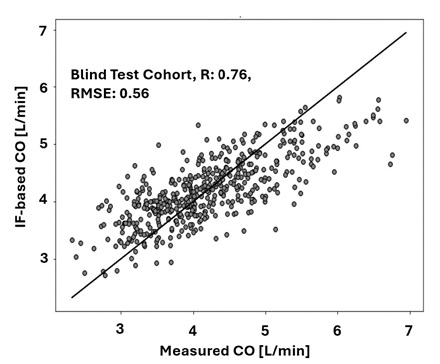
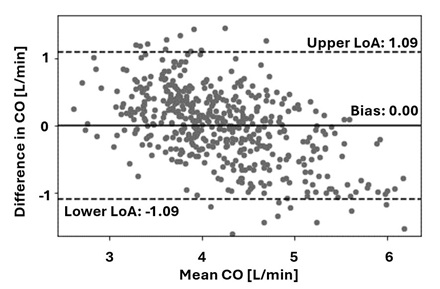
Abstract Body (Do not enter title and authors here): Introduction: Accurate assessment of cardiac output (CO), a standard cardiovascular performance index, is essential for diagnosing and managing a wide range of cardiovascular conditions, including heart failure, shock, and valvular disease (Eur Heart J.PMID: 2092985). However, standard methods such as echocardiography or thermodilution are either operator-dependent, resource-intensive, or invasive. This limits their use in routine screening and outpatient monitoring. A noninvasive, rapid method to estimate CO from a single arterial pressure waveform could transform cardiovascular care by enabling continuous or point-of-care evaluation. Aim: This study aimed to develop and validate a noninvasive method for estimating cardiac output using features extracted from a single carotid pressure waveform captured with a tonometry measurement device. Methods: A cohort of 2448 individuals (age range: 19–90 years) from the Framingham Heart Study was analyzed. All participants had consistent CO measurements across multiple echocardiographic recordings. Carotid pressure waveforms were obtained using an arterial tonometry device and calibrated using cuff-based brachial pressures. Reference aortic flow values were computed by first measuring the left ventricular outflow tract diameter from 2D echocardiography (parasternal long-axis view) to calculate the cross-sectional area. Then, the pulsed Doppler velocity waveform from the apical 5-chamber view is multiplied by this area to generate the aortic flow waveform over time. CO values were computed by averaging the flow waveform over the entire cardiac cycle. Intrinsic frequency (IF) parameters were computed from the carotid waveforms and used as inputs for machine learning models. Eighty percent of the data was used for model training, and the remaining twenty percent was reserved for blind testing. Results: Single-waveform CO estimation showed a Pearson correlation of 0.76, limits of agreement of ±1.09, and a bias of 0.00 compared to reference values in the blinded test set (Fig. 1 and 2). Conclusions: Estimating cardiac output from a single carotid pressure waveform offers a non-invasive and scalable tool for hemodynamic monitoring. This method may improve early detection and management of various cardiovascular conditions where cardiac output is critical, such as heart failure, cardiogenic shock, and myocardial infarction. This method is well-suited for both in-patient and remote patient monitoring.
Niroumandi, Soha
(
University of Southern California
, Los Angeles , California , United States )
Wei, Heng
(
University of Pennsylvania
, Philadelphia , Pennsylvania , United States )
Wolfson, Aaron
(
University of Southern California
, Los Angeles , California , United States )
Vaidya, Ajay
(
Keck School of Medicine of USC
, Los Angeles , California , United States )
Pahlevan, Niema
(
University of Southern California
, Los Angeles , California , United States )
Author Disclosures:
Soha Niroumandi:DO NOT have relevant financial relationships
| Heng Wei:DO NOT have relevant financial relationships
| Aaron Wolfson:No Answer
| Ajay Vaidya:DO NOT have relevant financial relationships
| Niema Pahlevan:DO have relevant financial relationships
;
Consultant:Avicena LLC (Ventric Health):Active (exists now)
; Ownership Interest:Avicena LLC (Ventric Health):Active (exists now)