Association Between Intrinsic Frequencies of Carotid Pressure Waveforms and AHA Cardiovascular Health Score: The Framingham Heart Study
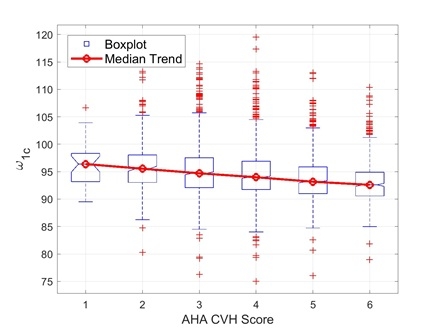
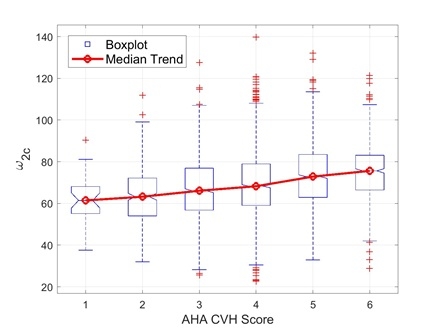
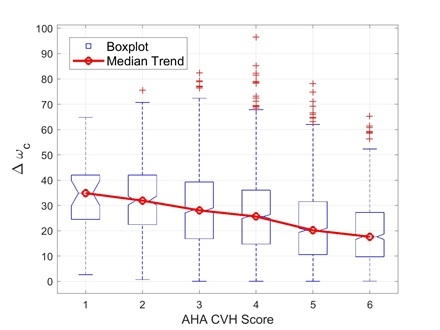
Abstract Body (Do not enter title and authors here): Introduction: The American Heart Association’s (AHA) Life’s Simple 7 (LS7) score defines cardiovascular health (CVH) and promotes healthy lifestyle behaviors through seven key components (Circulation, PMID: 20089546). Intrinsic frequencies (IFs) derived from carotid pressure waveforms are shown to be associated with cardiovascular performance in the Framingham Heart Study (Hypertension, PMID: 33390053). Here, we study whether IFs derived from carotid pressure waveforms relate to the AHA CVH score in a large community cohort. Methods: The study population was drawn from the Original, Offspring, and Third Generation Cohorts of the Framingham Heart Study where all the required metrics were available (N=5460; mean age 48 years). Per AHA LS7, we calculated CVH scores using fasting glucose, cholesterol, blood pressure, BMI, smoking status, and physical activity (excluding diet). Carotid pressure waveforms were acquired using an arterial tonometry device. From each non-calibrated waveform, we computed IF parameters: ω1c, IF of the coupled heart and vascular system during systole corrected by systolic period; ω2c, IF of the decoupled vasculature during diastole corrected by cardiac period; and △ωc, the difference between the two, which is a metric for left ventricle (LV)-arterial coupling. The association between AHA CVH score, and carotid-derived IFs was evaluated using box-and-whisker plots. Box plots were used to visualize the distribution of IFs across CVH score groups, with red lines connecting the group medians to highlight trends. Statistical significance across groups was assessed using either ANOVA or Kruskal–Wallis tests. Results: All three IF parameters showed clear, systematic trends across the CVH score groups. Specifically, ω1c declined, ω2c increased, and △ωc exhibited a steep decreasing trend with increasing the AHA CVH score (Figs. 1–3), reflecting improved LV-arterial coupling and vascular function with better cardiovascular health. Both one-way ANOVA and Kruskal–Wallis tests confirmed statistically significant differences (p < 0.0001) across the CVH score groups for all three IF parameters. Conclusion: Our results revealed that IFs of carotid pressure waveforms are associated with AHA CVH scores. The observed trends between IFs and CVH score were consistent with previous clinical and preclinical studies where higher ω1 and △ω but lower ω2 were associated with higher risk for incident composite cardiovascular disease events and incident heart failure.
Niroumandi, Soha
(
University of Southern California
, Los Angeles , California , United States )
Alavi, Rashid
(
Caltech
, Los Angeles , California , United States )
Pahlevan, Niema
(
University of Southern California
, Los Angeles , California , United States )
Author Disclosures:
Soha Niroumandi:DO NOT have relevant financial relationships
| Rashid Alavi:DO NOT have relevant financial relationships
| Niema Pahlevan:DO have relevant financial relationships
;
Consultant:Avicena LLC (Ventric Health):Active (exists now)
; Ownership Interest:Avicena LLC (Ventric Health):Active (exists now)