An Analysis of Ischemic Heart Disease Mortality Trends Attributable to High Body Mass Index in High-Income Countries: Global Burden of Disease Study from 1990-2021
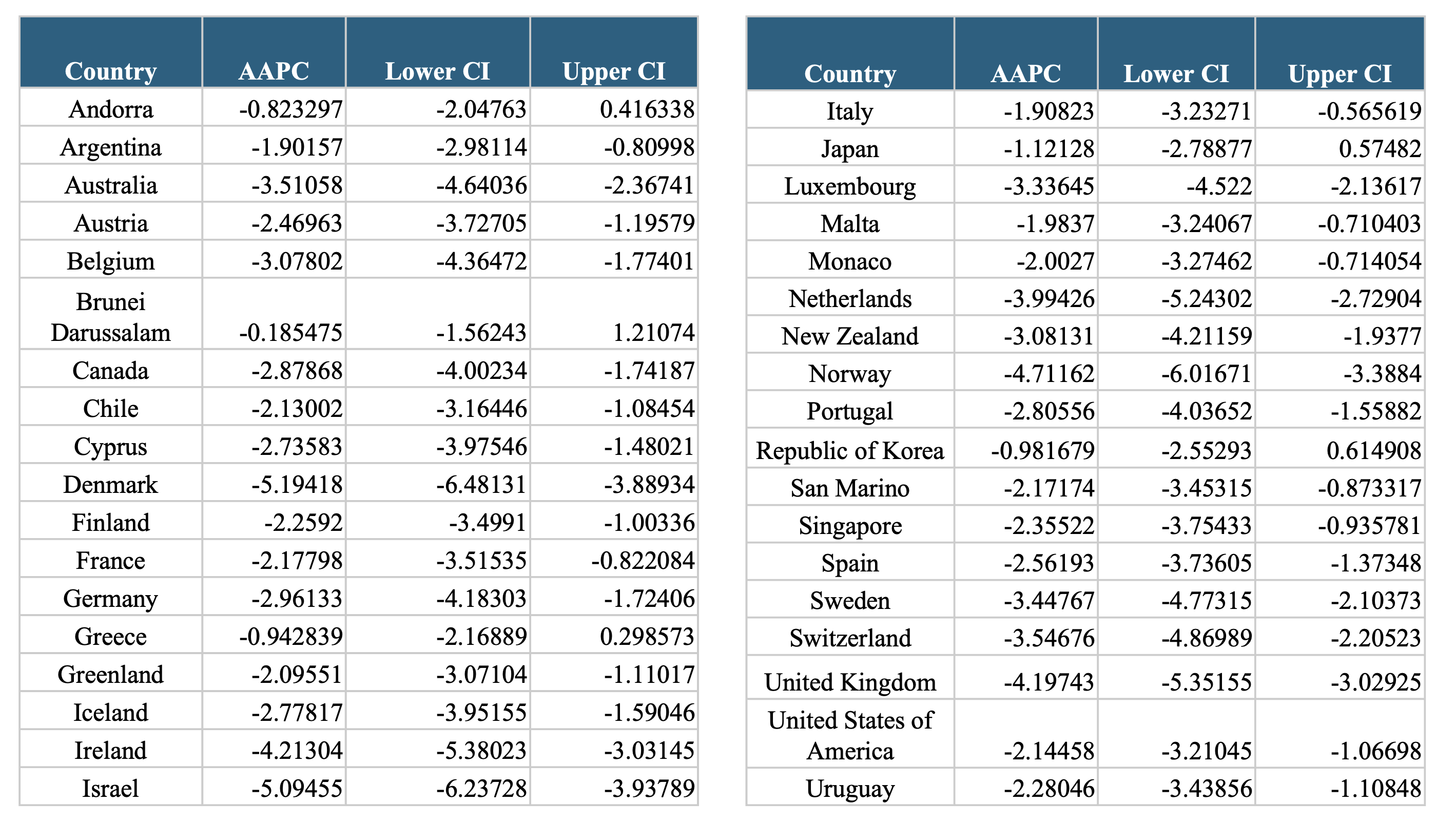
Abstract Body (Do not enter title and authors here): Introduction: Ischemic heart disease attributable to high body mass index (IHD-BMI) is a major health concern, often resulting in irreversible myocardial damage, progressive ventricular dilatation, reduced contractility, and premature heart failure. This study analyzes data from the Global Burden of Disease (GBD) study to evaluate trends in prevalence and IHD-BMI-related mortality in high-income countries from 1990 to 2021, using average annual percentage change (AAPC) values for both genders collectively, without separate stratification. Methods: A retrospective analysis was conducted using GBD-derived data on IHD-BMI-related mortality among high-income countries, as defined by World Bank income levels, from 1990 to 2021. Age-standardized death rates (ASDRs) per 100,000 population were extracted for all countries and disaggregated by sex and year. R Software (version 4.4.2) was used to calculate AAPC values with 95% confidence intervals (CIs). This approach enabled a detailed assessment of global and country-specific mortality trends, identifying regions with significant increases or decreases in IHD-BMI-related mortality. Results: Globally, IHD-BMI-related mortality has declined, though with substantial variation across regions. Among high-income countries, the most significant declines were observed in Denmark −5.19% (95% CI, −6.48 to −3.89), Israel −5.09% (95% CI, −6.24 to −3.94), Norway −4.71% (95% CI, −6.02 to −3.39), Ireland −4.21% (95% CI, −5.38 to −3.03), and the United Kingdom −4.20% (95% CI, −5.35 to −3.03). Conversely, the slowest declines were seen in Brunei Darussalam (−0.19% 95% CI, −1.56 to 1.21), Andorra (−0.82% 95% CI, −2.05 to 0.42), Greece (−0.94% 95% CI, −2.17 to 0.30), Republic of Korea (−0.98% 95% CI, −2.55 to 0.61), and Japan (−1.12% 95% CI, −2.79 to 0.57). Conclusion: While IHD-BMI-related mortality has decreased across high-income nations since 1990, the pace of decline varies considerably. Notable reductions in Denmark and Israel contrast with stagnation in countries like Japan and Greece, highlighting the need for targeted interventions in lagging regions.
Shaar, Abdalkader
(
University of Miami
, Miami , Florida , United States )
Bhat, Rakshita Ramesh
(
Cleveland Clinic Akron General
, Akron , Ohio , United States )
Khan, Wajeeh
(
DOW University Of Health Sciences
, Karachi , Pakistan )
Khan, Wajeeha
(
Karachi Metropolitan University
, Karachi , Pakistan )
Author Disclosures:
Abdalkader Shaar:DO NOT have relevant financial relationships
| Rakshita Ramesh Bhat:DO NOT have relevant financial relationships
| Wajeeh Khan:DO NOT have relevant financial relationships
| Wajeeha Khan:DO NOT have relevant financial relationships