
Global Trends in Ischemic Heart Disease Mortality: A 31-Year Analysis from the Global Burden of Disease Study (1990–2021)
Abstract Body (Do not enter title and authors here): Introduction: Ischemic heart disease (IHD) remains the leading cause of cardiovascular-related mortality worldwide, posing a persistent global health burden. Despite advances in prevention and management, substantial disparities in mortality rates persist across geographic regions and income levels.
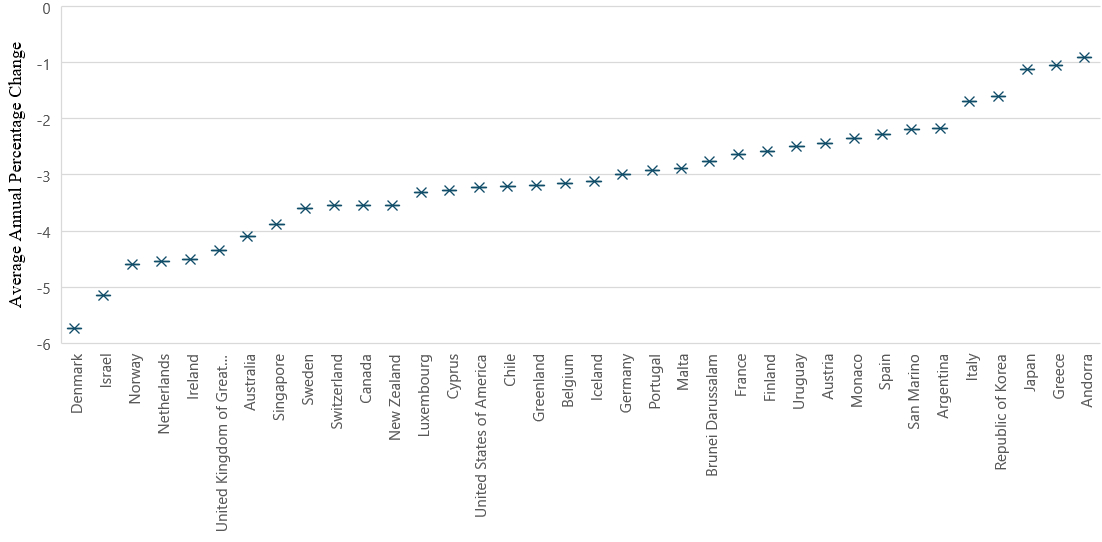
Objective: Our study aimed to evaluate global and regional trends in age-standardized IHD mortality from 1990 to 2021, using data from the Global Burden of Disease (GBD) Study. We aimed to identify countries with accelerating declines and those experiencing stagnation or reversal. Methods: We conducted a retrospective analysis using GBD-derived IHD mortality data from 1990 to 2021. Age-standardized death rates (ASDRs) per 100,000 population were extracted for high-income nations. Joinpoint regression analysis was used to calculate Average Annual Percentage Changes (AAPCs) with 95% confidence intervals (CI). Trends were examined globally and by country to identify regions with rising or falling IHD mortality. Results: Globally, IHD mortality declined with substantial regional variation. High-income countries such as Denmark (AAPC: -5.731), Israel (-5.154), Norway (-4.594), and Netherlands (-4.550) have shown marked reductions. Conversely, countries including the Republic of Korea (-1.606), Japan (-1.123), Greece (-1.039), and Andorra (-0.912) exhibited comparatively modest reductions, reflecting stagnating or worsening trends in some areas. Conclusion: Despite overall global progress in reducing IHD mortality, significant disparities persist, particularly among the selected high-income countries. Addressing these gaps requires tailored strategies that improve healthcare access, strengthen prevention, and tackle underlying social determinants of cardiovascular health. Sustained improvement requires equitable implementation of evidence-based policies, including early detection programs and health-promoting environments, to reduce the burden of IHD and promote longevity worldwide.
Khan, Wajeeh
(
DOW University of Health Sciences
, Karachi , Pakistan )
Hameed, Arooba
(
DOW University of Health Sciences
, Karachi , Pakistan )
Chigurupati, Himaja Dutt
(
East Carolina University
, Greenville , North Carolina , United States )
Shahid, Ahmad
(
DOW University of Health Sciences
, Karachi , Pakistan )
Khan, Wajeeha
(
Karachi Medical And Dental College
, Karachi , Pakistan )
Ahmed, Huda
(
DOW University of Health Sciences
, Karachi , Pakistan )
Alvares, Jenelle
(
DOW University of Health Sciences
, Karachi , Pakistan )
Mubbashir, Ayesha
(
DOW University of Health Sciences
, Karachi , Pakistan )
Naveed, Muhammad Abdullah
(
DOW University of Health Sciences
, Karachi , Pakistan )
Neppala, Sivaram
(
University of Texas Health SA
, Boerne , Texas , United States )
Author Disclosures:
Wajeeh Khan:DO NOT have relevant financial relationships
| Sivaram Neppala:DO NOT have relevant financial relationships
| arooba hameed:DO NOT have relevant financial relationships
| Himaja Dutt Chigurupati:DO NOT have relevant financial relationships
| Ahmad Shahid:DO NOT have relevant financial relationships
| Wajeeha Khan:DO NOT have relevant financial relationships
| Huda Ahmed:DO NOT have relevant financial relationships
| Jenelle Alvares:DO NOT have relevant financial relationships
| Ayesha Mubbashir:No Answer
| Muhammad Abdullah Naveed:DO NOT have relevant financial relationships