Increased Skeletal Muscle Mass Normalizes Cardiac Metabolic Pathways and Attenuates Left Ventricular Hypertrophy and Diastolic Dysfunction in Hypertrophic Cardiomyopathy
Abstract Body (Do not enter title and authors here): Background: Emerging evidence shows that key features of HCM—left-ventricular hypertrophy (LVH), diastolic dysfunction, and impaired cardiac energetics—are linked to systemic metabolic derangements such as insulin resistance. Because skeletal muscle mediates ~80% of post-prandial glucose disposal and ~25% of basal metabolic rate, even modest increases in muscle mass can markedly enhance whole-body insulin sensitivity. Moreover, dysregulated branched-chain amino acid (BCAA) catabolism yields intermediates that blunt insulin signaling and drive pathological cardiac growth, placing BCAA metabolism at the nexus of HCM and systemic insulin resistance.
Hypothesis: Pharmacologically induced skeletal-muscle hypertrophy—achieved by myostatin/activin blockade with the murine anti-ActRII antibody CDD866—increases muscle demand for glucose and BCAAs, thereby reducing insulin resistance, restoring cardiac metabolic flexibility, and ameliorating established HCM features.
Methods: Male R403Q-HCM mice (24 wk) received CDD866 or isotype control (20 mg/kg s.c. q3d) for 4 wk. End-point tests included echoMRI body composition, skeletal-muscle weights, echocardiography, oral glucose tolerance test (oGTT), grip strength, exercise tolerance test, and LV transcriptomics.
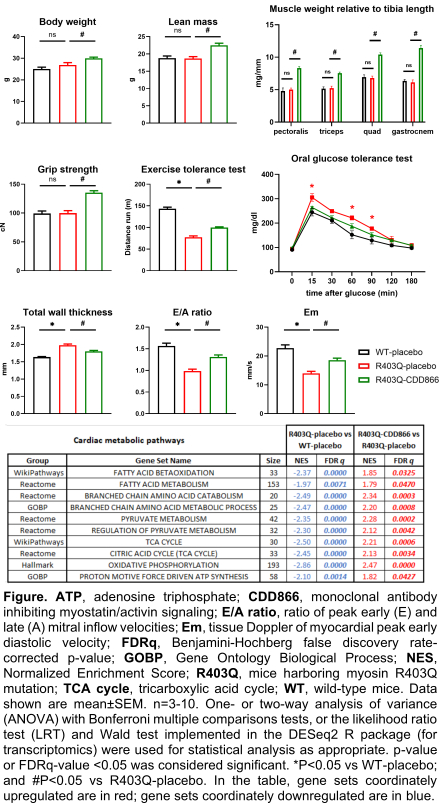
Results: CDD866 produced robust muscle hypertrophy (+20% lean mass; body weight +12%; individual muscles +44–87%) and lowered oGTT AUC, indicating improved insulin sensitivity. LVH was reduced (LV wall thickness −9%), diastolic indices improved (E/A and Em ↑), and cardiac gene expression reverted toward WT with up-regulation of fatty-acid oxidation, BCAA catabolism, and mitochondrial oxidative pathways. Functional capacity increased (grip strength +35%, treadmill endurance +29%).
Conclusions: Pharmacologic myostatin/activin blockade enlarges skeletal muscle, improves insulin sensitivity, restores cardiac metabolic flexibility, reduces LV hypertrophy, and enhances diastolic function in established HCM. Augmenting muscle mass therefore emerges as a promising adjunct therapy for HCM, especially in insulin-resistant states.
Baka, Tomas
(
Boston University Sch. of Medicine and Boston Medical Center
, Boston , Massachusetts , United States )
Qin, Fuzhong
(
Boston University Sch. of Medicine
, Boston , Massachusetts , United States )
Zhang, Aifeng
(
Boston University Sch. of Medicine and Boston Medical Center
, Boston , Massachusetts , United States )
Seta, Francesca
(
Boston University Sch. of Medicine
, Boston , Massachusetts , United States )
Pimentel, David
(
Boston University Sch. of Medicine and Boston Medical Center
, Boston , Massachusetts , United States )
Sam, Flora
(
Eli Lilly and Company
, Indianapolis , Indiana , United States )
Luptak, Ivan
(
Boston University Sch. of Medicine and Boston Medical Center
, Boston , Massachusetts , United States )
Author Disclosures:
Tomas Baka:DO NOT have relevant financial relationships
| Fuzhong Qin:DO NOT have relevant financial relationships
| Aifeng Zhang:No Answer
| Francesca Seta:DO NOT have relevant financial relationships
| David Pimentel:DO NOT have relevant financial relationships
| Flora Sam:No Answer
| Ivan Luptak:No Answer