
Dual SGLT1 and 2 Inhibition with Sotagliflozin Ameliorates Adverse Cardiac Remodeling and Diastolic Dysfunction in Mice with HCM Due to Tropomyosin E180G Mutation
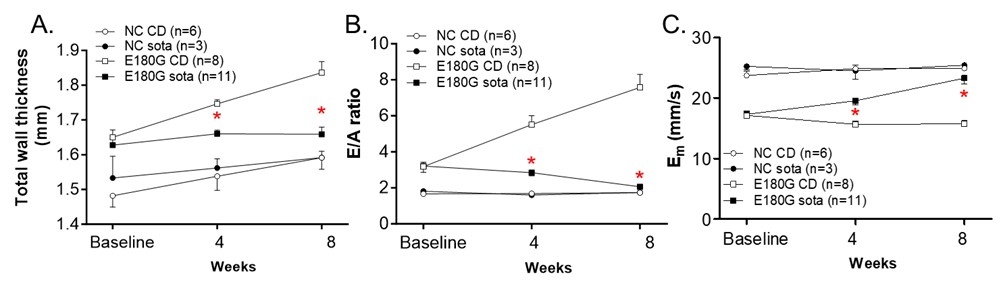
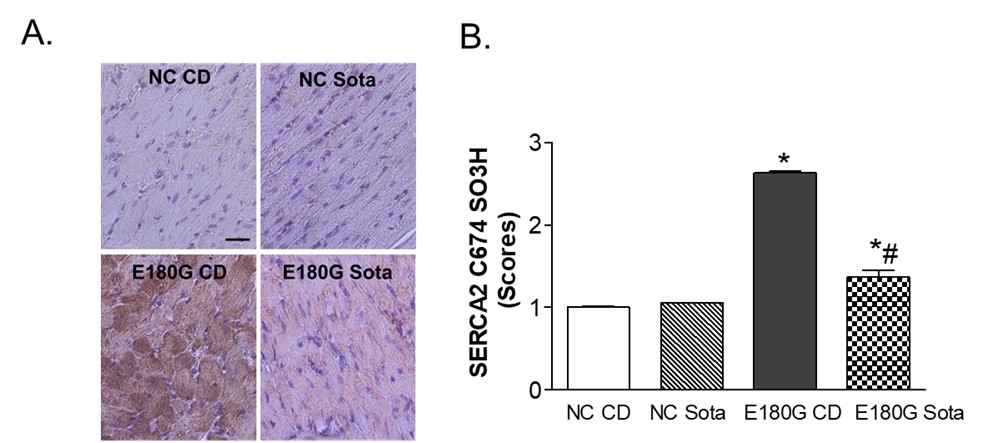
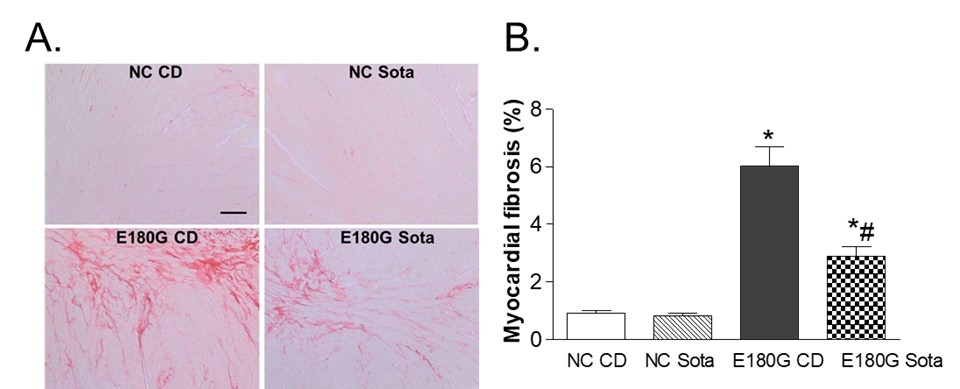
Abstract Body (Do not enter title and authors here): Background: Hypertrophic cardiomyopathy (HCM) is characterized by adverse cardiac remodeling associated with myocardial hypertrophy, diastolic dysfunction, dysregulated calcium handling and fibrosis. The dual SGLT1 and 2 inhibitor sotagliflozin (Sota) is being evaluated in patients with obstructive and non-obstructive HCM. Our goal was to determine the effects of Sota on myocardial remodeling, diastolic function, calcium dysregulation and fibrosis in a mouse model of HCM due to the tropomyosin E180G mutation (E180G). Methods: Male and female E180G and non-carrier (NC) mice 7-8 weeks old were randomized to Sota formulated in the chow (30 mg/kg chow) or control diet (CD) for 8 weeks. Cardiac structure and function were assessed by echocardiography at baseline, 4 and 8 weeks of treatment. At 8 weeks mice were sacrificed to assess oxidative modification of sarcoplasmic reticulum ATPase (SERCA) by immunohistochemical staining with a site-specific antibody for sulfonylation at cysteine 674 (SERCA C674 SO3H), myocardial fibrosis (Picrosirius Red) and RNA expression (RNA Sequencing). Results: At baseline E180G mice (compared to non-carriers) had mildly increased left ventricular (LV) wall thickness and diastolic dysfunction with increased peak early-to-late diastolic trans-mitral velocity (E/A) and decreased peak early diastolic myocardial tissue velocity (Em) - all of which worsened over the next 8 weeks. In E180G mice, Sota prevented further LV thickening and normalized E/A ratio and Em to values similar to NC mice (Fig 1). Oxidative modification of SERCA as indicated by sulfonylation of SERCA at C674 was increased in E180G mice and the increase was markedly attenuated by Sota (Fig 2). Myocardial fibrosis was increased in E180G mice and was markedly decreased by Sota (Fig 3). RNA gene sets for fibrosis and hypertrophy were increased in E180G and suppressed by Sota; whereas mitochondrial pathways were decreased in E180G and improved by Sota. Conclusion: Dual SGLT1 and 2 inhibition with Sota attenuated myocardial hypertrophy, diastolic dysfunction, SERCA oxidation and fibrosis in E180G HCM mice. Mitigation of SERCA oxidation and fibrosis by Sota may contribute to improved diastolic function. The attenuation of SERCA oxidation further indicates that Sota decreased oxidative stress, which is a stimulus for myocardial SERCA dysfunction, hypertrophy and fibrosis. These findings suggest that Sota may be of value in the treatment of patients with HCM.
Qin, Fuzhong
(
Boston University Sch. of Medicine
, Boston , Massachusetts , United States )
Pimentel, David
(
Boston University Sch. of Medicine
, Boston , Massachusetts , United States )
Baka, Tomas
(
Boston University Sch. of Medicine
, Boston , Massachusetts , United States )
Zhang, Aifeng
(
Boston University Sch. of Medicine
, Boston , Massachusetts , United States )
Croteau, Dominique
(
Boston University Medical Center
, Boston , Massachusetts , United States )
Luptak, Ivan
(
Boston University Sch. of Medicine
, Boston , Massachusetts , United States )
Colucci, Wilson
(
Boston University Sch. of Medicine
, Boston , Massachusetts , United States )
Author Disclosures:
Fuzhong Qin:DO NOT have relevant financial relationships
| David Pimentel:DO NOT have relevant financial relationships
| Tomas Baka:DO NOT have relevant financial relationships
| Aifeng Zhang:No Answer
| Dominique Croteau:DO NOT have relevant financial relationships
| Ivan Luptak:No Answer
| Wilson Colucci:DO have relevant financial relationships
;
Research Funding (PI or named investigator):Lexicon:Active (exists now)