How Preload Influences Left Ventricular Volumetric Changes in Heart Failure with Preserved Ejection Fraction
Abstract Body (Do not enter title and authors here): Background During exercise, many patients with heart failure with preserved ejection fraction (HFpEF) have an have impaired stroke volume response, which often attributed to increased left ventricular (LV) stiffness and external constraint, limiting end-diastolic volume (EDV). It is thought, but not known, that patients with HFpEF may be more dependent on end-systolic volume (ESV) to augment stroke volume during exercise. In this study, we used nitroglycerin (NTG) to alter venous return at rest and during exercise.
Hypothesis HFpEF patients would be more dependent on changes to ESV compared to EDV when preload was experimentally attenuated.
Methods Patients with invasively confirmed HFpEF (n = 36, 70±7 years, 69% female, average BMI = 37.3±6.1 kg/m2) underwent 2 consecutive seated-upright cardiopulmonary exercise test with right heart catheterization in a cross-over design with placebo and NTG. NTG was used to decrease venous return and preload. LV volumes (3D echocardiography) and pulmonary capillary wedge pressure (PCWP) were measured during rest and during 20W steady state submaximal exercise. Differences in volumes during rest and exercise conditions with and without NTG were compared, controlling for multiple comparisons.
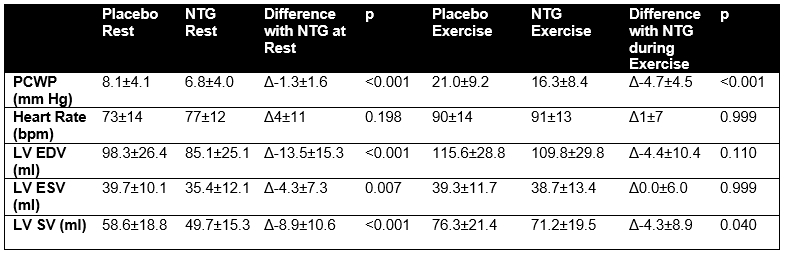
Results As shown in Table, NTG significant reduced PCWP during rest (Δ-1.3±1.6 mmHg, p <0.001) and exercise (Δ-4.7±4.5, p<0.001). NTG significant reduced stroke volume during rest (Δ-8.9±10.6 mL, p <0.001) and exercise (Δ-4.3±8.9, p = 0.040) with no change in heart rate. Both LV EDV and LV ESV were significantly lowered by NTG at rest (EDV Δ-13.5±15.3 mL p <0.001, ESV Δ-4.3±7.3 mL, p 0.007). There was a small, variable decrease in EDV with NTG during exercise (Δ-4.4±10.4mL, p =0.110) and no change in ESV (Δ0.0±6.0, p = 0.999).
Conclusions A reduction in venous return resulted in decreased LV filling pressure and stroke volume at rest and during exercise. At rest, LV end-diastolic volume dropped significantly and end-systolic volume decreased maintain stroke volume. Contrary to our hypothesis, end-systolic volume was unchanged both from baseline and with NTG. While variable there was a similar decrease in end-diastolic volume as stroke volume with NTG during exercise. This study demonstrates a dependency on preload and EDV, specifically, to maintain stroke volume during exercise in HFpEF and may explain why patients with HFpEF have not responded to therapies targeting preload during exercise.
Abbas, Syed
(
Institute for Exercise and Environmental Medicine
, Dallas , Texas , United States )
Brazile, Tiffany
(
INOVA Schar Heart and Vascular
, Falls Church , Virginia , United States )
Wakeham, Denis
(
IEEM
, Dallas , Texas , United States )
Leahy, Michael
(
IEEM
, Dallas , Texas , United States )
Hearon, Christopher
(
IEEM
, Dallas , Texas , United States )
Samels, Mitchel
(
IEEM
, Dallas , Texas , United States )
Balmain, Bryce
(
UT Southwestern Medical Center
, Dallas , Texas , United States )
Tomlinson, Andrew
(
UT Southwestern Medical Center
, Dallas , Texas , United States )
Babb, Tony
(
UT Southwester Medical Center
, Dallas , Texas , United States )
Levine, Benjamin
(
UT SOUTHWESTERN MEDICAL CENTER
, Dallas , Texas , United States )
Sarma, Satyam
(
UT Southwestern Medical Center
, Dallas , Texas , United States )
Macnamara, James
(
University of Virginia
, Crozet , Virginia , United States )
Author Disclosures:
Syed Abbas:DO NOT have relevant financial relationships
| Benjamin Levine:DO NOT have relevant financial relationshipsJames Macnamara:DO have relevant financial relationships
;
Consultant:Cytokinetics:Past (completed)
; Speaker:Bracco:Past (completed)
; Consultant:Bristol Myers Squibb:Past (completed)
| Tiffany Brazile:No Answer
| Denis Wakeham:DO NOT have relevant financial relationships
| Michael Leahy:DO NOT have relevant financial relationships
| Christopher Hearon:DO NOT have relevant financial relationships
| Mitchel Samels:DO NOT have relevant financial relationships
| Bryce Balmain:DO NOT have relevant financial relationships
| Andrew Tomlinson:DO NOT have relevant financial relationships
| Tony Babb:DO NOT have relevant financial relationships