
Logo

American Heart Association

  3
  0


Final ID: 29

Adverse Pregnancy Outcomes are Associated with Higher Blood Pressure Response to Exercise and Shorter Exercise Duration after Pregnancy: The CARDIA Cohort

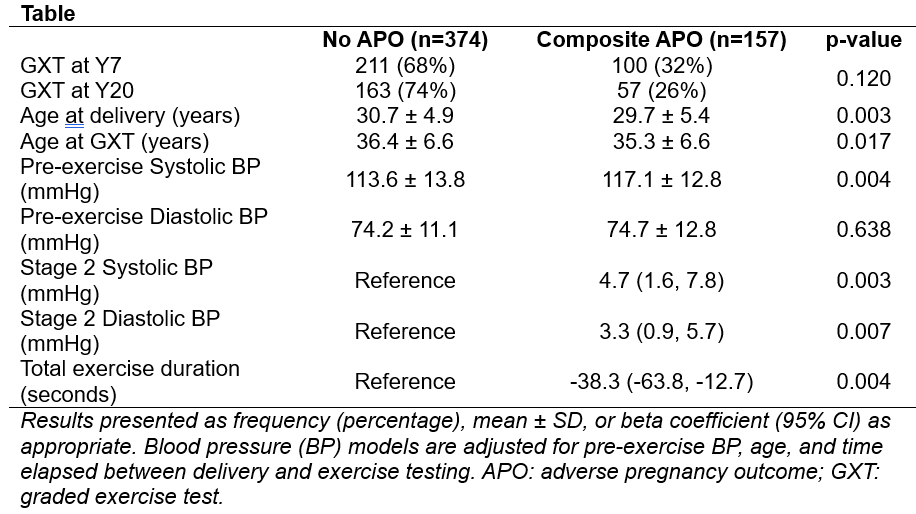
Abstract Body: Background. Adverse pregnancy outcomes are sex-specific risk factors for maternal cardiovascular disease (CVD). Elevated blood pressure (BP) response to exercise (i.e. when BP rises more steeply than expected given the workload) can reveal underlying abnormalities that are not evident at rest. BP response to submaximal exercise may represent the hemodynamic burden of daily activity and is associated with CVD independent of resting BP but has not been examined in women following pregnancy. Our objective was to examine the association between an adverse pregnancy outcome in a first birth and exercise response in the years after delivery in women in the CARDIA study. Methods. Included participants were nulliparous at baseline and reported a first birth prior to either the year 7 or year 20 symptom-limited graded exercise test (GXT). Adverse pregnancy outcomes were combined into a composite outcome including preterm birth, gestational diabetes, and preeclampsia. If more than one birth occurred prior to the GXT, only the first birth was defined as the exposure. Linear regression estimated the association between an adverse pregnancy outcome in a first birth and 1) systolic and diastolic BP at stage 2 of a modified Balke protocol (3.4 miles/hour at a 6% incline; workload=6.4 METs) and 2) total duration of exercise. BP models were adjusted for baseline BP; all models were adjusted for age and time between delivery and GXT. Results. Parous women completing a GXT at the year 7 (n=311) or 20 (n=220) CARDIA exam with stage 2 data were included. After adjustment, women with an adverse pregnancy outcome had higher stage 2 systolic and diastolic BP while total GXT duration was shorter than women with uncomplicated pregnancy (Table). Conclusions. Women who experienced an adverse pregnancy outcome in a first birth had a less favorable exercise response: higher stage 2 BP and shorter exercise duration in a GXT. These results suggest that women exposed to an adverse pregnancy outcome may have a greater cumulative BP load even if they have normal resting BP. Exercise response may be a useful tool to stratify risk in women following pregnancy.
Acknowledgements. The Coronary Artery Risk Development in Young Adults Study (CARDIA) is supported by contracts 75N92023D00002, 75N92023D00003, 75N92023D00004, 75N92023D00005, and 75N92023D00006 from the National Heart, Lung, and Blood Institute. Additional support was provided by the CARDIA Fitness Study (R01 HL078972 to BS).
  • Kozai, Andrea  ( University of Pittsburgh , Pittsburgh , Pennsylvania , United States )
  • Lane, Abbi  ( University of Michigan , Ann Arbor , Michigan , United States )
  • Koczo, Agnes  ( UPMC , Pittsburgh , Pennsylvania , United States )
  • Ray, Mitali  ( University of Pittsburgh , Pittsburgh , Pennsylvania , United States )
  • Sternfeld, Barbara  ( Kaiser Permanente , Sacramento , California , United States )
  • Gabriel, Kelley  ( University of Alabama at Birmingham , Birmingham , Alabama , United States )
  • Catov, Janet  ( UNIVERSITY OF PITTSBURGH , Pittsburgh , Pennsylvania , United States )
  • Author Disclosures:
Meeting Info:

EPI-Lifestyle Scientific Sessions 2026

2026

Boston, Massachusetts

Session Info:

Women's and Maternal Health

Thursday, 03/19/2026 , 10:30AM - 12:00PM

Oral Abstract Session

More abstracts on this topic:
Challenges in Assessing Exercise Impairment in Adolescent Obesity: Insights From Cardiopulmonary Exercise Testing

Bao Jasmine Yimeng, Falini Lauren, D Aloisio Gina, Balagopal Babu, Tsuda Takeshi

A Measure of Residential Segregation and Thrombo-inflammation in Black and White Americans

Manogaran Erin, Cushman Mary, Kamin Mukaz Debora, Sparks Andrew, Packer Ryan, Brochu Paige, Judd Suzanne, Howard Virginia, Plante Timothy, Long Leann, Cheung Katherine

More abstracts from these authors:
You have to be authorized to contact abstract author. Please, Login
Not Available