Pulmonary dynamic hyperinflation augments pulmonary capillary wedge pressure during exercise in patients with heart failure with preserved ejection fraction
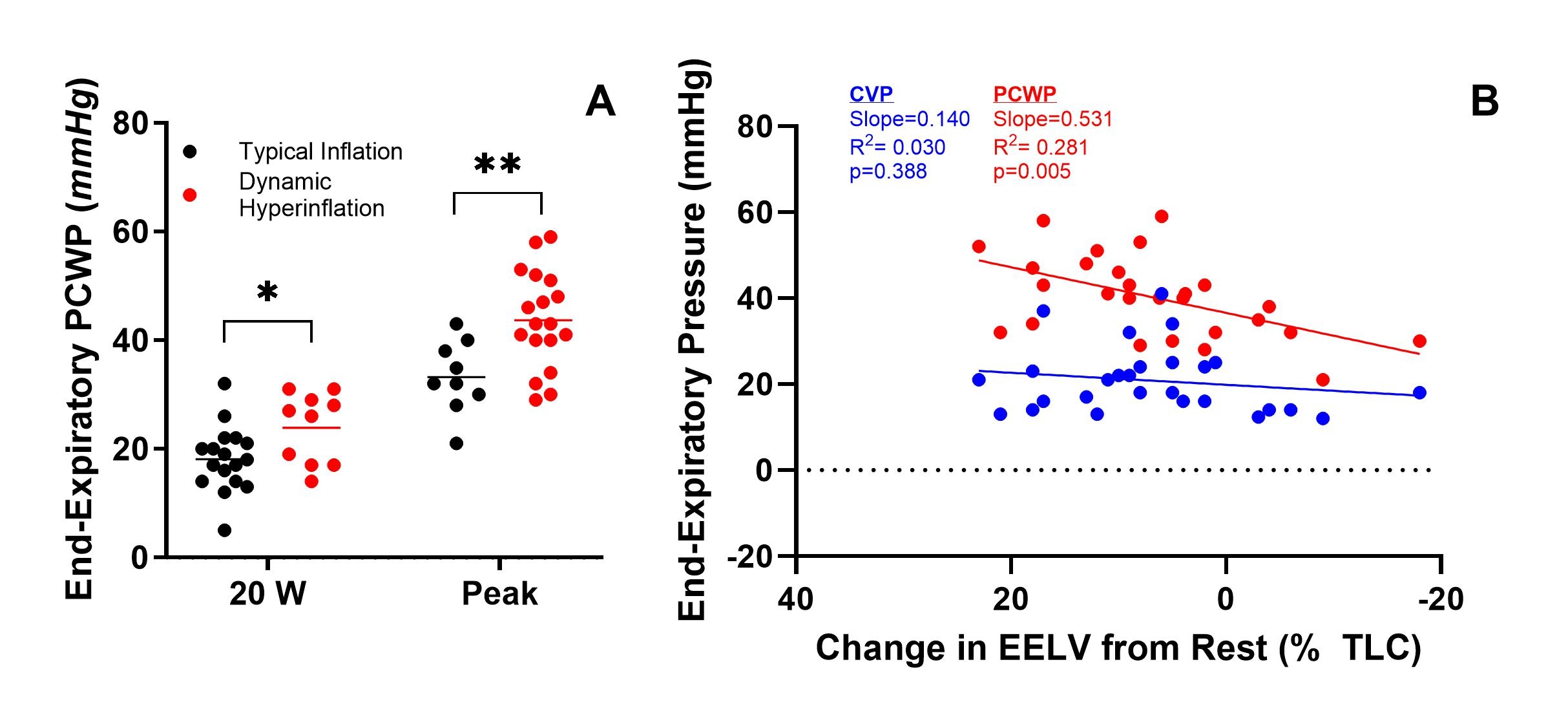
Abstract Body (Do not enter title and authors here): Introduction Adults with heart failure with preserved ejection fraction (HFpEF) have an exaggerated rise in pulmonary capillary wedge pressure (PCWP) with exercise. Pulmonary function in patients with HFpEF is often flow limited, thereby perpetuating dynamic hyperinflation (DH) and breathing at a mechanically unfavorable percentage of total lung volume. We therefore sought to characterize the impact of DH on PCWP in adults with HFpEF during exercise. Methods Twenty-seven patients with HFpEF were evaluated (Age: 70 ± 7 years, Female: 70 %, BMI: 38.1±6.3 kg/m2). PCWP and central venous pressure (CVP, right heart catheterization), oxygen uptake (breath by breath), cardiac output (direct Fick), and ventilation were measured upright at rest, 20 W, and peak exercise (73 ± 27 W) on a semi-recumbent cycle ergometer. End-expiratory lung volume was determined by having patients complete inspiratory capacity maneuvers during rest and exercise. DH was defined as an increase in end-expiratory lung volume of >150ml from rest. Results End-expiratory PCWP was greater in patients with DH at 20 W (DH: 24 ± 6 mmHg vs. Normal: 18 ± 6, p=0.033) and peak exercise (DH: 44 ± 9 vs. Normal: 31 ± 6 mmHg, Panel A, p=0.002). The effect of DH occurred despite similar change in stroke volume (DH: 29 ± 15 vs. Normal: 37 ± 11 mL, p=0.164) and cardiac output (DH: 10.4 ± 1.7 vs. Normal: 11.1 ± 2.7 L/min, p=0.420) at peak exercise; however, BMI was greater in patients with DH (40.1 ± 6.0 vs. 34.4 ± 5.4 kg/m2, p=0.020). The degree of dynamic inflation was significantly associated with end-expiratory PCWP during exercise (slope= 0.531, R2= 0.281, p= 0.005, Panel B). Conclusion Patients with HFpEF who dynamically hyperinflate during exercise have greater PCWP than those who do not. DH was associated with obesity and the severity of hyperinflation scaled proportionally to higher exercise PCWP. These findings indicate the augmented exercise PCWP in patients with HFpEF may not be entirely attributed to ventricular stiffness, but also a consequence of increased intrathoracic pressure from dysfunctional ventilatory mechanics.
Leahy, Michael
(
UT Southwestern Medical Center
, Dallas , Texas , United States )
Macnamara, James
(
UT Southwestern Medical Center
, Dallas , Texas , United States )
Brazile, Tiffany
(
UT Southwestern Medical Center
, Dallas , Texas , United States )
Wakeham, Denis
(
UT Southwestern Medical Center
, Dallas , Texas , United States )
Samels, Mitchel
(
IEEM
, Dallas , Texas , United States )
Hearon, Christopher
(
UT Southwestern Medical Center
, Dallas , Texas , United States )
Tomlinson, Andrew
(
UT Southwestern Medical Center
, Dallas , Texas , United States )
Balmain, Bryce
(
UT Southwestern Medical Center
, Dallas , Texas , United States )
Babb, Tony
(
UT Southwestern Medical Center
, Dallas , Texas , United States )
Levine, Benjamin
(
UT Southwestern Medical Center
, Dallas , Texas , United States )
Sarma, Satyam
(
UT Southwestern Medical Center
, Dallas , Texas , United States )
Author Disclosures:
Michael Leahy:DO NOT have relevant financial relationships
| Benjamin Levine:DO NOT have relevant financial relationships
| Satyam Sarma:DO NOT have relevant financial relationships
| James MacNamara:No Answer
| Tiffany Brazile:DO NOT have relevant financial relationships
| Denis Wakeham:DO NOT have relevant financial relationships
| Mitchel Samels:DO NOT have relevant financial relationships
| Christopher Hearon:DO NOT have relevant financial relationships
| Andrew Tomlinson:DO NOT have relevant financial relationships
| Bryce Balmain:DO NOT have relevant financial relationships
| Tony Babb:No Answer