The Use of Common Cardiovascular Medications Is Associated With a Comparable Decreased Relative CVD Risk in Cancer Survivors and non-Cancer Patients
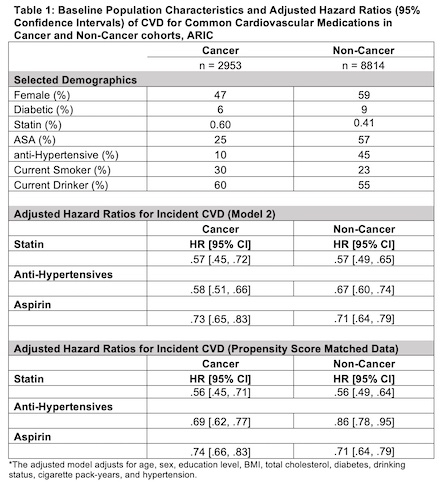
Abstract Body (Do not enter title and authors here): Introduction:The frequent coexistence of cardiovascular disease (CVD) and cancer, including due to shared risk factors, necessitates understanding the benefit of medications in CVD prevention in cancer survivors. Hypothesis: We hypothesized that the use of statins, anti-hypertensives, and aspirin (ASA), provides equivalent CVD prevention for cancer and non-cancer patients for the same extent of CVD risk. Methods:We used data from the Atherosclerosis Risk in Communities (ARIC) study, a cohort with 28 years of follow-up. After excluding those with prevalent cancer or CVD, the study population included 12,832 persons. Statin, anti-hypertensive, or ASA use was assessed by interview and bottle review at each study visit. Participants contributed time at risk of CVD until CVD diagnosis, cancer diagnosis, death, or administrative censoring, whichever came first. In the cancer survivor group, time at risk began at cancer diagnosis; participants with CVD diagnosed before cancer were excluded. Cox regression yielded the hazard ratio of CVD for medication use (time-varying) in those with and without cancer, adjusted for CVD risk factors*. As a sensitivity analysis and to increase the comparability of groups, Cox regression was performed on matched data where cancer and non-cancer participants were matched 1:1 using propensity scores based on clinical and demographic factors. Results: Table 1 displays baseline characteristics between the cancer and non-cancer groups. The number of those who developed incident CVD in the non-cancer group was 3653 out of 8814 participants. The number of those who developed incident CVD in the cancer group was 877 out of 2953 participants. Table 1 also displays the results of the proportional hazards models, including those obtained after propensity score matching. Across both the unmatched and matched analyses, statins, anti-hypertensives, and ASA were all associated with a decreased risk of incident CVD in both cancer and non-cancer groups. The hazard ratios were comparable between the matched and unmatched analyses. Conclusion:In this prospective study, statin, anti-hypertensive, and ASA use were associated with a comparable decreased CVD relative risk among those with and without cancer. This work suggests that cancer survivors may experience comparable CVD risk reduction benefit from these common medications.
Malik, Sarah
(
Duke University Hospital
, Durham , North Carolina , United States )
Guha, Avirup
(
Medical College of Georgia
, Augusta , Georgia , United States )
Jaganathan, Nikhil
(
Medical College of Georgia
, Augusta , Georgia , United States )
Florido, Roberta
(
University of Utah
, Salt Lake City , Utah , United States )
Prizment, Anna
(
University of Minnesota
, Minneapolis , Minnesota , United States )
Polter, Elizabeth
(
University of Minnesota
, Minneapolis , Minnesota , United States )
Blaes, Anne
(
University of Minnesota
, Minneapolis , Minnesota , United States )
Alonso, Alvaro
(
Emory University
, Atlanta , Georgia , United States )
Joshu, Corinne
(
Johns Hopkins University
, Baltimore , Maryland , United States )
Kutty, Shelby
(
JOHNS HOPKINS MEDICINE
, Baltimore , Maryland , United States )
Platz, Elizabeth
(
Johns Hopkins Bloomberg School of P
, Baltimore , Maryland , United States )
Author Disclosures:
Sarah Malik:DO NOT have relevant financial relationships
| Shelby Kutty:No Answer
| Elizabeth Platz:DO NOT have relevant financial relationships
| Avirup Guha:DO NOT have relevant financial relationships
| Nikhil Jaganathan:DO NOT have relevant financial relationships
| Roberta Florido:DO NOT have relevant financial relationships
| Anna Prizment:DO NOT have relevant financial relationships
| Elizabeth Polter:DO NOT have relevant financial relationships
| Anne Blaes:No Answer
| Alvaro Alonso:DO NOT have relevant financial relationships
| Corinne Joshu:DO NOT have relevant financial relationships
Elsayed Omar, Joshu Corinne, Platz Elizabeth, Guha Avirup, Shah Viraj, Wang Xiaoling, Weintraub Neal, Harris Ryan, Martini Rachel, Davis Melissa, Boerwinkle Eric, Coughlin Steven
4367314_File000000.jpg
You have to be authorized to contact abstract author. Please, Login